
Preconfirmation (Pre-confirm)

Preconfirmation (Pre-confirm): Faster Transaction Guarantees

Preconfirmations provide early guarantees that transactions will be included in upcoming blocks before final confirmation. It’s like getting a reservation confirmation before the restaurant officially opens.

Preconfirmation is a mechanism where validators or sequencers provide early commitments to include specific transactions in future blocks. This reduces user-perceived latency by providing execution guarantees before final settlement.

How Preconfirmations Work

Early commitments from validators signal intent to include transactions in their next block, providing users with confidence about execution timing.

Economic bonds often back preconfirmation promises, with validators facing penalties if they fail to include preconfirmed transactions.

Reduced uncertainty enables applications to provide better user experiences by showing transaction status before final blockchain confirmation.
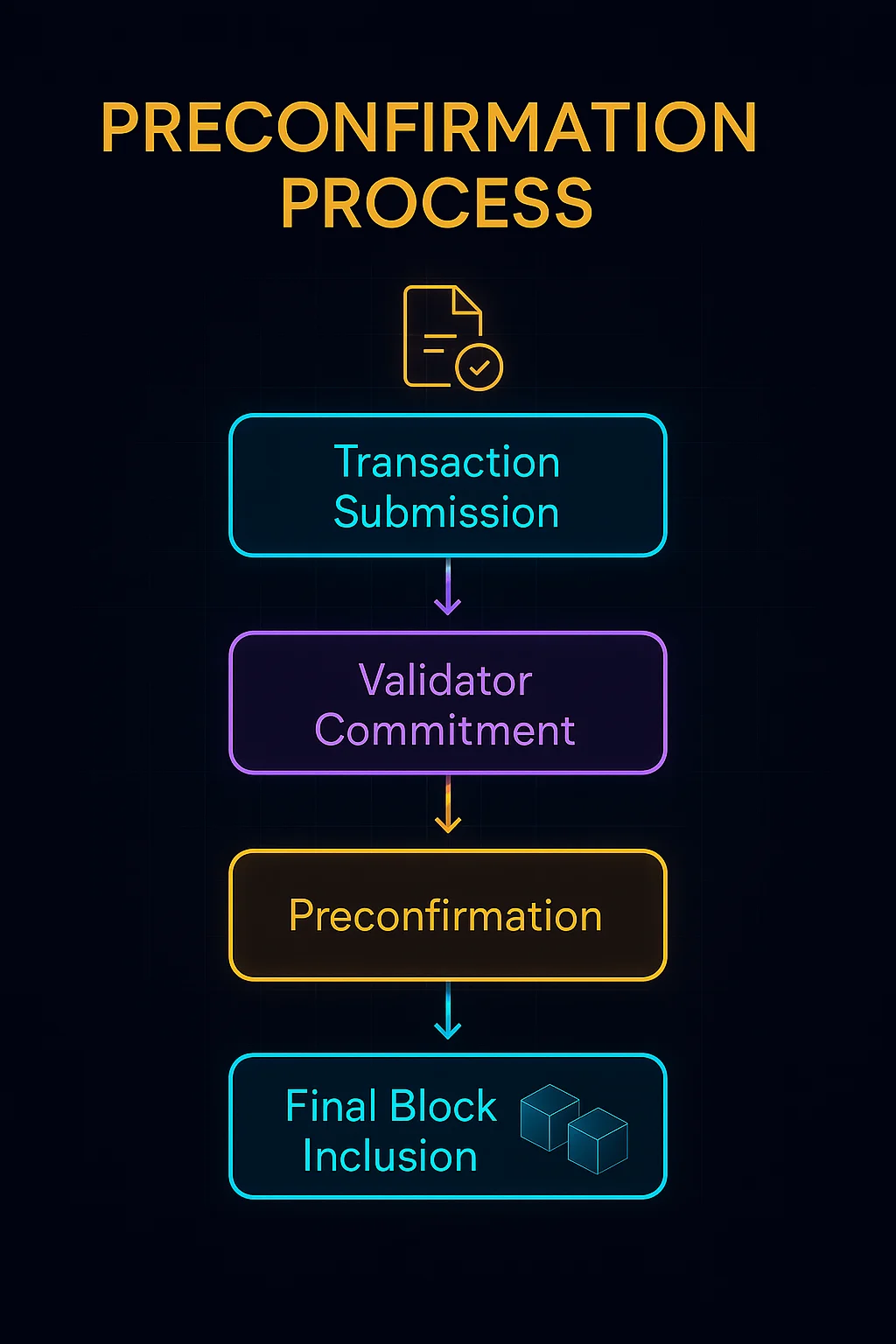
Infographic showing blockchain preconfirmation process: transaction submission, validator commitment, preconfirmation, and final block inclusion

Real-World Examples

  • Layer 2 sequencers provide preconfirmations for faster user feedback on rollup transactions
  • MEV-Boost implementations experiment with preconfirmation mechanisms for Ethereum
  • Application-specific chains often implement preconfirmations for improved user experience

Why Beginners Should Care

Faster feedback improves user experience by reducing perceived transaction latency even when final confirmation takes the same time.

Trust assumptions require believing that validators will honor their preconfirmation commitments rather than waiting for cryptographic finality.

Implementation complexity makes preconfirmations challenging to implement correctly without introducing new attack vectors or centralization risks.

Related Terms: Block Confirmation, Finality, Sequencer

Back to Crypto Glossary

Similar Posts

  • Seed Phrase

    Seed Phrase: Your Crypto Recovery Backup Your seed phrase is your crypto’s ultimate backup. More important than passwords, more valuable than the device itself. A seed phrase is a list of 12-24 words that can restore access to all your cryptocurrency wallets and funds. It’s your master key – lose it and your crypto is…

  • On-Chain Gaming

    On-Chain Gaming: Fully Decentralized Games On-chain gaming runs game logic entirely on blockchain networks rather than traditional servers. It’s like having board games where the rules are enforced by mathematics instead of human referees. On-chain gaming executes all game logic, state management, and interactions through smart contracts on blockchain networks. Unlike traditional games with centralized…

  • Hash Rate

    Hash Rate: Network Security Measurement Hash rate measures how much computational power secures a blockchain network. Higher hash rates mean stronger security against attacks and manipulation. Hash rate is the total computational power used by miners to process transactions and secure a proof-of-work blockchain network. It’s measured in hashes per second – calculations attempting to…

  • Difficulty

    Difficulty: Mining Competition AdjustmentDifficulty refers to how hard it is to mine new blocks in proof-of-work cryptocurrencies, automatically adjusting to maintain consistent block times. It's like a video game that gets harder when you're doing too well and easier when you're struggling.Difficulty describes the measure of how computationally challenging it is to find valid proof-of-work…

  • Layer Separation

    Layer Separation: Modular Blockchain ArchitectureLayer separation divides blockchain functionality into distinct layers that can be optimized independently. It's like having specialized departments in a company that each focus on what they do best.Layer separation refers to blockchain architectures that divide functionality into distinct layers such as consensus, execution, and data availability, enabling independent optimization and…

  • Sybil Attack

    Sybil Attack: Fake Identity Manipulation Sybil attacks involve creating multiple fake identities to gain disproportionate influence in networks that assume one person equals one vote. It’s like stuffing the ballot box with imaginary voters. A Sybil attack is when an individual or entity creates multiple fake identities to gain unfair influence over a network, voting…