
Bagholder

Bagholder: Stuck with Worthless Tokens

A bagholder is someone stuck holding cryptocurrency that has lost most of its value with little hope of recovery. It’s crypto’s version of being left holding the bag.

A bagholder is an investor who continues holding a cryptocurrency that has significantly decreased in value, often because they’re unable or unwilling to realize the loss. The “bag” represents their depreciating investment that nobody else wants to buy.

How People Become Bagholders

FOMO buying near price peaks leaves investors with positions that immediately move against them as market sentiment shifts and prices crash.

Averaging down on failing investments can turn small losses into large ones as investors throw good money after bad, increasing their position size in declining assets.

Emotional attachment to projects or communities prevents rational selling decisions even when fundamental reasons for holding no longer exist.
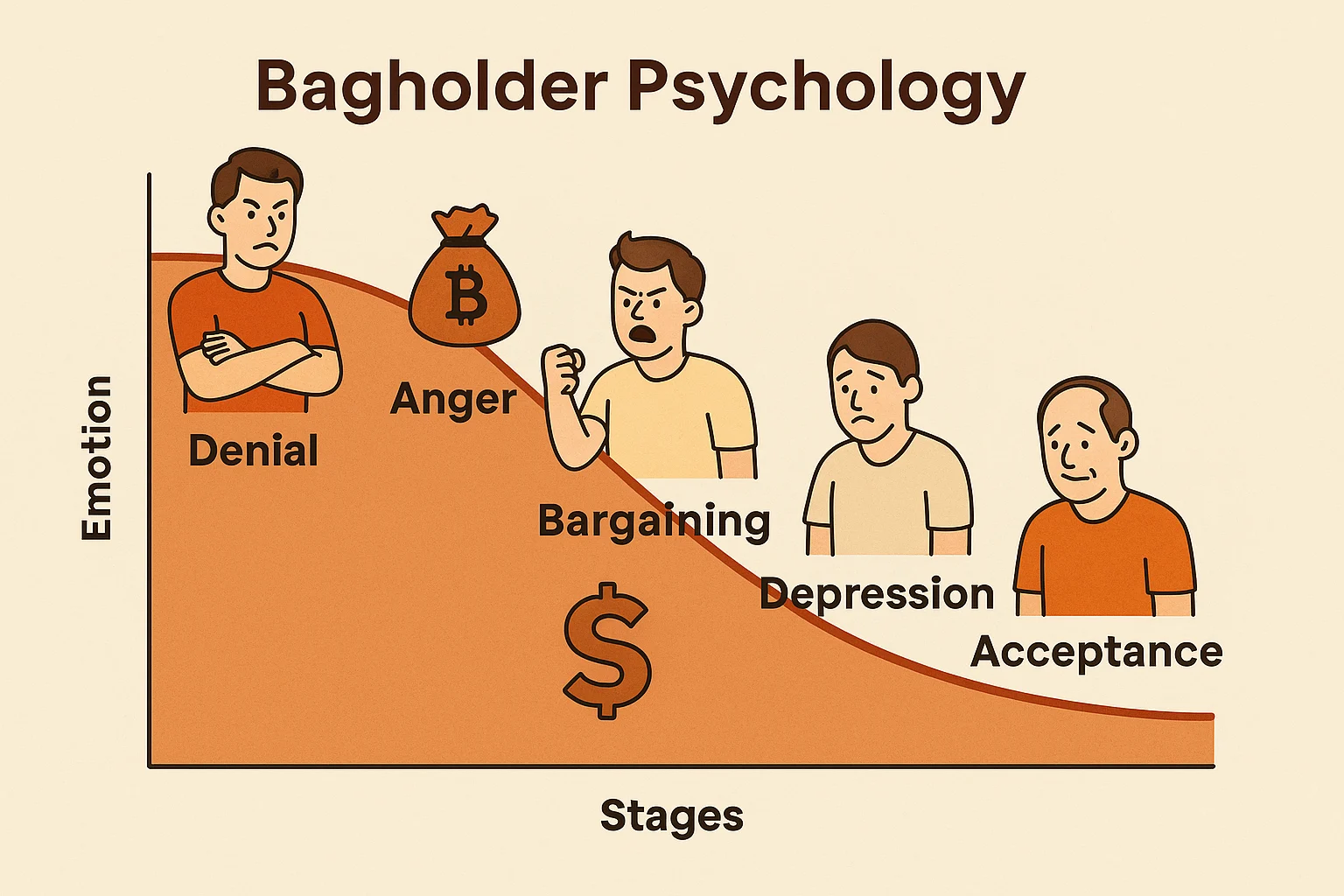
Infographic showing the emotional stages of a bagholder from denial to acceptance, illustrated with a descending curve and character expressions

Real-World Examples

  • ICO token holders from 2017-2018 who bought projects that never delivered working products
  • Terra Luna investors who held through the algorithmic stablecoin collapse
  • Various DeFi token holders who believed in projects that got abandoned or exploited

Why Beginners Should Care

Cutting losses is often the smart financial decision, but psychological factors make it difficult to admit mistakes and move on to better opportunities.

Opportunity cost of bagholding means missing other investments while holding depreciating assets that may never recover their previous values.

Tax strategies can make bagholding rational in some cases where realizing losses provides tax benefits that offset portfolio optimization concerns.

Related Terms: FOMO, Paper Hands, Sunk Cost, Exit Strategy

Back to Crypto Glossary

Similar Posts

  • Profit Taking

    Profit Taking: Realizing Investment GainsProfit taking involves selling cryptocurrency holdings to lock in gains and convert unrealized profits into actual cash or other assets. It's like cashing out your casino chips while you're ahead.Profit taking refers to the strategic sale of cryptocurrency positions to realize gains and reduce exposure when investments have appreciated in value. This…

  • Centralization Risk

    Centralization Risk: Single Point of Failure DangersCentralization risk refers to vulnerabilities created when critical functions are controlled by single entities rather than distributed among many participants. It's like having all eggs in one basket that could break everything at once.Centralization risk encompasses the potential negative impacts when blockchain networks, applications, or services become overly dependent…

  • Recursive Proofs

    Recursive Proofs: Self-Verifying Cryptographic SystemsRecursive proofs are cryptographic proofs that can verify other proofs of the same type, enabling compression and scalability. They're like mathematical matryoshka dolls where each proof contains and verifies other proofs.Recursive proofs are cryptographic systems where proofs can verify other instances of the same proof system, enabling compression of multiple proofs…

  • Wallet Connect

    Wallet Connect: Universal dApp Connection Standard WalletConnect is an open protocol that enables secure connections between mobile wallets and desktop applications. It’s like Bluetooth for crypto wallets and dApps. WalletConnect is a communication protocol that allows cryptocurrency wallets to interact with decentralized applications across different devices and platforms. It enables secure, encrypted connections without exposing…

  • Capital Efficiency

    Capital Efficiency: Maximizing Resource UtilizationCapital efficiency measures how effectively investments generate returns relative to the amount of capital deployed. It's like getting the most miles per gallon from your investment fuel.Capital efficiency refers to maximizing returns or utility from invested capital through optimal allocation, leverage, or innovative strategies that reduce required capital while maintaining or…

  • Session Keys

    Session Keys: Temporary Wallet Permissions Session keys provide temporary, limited permissions for applications to perform specific actions without exposing main wallet private keys. It’s like giving valet keys instead of your full car keys. Session keys are temporary cryptographic keys that grant limited permissions to applications for specific time periods or transaction types. They enable…