
Data Availability Layer

Data Availability Layer: Ensuring Information Access

Data availability layers ensure that blockchain data remains accessible for verification without requiring full nodes to store everything. It’s like having a library system where you can verify any book exists without storing them all.

A data availability layer guarantees that blockchain transaction data is published and remains accessible for verification, even if not all nodes store complete copies. This enables scalable architectures while maintaining security guarantees.

How Data Availability Works

Data publication requires block producers to make transaction data publicly available, even if execution happens elsewhere or in summarized form.

Availability proofs use cryptographic techniques like data availability sampling to verify data accessibility without downloading complete datasets.

Fraud prevention ensures malicious actors cannot hide transaction data that would enable verification of incorrect state transitions or invalid blocks.
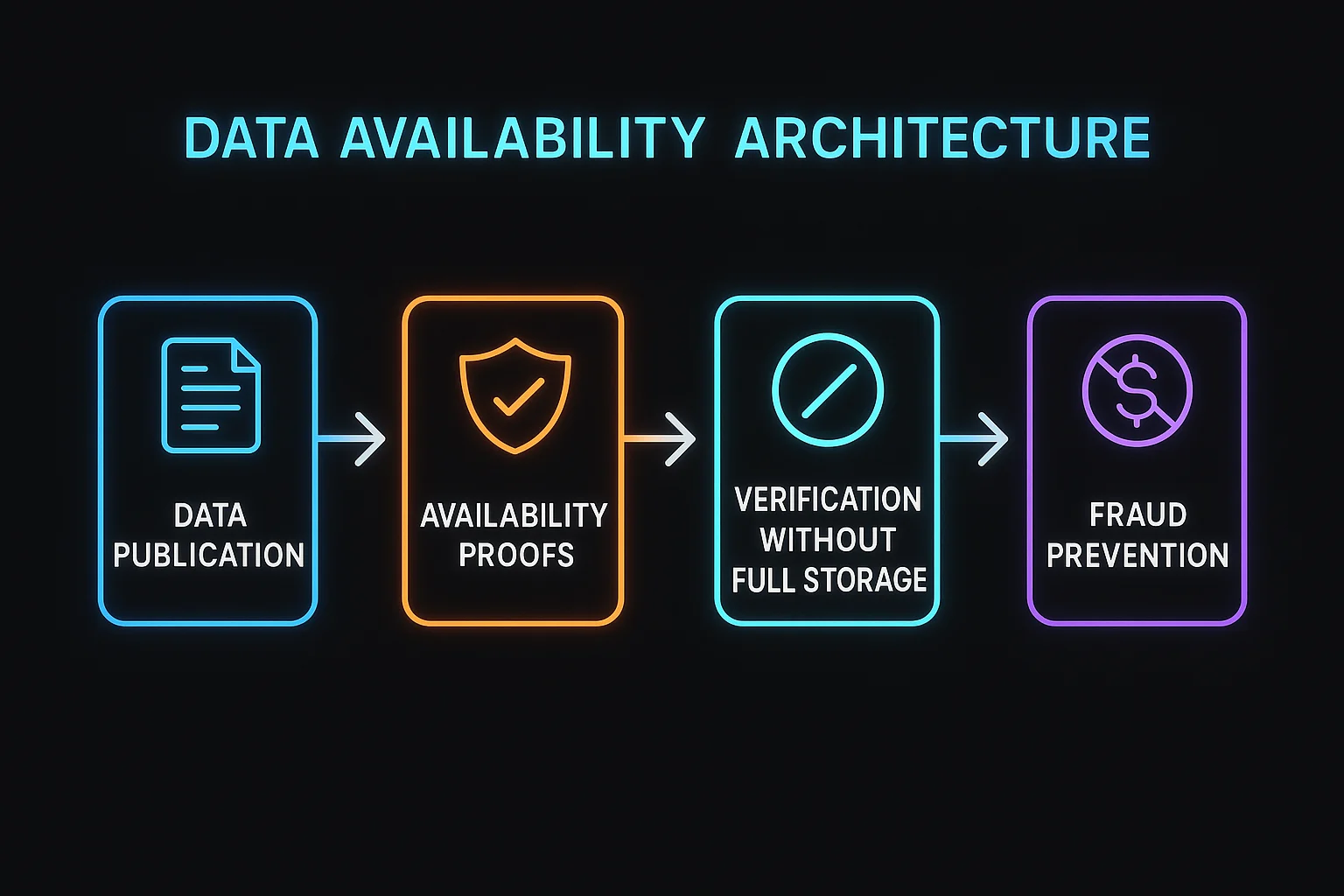
Data availability architecture showing data publication, availability proofs, verification without full storage, and fraud prevention

Real-World Examples

  • Celestia provides dedicated data availability services for modular blockchain architectures
  • Ethereum serves as a data availability layer for various Layer 2 rollup solutions
  • Polygon Avail offers scalable data availability for sovereign blockchain networks

Why Beginners Should Care

Scalability enablement through data availability layers that support much higher transaction throughput than traditional blockchain architectures.

Security preservation maintains verification capabilities and fraud detection without requiring all participants to store complete blockchain histories.

Technical complexity in understanding how data availability relates to overall blockchain security and decentralization properties.

Related Terms: Modular Blockchain, Data Sampling, Fraud Proof, Scalability

Back to Crypto Glossary

Similar Posts

  • Stable Yield

    Stable Yield: Predictable DeFi Returns Stable yield refers to DeFi strategies that provide consistent returns with lower volatility than traditional yield farming. It’s like finding the boring but reliable investment in a casino full of slot machines. Stable yield strategies focus on generating consistent returns from DeFi protocols with lower risk and volatility than high-APY…

  • Rollups

    Rollups: Scaling Through Bundling Rollups process hundreds of transactions off-chain then bundle the results into single on-chain transactions. It’s like carpooling for blockchain transactions – everyone shares the gas costs. Rollups are Layer 2 scaling solutions that execute transactions off the main blockchain but post transaction data on-chain for security. They inherit the security of…

  • DeFi Insurance

    DeFi Insurance: Protecting Against Smart Contract Risk DeFi insurance provides coverage against smart contract failures, hacks, and protocol exploits. It’s like buying fire insurance for your digital assets in experimental financial protocols. DeFi insurance offers protection against losses from smart contract bugs, hacks, oracle failures, and other technical risks in decentralized finance protocols. Users pay…

  • Liquid Restaking

    Liquid Restaking: Flexible High-Yield Staking Liquid restaking combines the capital efficiency of liquid staking with additional yield from securing multiple networks. It’s like having your cake and eating it too, but with slashing risks. Liquid restaking allows staked assets to secure additional protocols while remaining liquid through tokenized representations. Users can earn enhanced yields from…

  • Social Recovery

    Social Recovery: Community-Based Account RecoverySocial recovery allows regaining access to cryptocurrency accounts through trusted contacts rather than relying solely on seed phrases. It's like having friends hold spare keys to your house.Social recovery is a wallet security mechanism that enables account recovery through a network of trusted contacts rather than requiring users to manage seed…

  • Proof of Stake (PoS)

    Proof of Stake (PoS): Energy-Efficient Consensus Proof of Stake secures blockchain networks through economic staking rather than energy-intensive mining. It’s like replacing a gold rush with a security deposit system. Proof of Stake (PoS) is a consensus mechanism where validators are chosen to create new blocks based on their stake in the network rather than…