
Hash Rate

Hash Rate: Network Security Measurement

Hash rate measures how much computational power secures a blockchain network. Higher hash rates mean stronger security against attacks and manipulation.

Hash rate is the total computational power used by miners to process transactions and secure a proof-of-work blockchain network. It’s measured in hashes per second – calculations attempting to solve the cryptographic puzzle for each block.

How Hash Rate Works

Mining competition drives hash rate as miners add computational power to increase their chances of earning block rewards. More miners mean higher total hash rate.

Difficulty adjustment maintains consistent block times as hash rate changes. If hash rate doubles, difficulty increases to keep block times steady at target intervals.

Security correlation exists between hash rate and network security. Higher hash rates make 51% attacks more expensive and practically impossible for major networks.
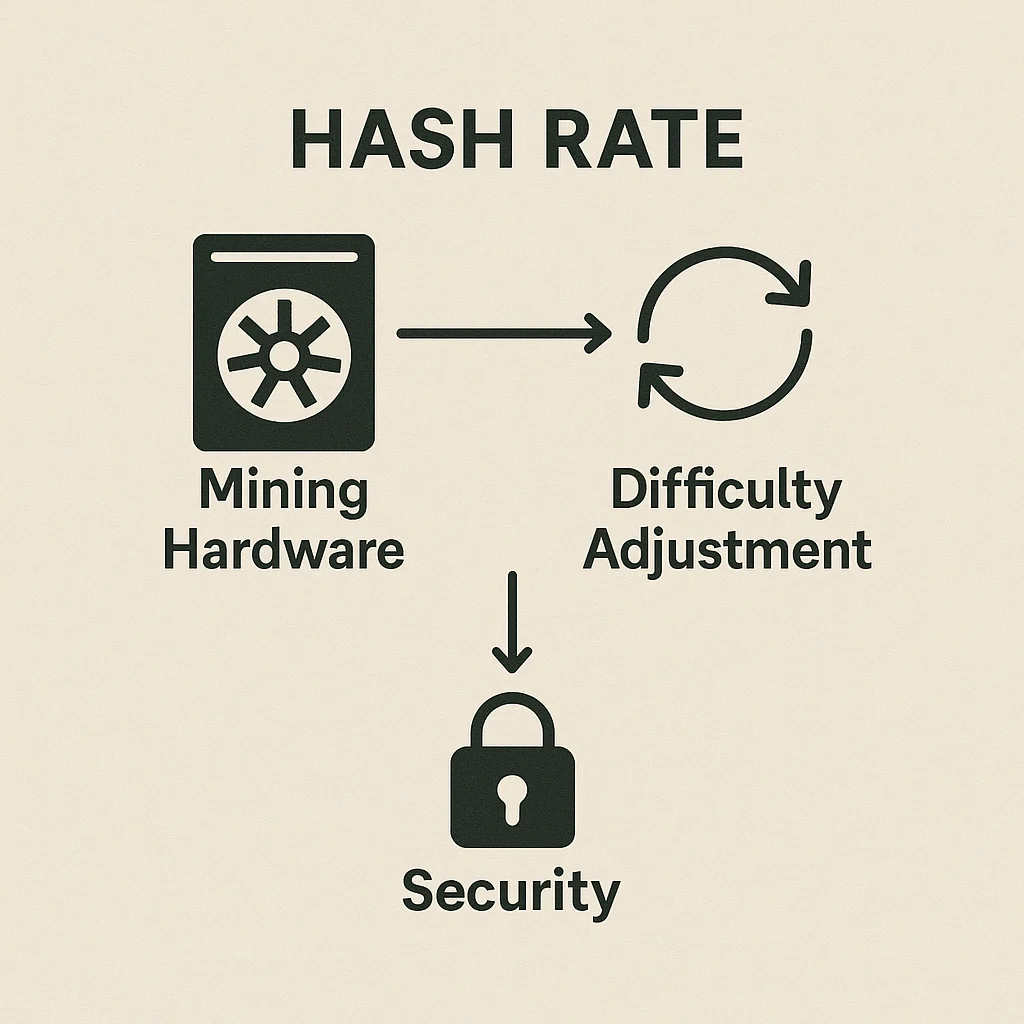
Infographic showing the relationship between mining hardware, difficulty adjustment, and blockchain security in hash rate dynamics

Real-World Examples

  • Bitcoin hash rate exceeded 500 exahashes per second at peak – more computing power than all global supercomputers combined
  • Hash rate crashes during miner capitulation events can temporarily reduce network security
  • Geographic distribution of hash rate affects decentralization and regulatory risks

Why Beginners Should Care

Hash rate trends indicate miner confidence in long-term profitability. Sustained hash rate growth suggests healthy network fundamentals and security.

Network security depends on hash rate distribution. Concentrated hash rate in single locations or entities creates centralization risks and potential attack vectors.

Mining bans or regulatory crackdowns can cause temporary hash rate drops, affecting transaction processing times until difficulty adjusts downward.

Related Terms: Mining, Proof of Work, Difficulty, 51% Attack

Back to Crypto Glossary

Similar Posts

  • DPoS

    DPoS: Democratic Blockchain GovernanceDelegated Proof of Stake (DPoS) is a consensus mechanism where token holders vote for representatives who validate transactions on their behalf. It's like electing politicians to make decisions for the community.Delegated Proof of Stake (DPoS) is a consensus mechanism where token holders vote for a limited number of delegates who are responsible…

  • NFT (Non-Fungible Token)

    NFT (Non-Fungible Token): Digital Ownership Certificates NFTs transformed JPEGs into million-dollar assets and made digital ownership mainstream. Love them or hate them, they’re reshaping how we think about digital property. A Non-Fungible Token (NFT) is a unique digital certificate stored on a blockchain that proves ownership of a specific digital asset. Unlike cryptocurrencies where each…

  • Dynamic Gas Pricing

    Dynamic Gas Pricing: Adaptive Fee Markets Dynamic gas pricing automatically adjusts transaction fees based on network demand. It’s like surge pricing for blockchain transactions – pay more when everyone wants to transact. Dynamic gas pricing is a mechanism that automatically adjusts transaction fees based on current network congestion and demand. This creates more efficient fee…

  • Oracle

    Oracle: Connecting Blockchains to Reality Oracles are the bridges between blockchain smart contracts and real-world data. Without them, DeFi would be a closed system talking only to itself. An oracle is a service that provides external data to blockchain networks, enabling smart contracts to access real-world information like prices, weather, sports scores, or any off-chain…

  • SegWit

    SegWit: Bitcoin's Transaction Efficiency UpgradeSegregated Witness (SegWit) is a Bitcoin protocol upgrade that increased transaction capacity by separating signature data from transaction data. It's like reorganizing luggage to fit more in the same space.SegWit (Segregated Witness) is a Bitcoin protocol upgrade that moves signature data outside the main transaction block, effectively increasing block capacity and…

  • |

    Bridgeless Interop

    Bridgeless Interop: Direct Cross-Chain Communication Bridgeless interoperability enables direct communication between blockchains without traditional bridge infrastructure. It’s like having chains that can talk directly to each other instead of using translators. Bridgeless interoperability refers to cross-chain communication methods that don’t rely on traditional bridge protocols, instead using native blockchain features or specialized infrastructure for direct…