
MEV (Maximal Extractable Value)

MEV (Maximal Extractable Value): The Hidden Tax on DeFi

MEV is the extra profit that miners and validators can extract by reordering, including, or excluding transactions within blocks. It’s like cutting in line at the blockchain cafeteria.

Maximal Extractable Value (MEV) is the additional profit that block producers can capture by strategically ordering transactions, beyond standard block rewards and fees. This creates an invisible tax on DeFi users through front-running, sandwich attacks, and arbitrage extraction.

How MEV Works

Transaction ordering power lets miners and validators see pending transactions and arrange them to maximize their profit, often at the expense of regular users.

Front-running involves placing transactions ahead of known profitable trades to capture arbitrage opportunities or cause slippage for the original trader.

Sandwich attacks place transactions before and after target trades to manipulate prices and extract value from the victim’s transaction through artificial slippage.
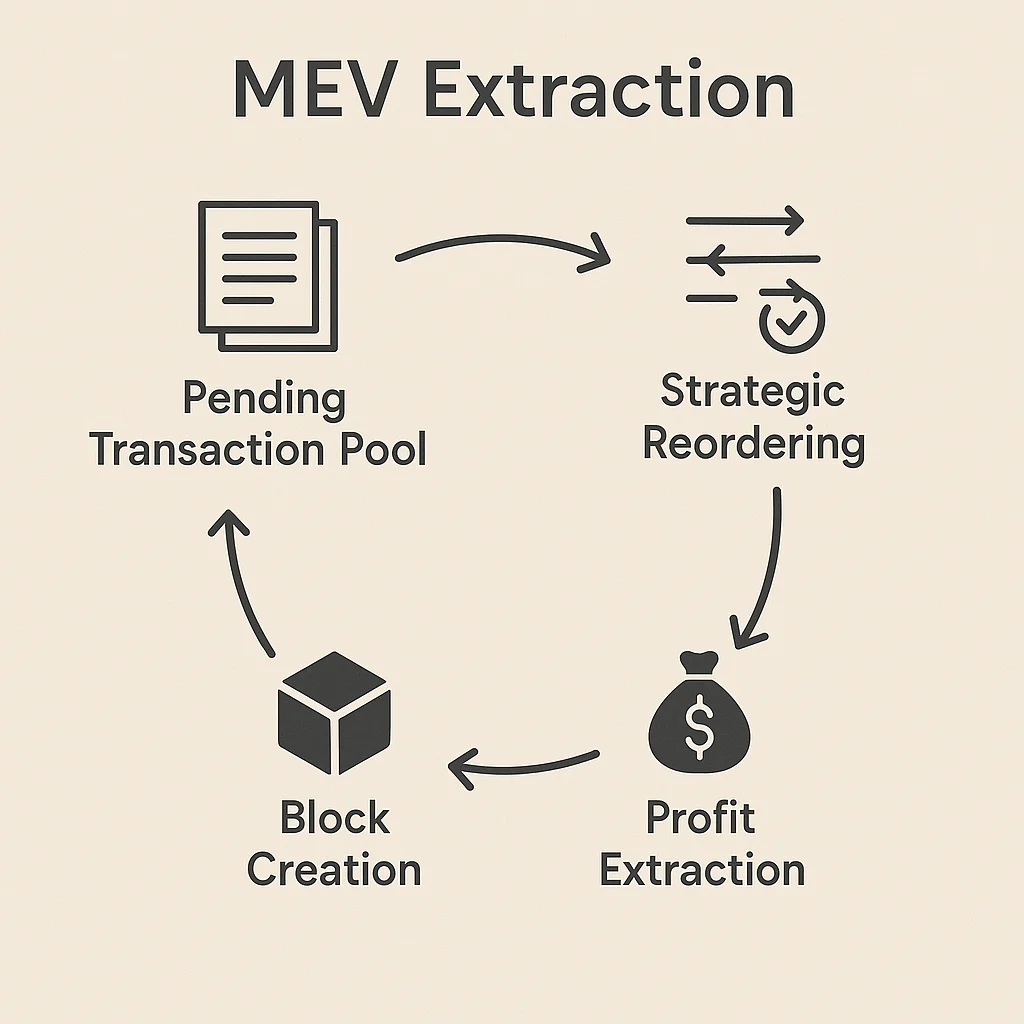
Infographic showing MEV extraction process: pending transaction pool, strategic reordering, profit extraction, and block creation

Real-World Examples

  • DEX arbitrage bots extract millions daily by front-running price differences between exchanges
  • Liquidation sniping involves front-running liquidation transactions to capture discounted collateral
  • NFT sniping uses MEV to front-run popular NFT purchases and flip for immediate profit

Why Beginners Should Care

Hidden costs from MEV can significantly increase the real cost of DeFi transactions beyond visible gas fees through increased slippage and worse execution prices.

Protection strategies include using private mempools, MEV-protected RPC endpoints, or protocols specifically designed to prevent MEV extraction.

Ecosystem impact sees billions in value extracted from regular users annually, raising questions about fairness and sustainability of current blockchain designs.

Related Terms: Front-Running, Sandwich Attack, Slippage, DeFi

Back to Crypto Glossary

Similar Posts

  • Transaction Cost

    Transaction Cost: The Price of Blockchain OperationsTransaction cost refers to the total expense of executing operations on blockchain networks, including fees, gas, and opportunity costs. It's the price you pay for using decentralized financial infrastructure.Transaction cost encompasses all expenses associated with executing blockchain operations, including network fees, gas costs, slippage, and time value. Understanding total transaction…

  • Cross-Chain Messaging

    Cross-Chain Messaging: Inter-Blockchain Communication Cross-chain messaging enables smart contracts on different blockchains to communicate and trigger actions across networks. It’s like having a universal translator for blockchain conversations. Cross-chain messaging allows smart contracts on different blockchain networks to send data, trigger functions, and coordinate actions across multiple chains. This enables true interoperability beyond simple asset…

  • Throughput

    Throughput: Network Processing CapacityThroughput measures how many transactions a blockchain network can process per second. It's like measuring how many cars can drive through a highway during rush hour.Throughput refers to the number of transactions a blockchain network can process within a given time period, typically measured in transactions per second (TPS). Higher throughput enables more…

  • FOMO (Fear of Missing Out)

    FOMO: The Psychology That Drives Crypto Markets FOMO (Fear of Missing Out) is responsible for more bad crypto decisions than any technical analysis could prevent. It’s the emotional trap that turns rational people into panic buyers. FOMO is the anxiety that others are experiencing rewarding experiences from which one is absent. In crypto, it manifests…

  • DCA

    DCA: Dollar Cost Averaging Investment StrategyDCA (Dollar Cost Averaging) involves making regular purchases of cryptocurrency regardless of price to reduce timing risk. It's like buying groceries on the same day each week instead of trying to predict when prices will be lowest.Dollar Cost Averaging (DCA) is an investment strategy that involves purchasing cryptocurrency at regular…

  • Wei

    Wei: Ethereum's Smallest UnitWei is the smallest denomination of Ethereum, similar to how cents are the smallest unit of dollars. It's like measuring distances in millimeters when you need precision, even though we usually think in meters or kilometers.Wei represents the smallest possible unit of Ethereum (ETH), with one ETH equal to 1,000,000,000,000,000,000 (10^18) wei. This…