
Liquidity Mining

Liquidity Mining: Earning Rewards for Providing Liquidity

Liquidity mining rewards users who provide capital to DeFi protocols with governance tokens. It’s like getting paid to be the house money at a casino.

Liquidity mining is a DeFi incentive mechanism where protocols distribute governance tokens to users who provide liquidity to their platforms. Users earn both trading fees and token rewards for supplying capital to liquidity pools.

How Liquidity Mining Works

Yield farming involves providing liquidity to automated market makers, lending protocols, or other DeFi applications in exchange for native token rewards.

Emission schedules control how many tokens get distributed and over what timeframe, often decreasing over time to prevent excessive inflation.

Staking rewards supplement trading fees with governance tokens, creating additional income streams for liquidity providers beyond fee sharing.
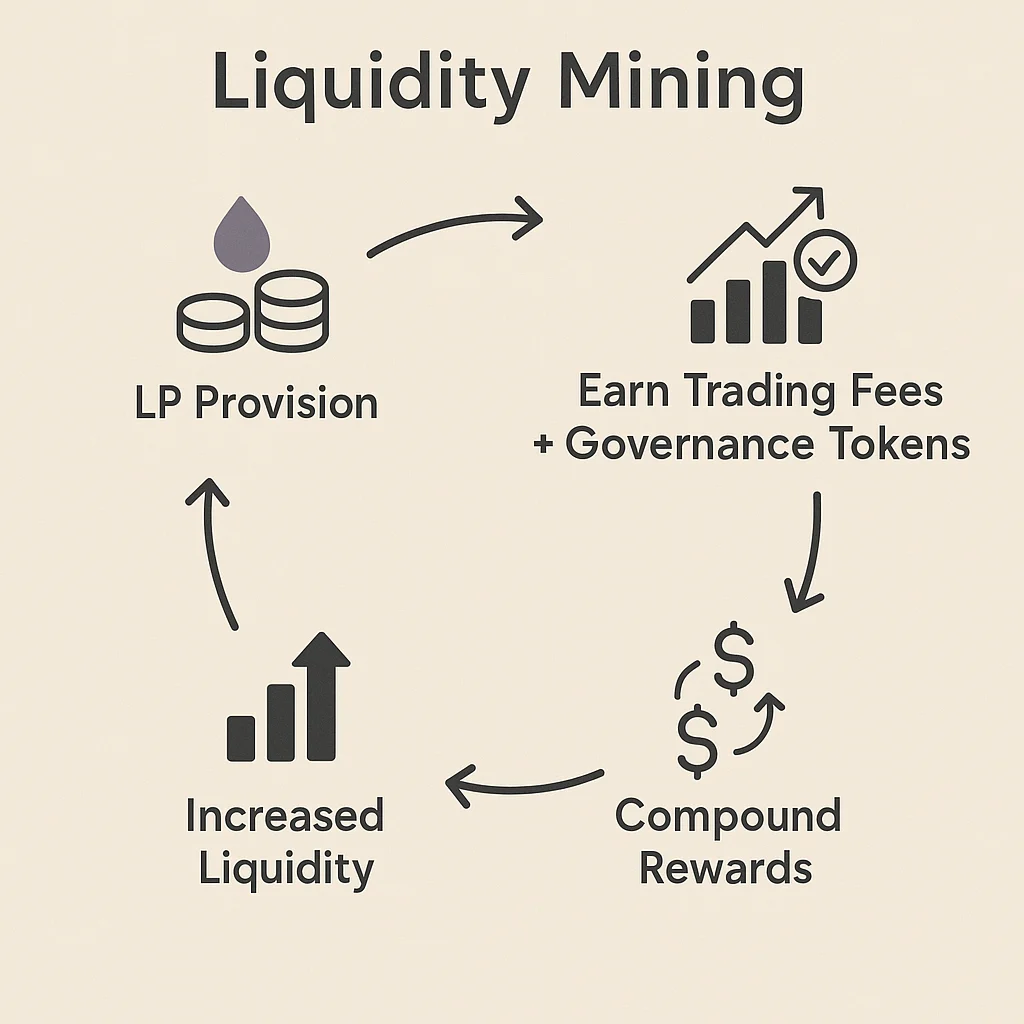
Infographic showing the liquidity mining cycle with steps: LP provision, earning trading fees and governance tokens, compounding rewards, and increasing liquidity

Real-World Examples

  • Uniswap’s UNI distribution rewarded early liquidity providers with governance tokens worth thousands
  • Compound’s COMP mining launched the DeFi summer of 2020 with lucrative token rewards
  • SushiSwap vampire attack used higher liquidity mining rewards to steal liquidity from Uniswap

Why Beginners Should Care

High yields during protocol launches can provide exceptional returns, but these often decrease rapidly as more users participate and token prices stabilize.

Token risk means liquidity mining rewards may become worthless if governance tokens lose value, potentially wiping out gains from fee earnings.

Impermanent loss still applies to liquidity mining positions, requiring careful analysis of whether token rewards compensate for potential price divergence losses.

Related Terms: Yield Farming, Liquidity Pool, Governance Token, Impermanent Loss

Back to Crypto Glossary

Similar Posts

  • NFT (Non-Fungible Token)

    NFT (Non-Fungible Token): Digital Ownership Certificates NFTs transformed JPEGs into million-dollar assets and made digital ownership mainstream. Love them or hate them, they’re reshaping how we think about digital property. A Non-Fungible Token (NFT) is a unique digital certificate stored on a blockchain that proves ownership of a specific digital asset. Unlike cryptocurrencies where each…

  • Collection

    Collection: Grouped NFT SeriesA collection is a group of related NFTs that share common themes, artwork, or attributes. It's like a series of trading cards or stamps that belong to the same set.A collection refers to a group of related NFTs that share common characteristics, themes, or attributes, typically created by the same artist or…

  • Multi-Signature (Multisig)

    Multi-Signature (Multisig): Shared Control for Enhanced Security Multisig wallets require multiple signatures to authorize transactions. It’s like requiring multiple keys to open a safe – no single person can move funds alone. Multi-signature (multisig) is a wallet configuration that requires signatures from multiple private keys to authorize transactions. Common setups include 2-of-3 (any 2 signatures…

  • Transparency

    Transparency: Open Information AccessTransparency in cryptocurrency refers to the open, verifiable nature of blockchain data that allows anyone to inspect transactions and network operations. It's like having buildings made entirely of glass where you can see exactly what's happening inside every room.Transparency describes the property of blockchain systems that makes transaction data, network operations, and…

  • Blockchain

    Blockchain: The Unchangeable Digital Ledger Forget the hype – blockchain is simply a better way to keep records. It’s like a ledger book that everyone can see, but no one can cheat. Blockchain is a chain of digital records (blocks) that are linked together and secured using cryptography. Once information goes into a block, changing…

  • Gas Fees

    Gas Fees: The Cost of Using Ethereum Gas fees are the tolls you pay to use Ethereum. Sometimes they’re pennies, sometimes they’re hundreds of dollars. Welcome to decentralized computing. Gas fees are transaction costs paid to miners or validators for processing transactions on blockchain networks. Think of gas as the fuel needed to power your…