
Impermanent Loss

Impermanent Loss: The Hidden Cost of Liquidity Providing

Impermanent loss is the sneaky tax on liquidity providers. Your tokens can lose value even when the pool is profitable. It’s math, not magic – but it feels like getting robbed.

Impermanent loss occurs when the price ratio of tokens in a liquidity pool changes compared to when you deposited them. You end up with less value than if you had simply held the tokens separately, even though you earned trading fees.

How Impermanent Loss Works

Automated Market Makers maintain token ratios through arbitrage. When one token’s price increases, arbitrageurs buy it from the pool until the price matches external markets.

You’re selling winners and buying losers automatically. If ETH pumps 50% against USDC, the pool sells your ETH for USDC to maintain balance, giving you less ETH than you started with.

The loss is “impermanent” because if prices return to original ratios, the loss disappears. But if price divergence persists, the loss becomes very real.
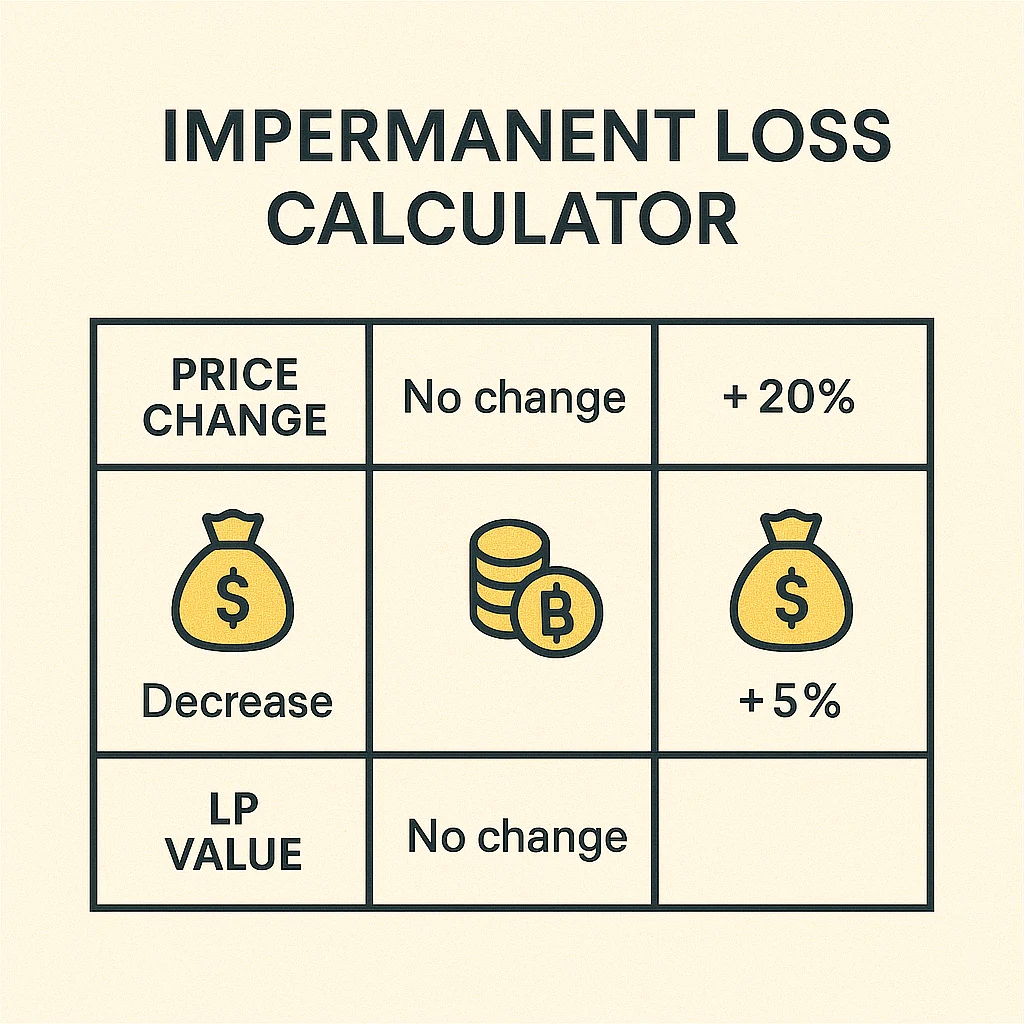
Infographic showing impermanent loss scenarios based on token price changes and their impact on LP value

Real-World Examples

  • ETH/USDC pool during ETH bull run – you miss some ETH gains but earn trading fees
  • Stablecoin pools have minimal impermanent loss but lower fee returns
  • Volatile pairs can create severe impermanent loss that exceeds fee earnings

Why Beginners Should Care

Many new DeFi users discover impermanent loss after the fact, wondering why their “profitable” liquidity position lost money compared to holding tokens.

Calculate the trade-off before providing liquidity. High-fee pools might compensate for impermanent loss, while low-fee pools might not justify the risk.

Stablecoin pairs minimize impermanent loss risk while still earning yield from trading fees and liquidity mining rewards.

Related Terms: Liquidity Pool, Yield Farming, AMM, DEX

Back to Crypto Glossary

Similar Posts

  • Proof of History

    Proof of History: Solana’s Time Innovation Proof of History creates a cryptographic timestamp that proves events occurred in a specific sequence. It’s like having an unforgeable clock built into the blockchain. Proof of History (PoH) is a consensus mechanism that creates a historical record proving that events occurred at specific moments in time. It uses…

  • Meta Transactions

    Meta Transactions: Gasless User InteractionsMeta transactions enable users to interact with blockchain applications without paying gas fees directly. It's like having someone else pay your transaction fees while you control the actual operations.Meta transactions are blockchain transactions where the gas fees are paid by a third party (relayer) while the user maintains control over the…

  • Scaling

    Scaling: Handling More TransactionsScaling refers to increasing a blockchain network's capacity to handle more transactions per second without sacrificing security or decentralization. It's the holy grail of blockchain development.Scaling in blockchain technology involves improving transaction throughput, reducing costs, and maintaining performance as networks grow in size and usage. This typically requires technical solutions that balance speed,…

  • Leverage

    Leverage: Borrowing Money to Amplify TradesLeverage lets you control larger positions than your actual capital by borrowing funds from exchanges or platforms. It's like using a lever to lift heavy objects – small movements create big effects.Leverage in cryptocurrency trading allows borrowing funds to increase position sizes beyond available capital, amplifying both potential profits and…

  • Resistance

    Resistance: Technical Analysis Price BarriersResistance refers to price levels where cryptocurrency faces selling pressure that prevents further upward movement. It's like hitting an invisible ceiling where the price bounces back down, as if there's a barrier preventing it from going higher.Resistance describes price levels where selling pressure consistently prevents cryptocurrency prices from rising further, creating…

  • Self-Custody

    Self-Custody: Direct Asset ControlSelf-custody means personally controlling your cryptocurrency private keys rather than trusting third parties to hold your assets. It's like keeping cash in your own safe instead of depositing it in someone else's bank account.Self-custody refers to the practice of personally maintaining control over cryptocurrency private keys and digital assets without relying on…