
Liquidity Pool

Liquidity Pool: The Fuel That Powers DEX Trading

Liquidity pools are why decentralized exchanges work. They’re shared pots of tokens that enable trading without traditional buyers and sellers.

A liquidity pool is a collection of tokens locked in a smart contract that provides liquidity for decentralized trading. Instead of matching buy and sell orders, traders swap against these pools using automated market maker (AMM) algorithms.

How Liquidity Pools Work

Liquidity providers deposit equal values of two tokens (like ETH and USDC) into a pool. When traders want to swap ETH for USDC, they trade against this pool rather than with another person.

The pool maintains balance using mathematical formulas. As one token gets scarce, its price automatically increases to encourage arbitrageurs to rebalance the pool.

Liquidity providers earn trading fees proportional to their share of the pool. More trading volume means more fees for providers.
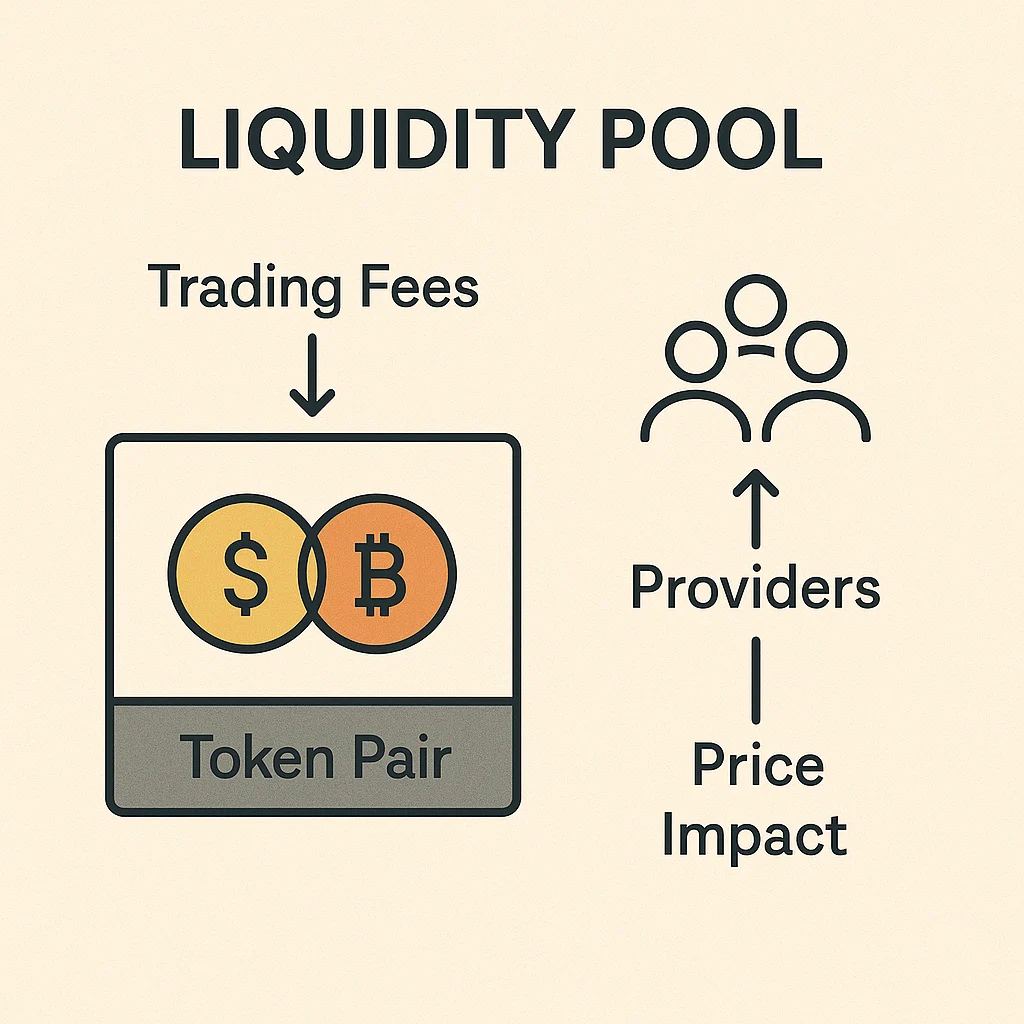
Infographic showing a liquidity pool with token pairs, trading fees flowing to providers, and price impact mechanics

Real-World Examples

  • ETH/USDC pools on Uniswap earn steady fees from high trading volume
  • Stablecoin pools offer lower risk but smaller returns
  • New token pools can be highly profitable but extremely risky

Why Beginners Should Care

Liquidity pools let you earn passive income from your crypto holdings. Instead of holding tokens that do nothing, you can put them to work earning trading fees.

But understand impermanent loss first – if token prices diverge significantly, you might end up with less value than just holding the tokens separately.

Related Terms: DEX, Impermanent Loss, Yield Farming, AMM

Back to Crypto Glossary

Similar Posts

  • Web3

    Web3: The Decentralized Internet Dream Web3 promises an internet where users own their data, identity, and digital assets instead of tech giants controlling everything. It’s part vision, part reality, part marketing buzzword. Web3 refers to a decentralized version of the internet built on blockchain technology where users control their own data, identity, and assets rather…

  • Due Diligence

    Due Diligence: Research Before InvestmentDue diligence involves thoroughly researching and evaluating cryptocurrency projects before investing. It's like test driving a car and checking its history before buying.Due diligence refers to the comprehensive investigation and analysis of cryptocurrency projects, including technology, team, tokenomics, and market factors before making investment decisions. Proper due diligence helps identify opportunities and…

  • Scalability

    Scalability: Handling Growing Network DemandScalability refers to a blockchain network's ability to handle increasing transaction volumes without degrading performance or significantly increasing costs. It's like building highways that don't get congested as more cars use them.Scalability describes how well blockchain networks can accommodate growing user bases and transaction volumes while maintaining reasonable fees and confirmation…

  • Anti-Sybil Mechanism

    Anti-Sybil Mechanism: Preventing Fake Identity Attacks Anti-Sybil mechanisms prevent individuals from creating multiple fake identities to gain unfair advantages in voting, airdrops, or governance systems. They’re like requiring photo ID to prevent ballot stuffing. Anti-Sybil mechanisms are systems designed to prevent or detect when single entities create multiple fake identities to manipulate voting, governance, or…

  • EigenLayer

    EigenLayer: Ethereum Restaking ProtocolEigenLayer enables Ethereum validators to restake their ETH to secure additional protocols and earn extra rewards. It's like using the same security deposit to protect multiple different services simultaneously.EigenLayer is a protocol that allows Ethereum validators to restake their staked ETH to provide security for additional protocols and services beyond Ethereum itself. This…

  • DPoS

    DPoS: Democratic Blockchain GovernanceDelegated Proof of Stake (DPoS) is a consensus mechanism where token holders vote for representatives who validate transactions on their behalf. It's like electing politicians to make decisions for the community.Delegated Proof of Stake (DPoS) is a consensus mechanism where token holders vote for a limited number of delegates who are responsible…