
Anti-Sybil Mechanism

Anti-Sybil Mechanism: Preventing Fake Identity Attacks

Anti-Sybil mechanisms prevent individuals from creating multiple fake identities to gain unfair advantages in voting, airdrops, or governance systems. They’re like requiring photo ID to prevent ballot stuffing.

Anti-Sybil mechanisms are systems designed to prevent or detect when single entities create multiple fake identities to manipulate voting, governance, or reward distribution systems. These defenses ensure one person equals one vote or allocation.

How Anti-Sybil Mechanisms Work

Identity verification through various means like social graphs, proof of humanity protocols, or proof of unique human presence that’s difficult to fake.

Economic barriers require significant stake or cost to participate, making it expensive to create multiple identities for attacks.

Behavioral analysis identifies patterns suggesting coordinated fake accounts through timing, transaction history, or interaction patterns.
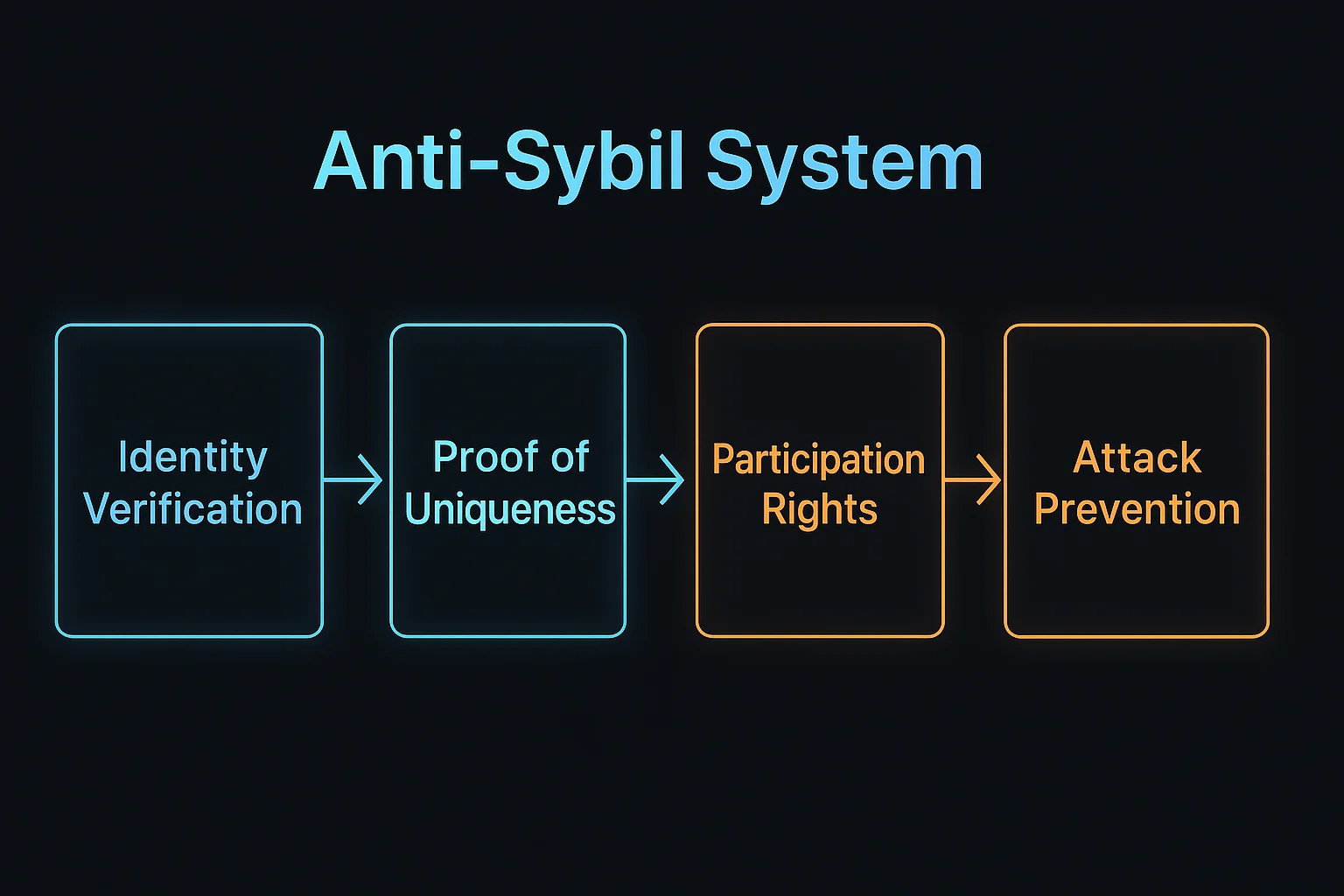
Anti-Sybil system diagram showing identity verification, uniqueness proof, participation rights, and attack prevention

Real-World Examples

  • Gitcoin Grants uses Gitcoin Passport to verify unique human participants in quadratic funding
  • Proof of Humanity creates registries of verified unique humans for various applications
  • BrightID provides decentralized identity verification through social graph analysis

Why Beginners Should Care

Fair distribution depends on anti-Sybil measures to prevent wealthy actors from claiming multiple shares of airdrops or governance power.

Privacy trade-offs as effective anti-Sybil systems often require revealing personal information or social connections.

System integrity for democratic governance and fair resource allocation across crypto protocols and DAOs.

Related Terms: Sybil Attack, Quadratic Funding, Governance

Back to Crypto Glossary

Similar Posts

  • Digital Securities

    Digital Securities: Blockchain-Based Financial InstrumentsDigital securities are traditional financial instruments like stocks and bonds represented as tokens on blockchain networks. They're like digitizing paper stock certificates to work on the internet.Digital securities are blockchain-based tokens that represent ownership in traditional financial instruments such as stocks, bonds, or real estate, subject to securities regulations. These bridge conventional…

  • Supply

    Supply: Total Token Quantity AvailableSupply refers to the total amount of cryptocurrency tokens available, including those in circulation, locked up, or held by various parties. It's a fundamental economic factor affecting token value.Supply encompasses all cryptocurrency tokens that exist or will exist, including circulating supply available for trading and locked supply held by teams, investors,…

  • Restaking

    Restaking: Double-Duty for Staked Assets Restaking allows already-staked cryptocurrency to secure additional networks and earn extra rewards. It’s like getting paid twice for the same job, but with twice the risk. Restaking is a mechanism that allows staked cryptocurrency to simultaneously secure multiple networks or protocols, earning additional rewards beyond the base staking yield. Validators…

  • AMM

    AMM: Automated Market MakingAutomated Market Makers use mathematical formulas to price assets and facilitate trading without traditional order books. They're like vending machines for cryptocurrency trading.An Automated Market Maker (AMM) is a decentralized exchange mechanism that uses mathematical algorithms to price assets and facilitate trading through liquidity pools instead of order books. AMMs enable constant liquidity…

  • Liquidity Lock

    Liquidity Lock: Securing Trading LiquidityLiquidity lock prevents withdrawal of trading liquidity for specified time periods to ensure market stability and prevent rug pulls. It's like putting trading funds in a time-locked safe that can't be opened early.Liquidity lock refers to mechanisms that prevent withdrawal of liquidity provider tokens or trading pair liquidity for predetermined time…

  • Anonymity

    Anonymity: Hiding Identity in Digital TransactionsAnonymity in cryptocurrency refers to the ability to conduct transactions without revealing personal identity. It's like wearing a mask that completely hides who you are during financial transactions.Anonymity refers to the state of being unidentifiable in cryptocurrency transactions and blockchain interactions. True anonymity means that transaction participants cannot be linked to…