
Delegated Proof of Stake (DPoS)

Delegated Proof of Stake (DPoS): Democratic Validation

DPoS lets token holders vote for validators who secure the network on their behalf. It’s like electing representatives to Congress, but for blockchain consensus.

Delegated Proof of Stake (DPoS) is a consensus mechanism where token holders vote for a limited number of delegates who validate transactions and secure the network. This creates a more scalable system than pure Proof of Stake while maintaining democratic participation.

How DPoS Works

Voting power corresponds to token holdings, allowing larger stakeholders to have more influence over delegate selection while still enabling smaller holders to participate.

Fixed validator sets typically include 21-101 elected delegates who take turns producing blocks, creating faster consensus than systems with thousands of validators.

Continuous elections let token holders change their votes at any time, removing poorly performing delegates and encouraging good behavior through threat of replacement.
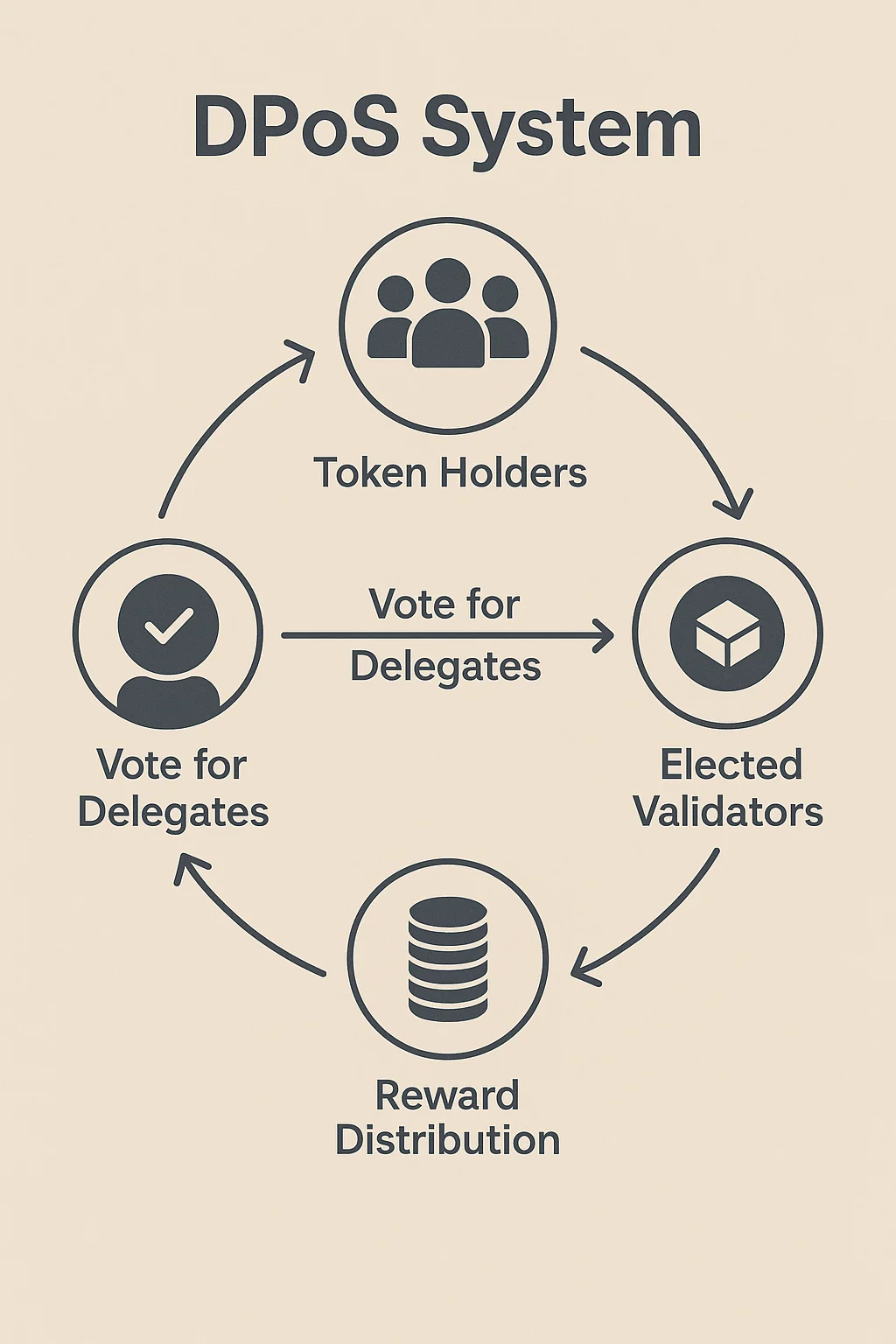
Infographic showing how Delegated Proof of Stake works, with token holders voting for delegates who become validators, produce blocks, and distribute rewards

Real-World Examples

  • EOS blockchain uses 21 elected block producers chosen by token holder voting
  • Tron (TRX) employs 27 Super Representatives elected through continuous voting
  • Lisk uses 101 delegates selected by stakeholder voting for network validation

Why Beginners Should Care

Faster transactions result from smaller validator sets that can reach consensus more quickly than systems requiring agreement from thousands of nodes.

Political dynamics emerge as delegates campaign for votes, form alliances, and compete for positions, sometimes leading to centralization concerns.

Voter apathy can concentrate power among a few large stakeholders if smaller token holders don’t actively participate in delegate selection.

Related Terms: Proof of Stake, Validator, Consensus Mechanism, Governance

Back to Crypto Glossary

Similar Posts

  • Cross Chain Communication

    Cross Chain Communication: Blockchain Network MessagingCross-chain communication enables different blockchain networks to exchange information and coordinate actions. It's like having universal translators that help different blockchain languages understand each other.Cross-chain communication refers to protocols and technologies that enable different blockchain networks to exchange data, verify states, and coordinate actions across network boundaries. This enables interoperability and…

  • Collateral Ratio

    Collateral Ratio: Loan Security MeasurementCollateral ratio measures the value of assets securing a loan compared to the loan amount. It's like the down payment percentage when buying a house with a mortgage.Collateral ratio is the percentage relationship between the value of collateral assets and the amount borrowed against them. Higher ratios provide more security for lenders…

  • DeFi Aggregator

    DeFi Aggregator: Finding the Best Yields DeFi aggregators automatically find the best rates across multiple protocols for lending, borrowing, or trading. They’re like Expedia for decentralized finance. A DeFi aggregator is a platform that searches multiple protocols to find the best rates, yields, or liquidity for users’ specific needs. Instead of manually checking dozens of…

  • Governance Token

    Governance Token: Voting Rights in CryptoGovernance tokens provide holders with voting rights in decentralized protocols and organizations. They're like shares in a company, but for decentralized projects where the community makes decisions.A governance token is a cryptocurrency that grants holders voting rights over protocol changes, treasury allocation, and other governance decisions in decentralized projects. These tokens…

  • DEX Aggregator

    DEX Aggregator: Optimal Trading Route FinderDEX aggregators find the best prices across multiple decentralized exchanges for cryptocurrency trades. They're like price comparison websites that automatically execute trades at the best available rates.A DEX aggregator is a service that compares prices and liquidity across multiple decentralized exchanges to find optimal trading routes for cryptocurrency swaps. These platforms…

  • Mobile Wallet

    Mobile Wallet: Cryptocurrency on Your PhoneMobile wallets are smartphone applications that store, send, and receive cryptocurrency. They're like having a digital bank in your pocket with global reach.A mobile wallet is a smartphone application that enables users to store, manage, and transact with cryptocurrencies directly from their mobile devices. These wallets prioritize convenience and accessibility for…