
Proof of Stake (PoS)

Proof of Stake (PoS): Energy-Efficient Consensus

Proof of Stake secures blockchain networks through economic staking rather than energy-intensive mining. It’s like replacing a gold rush with a security deposit system.

Proof of Stake (PoS) is a consensus mechanism where validators are chosen to create new blocks based on their stake in the network rather than computational power. Validators put up cryptocurrency as collateral and earn rewards for honest participation.

How Proof of Stake Works

Stake-based selection chooses validators to propose and validate blocks based on the amount of cryptocurrency they’ve locked up as collateral.

Economic security aligns validator incentives through rewards for honest behavior and penalties (slashing) for malicious actions or poor performance.

Energy efficiency eliminates the need for energy-intensive mining since validators are selected through economic mechanisms rather than computational competition.
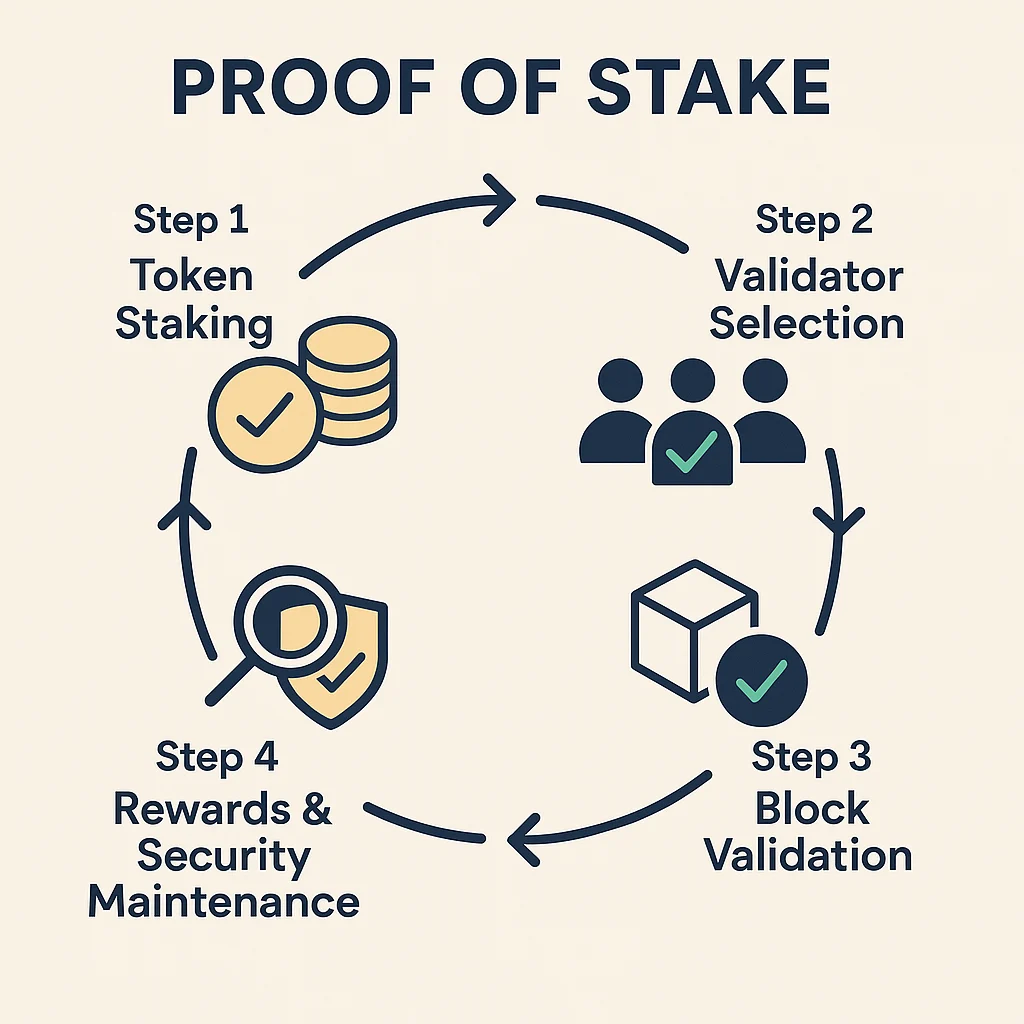
Infographic showing the Proof of Stake cycle: token staking, validator selection, block validation, rewards distribution, and security maintenance

Real-World Examples

  • Ethereum 2.0 transitioned from Proof of Work to Proof of Stake in 2022, reducing energy consumption by 99%+
  • Cardano built on Proof of Stake from launch with focus on peer-reviewed development
  • Polkadot uses nominated Proof of Stake with delegation to professional validators

Why Beginners Should Care

Environmental benefits make PoS networks much more sustainable than energy-intensive Proof of Work mining.

Participation opportunities allow token holders to earn staking rewards by helping secure networks without specialized mining hardware.

Different trade-offs compared to Proof of Work in terms of decentralization, security assumptions, and wealth concentration dynamics.

Related Terms: Staking, Validator, Slashing, Proof of Work

Back to Crypto Glossary

Similar Posts

  • Node

    Node: The Network’s Backbone Nodes are individual computers that maintain copies of the blockchain and enforce network rules. They’re the distributed infrastructure that makes cryptocurrency possible. A node is a computer that participates in a blockchain network by maintaining a copy of the distributed ledger and relaying transactions. Nodes validate transactions, store blockchain history, and…

  • Slippage

    Slippage: The Cost of Market Impact Slippage is the difference between expected and actual trade prices. It’s the tax you pay for moving markets when your trade is large relative to available liquidity. Slippage occurs when the execution price of a trade differs from the expected price due to market movement or insufficient liquidity. Large…

  • Verification

    Verification: Confirming Accuracy and AuthenticityVerification is the process of confirming that information, transactions, or claims are accurate and authentic without requiring trust in the information source. It's like being able to personally test that a diamond is real using scientific instruments instead of just believing the jeweler's word.Verification refers to the mathematical and cryptographic processes…

  • DeFi Composability

    DeFi Composability: Building Block Finance DeFi composability allows protocols to integrate seamlessly, creating complex financial products by combining simpler components. It’s like financial Lego blocks that snap together perfectly. DeFi composability refers to the ability of decentralized finance protocols to interact and build upon each other, creating more complex financial products through modular integration. This…

  • Satoshi

    Satoshi: Bitcoin's Smallest UnitA satoshi is the smallest unit of bitcoin, equal to 0.00000001 BTC. It's named after Bitcoin's pseudonymous creator and makes bitcoin divisible for everyday transactions.A satoshi (sat) is the smallest divisible unit of bitcoin, representing one hundred millionth of a bitcoin. This granular divisibility enables bitcoin to function as digital cash for transactions…

  • Circulating Supply

    Circulating Supply: Tokens Available for TradingCirculating supply represents the number of cryptocurrency tokens currently available for public trading and use. It's like counting how much money is actually in circulation versus locked away.Circulating supply refers to the number of cryptocurrency tokens that are publicly available and actively trading in the market. This excludes tokens that are…