
Node

Node: The Network’s Backbone

Nodes are individual computers that maintain copies of the blockchain and enforce network rules. They’re the distributed infrastructure that makes cryptocurrency possible.

A node is a computer that participates in a blockchain network by maintaining a copy of the distributed ledger and relaying transactions. Nodes validate transactions, store blockchain history, and help maintain network decentralization.

How Nodes Work

Full nodes download and validate every transaction and block in the blockchain’s history, ensuring all network rules are followed. They can independently verify the entire network state.

Light nodes (or SPV nodes) download only block headers and specific transactions they need, relying on full nodes for complete validation while using less storage and bandwidth.

Network communication happens through peer-to-peer connections where nodes share new transactions and blocks with their connected peers, propagating information across the entire network.
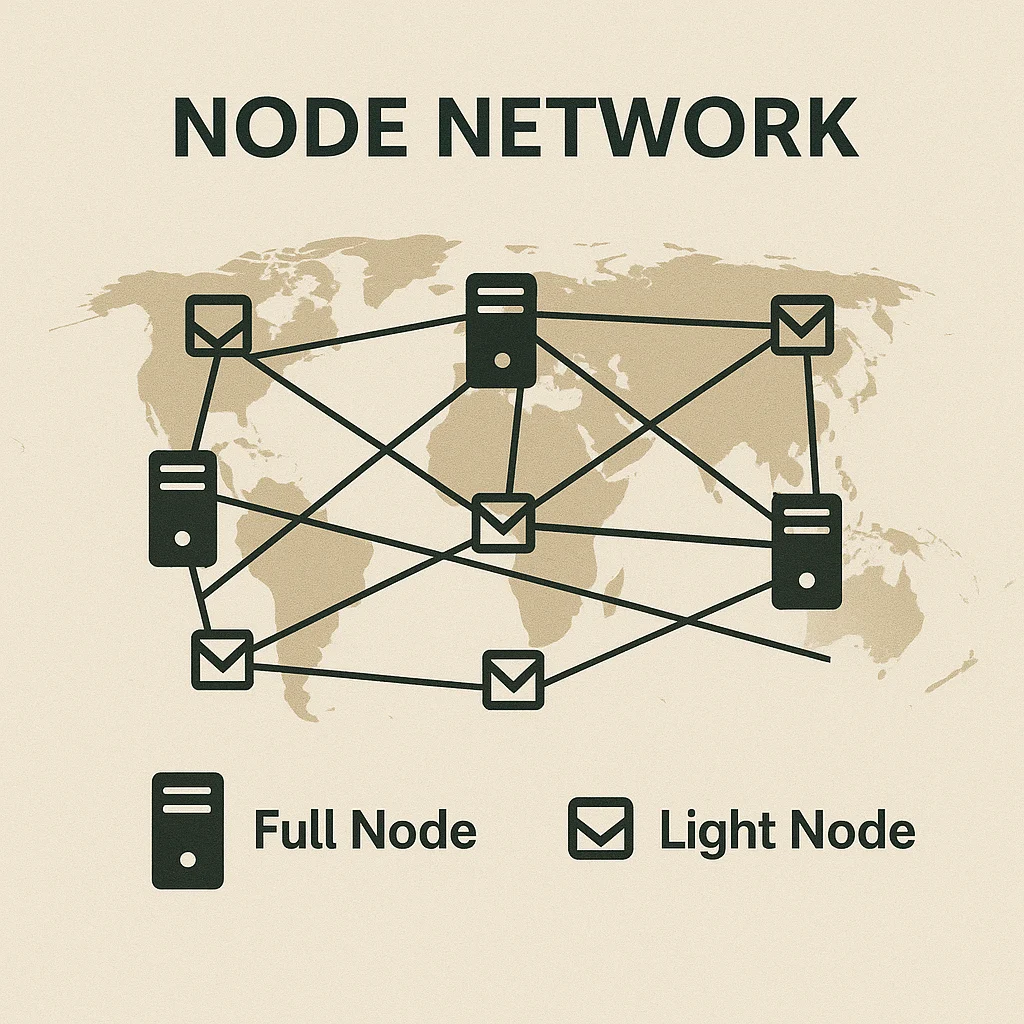
Infographic showing a global node network with full nodes and light nodes connected peer-to-peer across a world map

Real-World Examples

  • Bitcoin Core – Reference implementation running on thousands of full nodes worldwide
  • Ethereum Geth – Popular Ethereum node software maintaining network state
  • Raspberry Pi nodes – Affordable home setups contributing to network decentralization

Why Beginners Should Care

Node diversity strengthens network decentralization and censorship resistance. More independent node operators mean less reliance on centralized infrastructure providers.

Running a node gives you direct access to the blockchain without trusting third parties like exchanges or wallet providers to give you accurate information.

Technical requirements include reliable internet, adequate storage (500GB+ for Bitcoin), and basic technical knowledge for setup and maintenance.

Related Terms: Full Node, Light Node, Peer-to-Peer, Decentralization

Back to Crypto Glossary

Similar Posts

  • Ring Signatures

    Ring Signatures: Anonymous Group AuthorizationRing signatures enable one member of a group to create signatures on behalf of the group without revealing which specific member signed. It's like having a group of people where any one can speak for the group anonymously, but observers know the statement came from a legitimate group member.Ring signatures are…

  • NFT (Non-Fungible Token)

    NFT (Non-Fungible Token): Digital Ownership Certificates NFTs transformed JPEGs into million-dollar assets and made digital ownership mainstream. Love them or hate them, they’re reshaping how we think about digital property. A Non-Fungible Token (NFT) is a unique digital certificate stored on a blockchain that proves ownership of a specific digital asset. Unlike cryptocurrencies where each…

  • Altcoin

    Altcoin: Every Cryptocurrency That Isn’t Bitcoin “Altcoin” literally means “alternative to Bitcoin.” Some are innovative improvements, others are marketing experiments, and many are outright scams. An altcoin is any cryptocurrency other than Bitcoin. The term covers everything from Ethereum’s smart contract platform to obscure meme coins with dog themes. How Altcoins Work Each altcoin attempts…

  • Conservative Investing

    Conservative Investing: Low-Risk Investment ApproachConservative investing prioritizes capital preservation and steady returns over high-risk, high-reward strategies. It's like choosing the scenic route that takes longer but is much safer than the dangerous mountain pass.Conservative investing refers to investment strategies that prioritize capital preservation and risk reduction over maximum returns, typically focusing on established assets and…

  • Throughput

    Throughput: Network Processing CapacityThroughput measures how many transactions a blockchain network can process per second. It's like measuring how many cars can drive through a highway during rush hour.Throughput refers to the number of transactions a blockchain network can process within a given time period, typically measured in transactions per second (TPS). Higher throughput enables more…

  • Wallet Integration

    Wallet Integration: Seamless Application ConnectivityWallet integration enables applications to connect with cryptocurrency wallets for user authentication and transaction processing. It's like having a universal credit card reader that works with every type of payment card, making transactions smooth and effortless.Wallet integration refers to the technical implementation that allows decentralized applications to connect with various cryptocurrency…