
Decentralization

Decentralization: Power to the People

Decentralization distributes control away from single authorities across many independent participants. It’s the difference between having one king versus a thousand voters making decisions.

Decentralization refers to the distribution of power, control, and decision-making away from central authorities to a network of independent participants. In blockchain systems, this means no single entity controls the network, transactions, or governance decisions.

How Decentralization Works

Distributed control spreads network operations across thousands of independent nodes, miners, or validators who collectively maintain system integrity without central coordination.

Consensus mechanisms enable distributed networks to agree on valid transactions and network state without requiring trust in central authorities or intermediaries.

Resistance benefits make decentralized systems harder to shut down, censor, or manipulate since attackers would need to compromise many independent participants simultaneously.
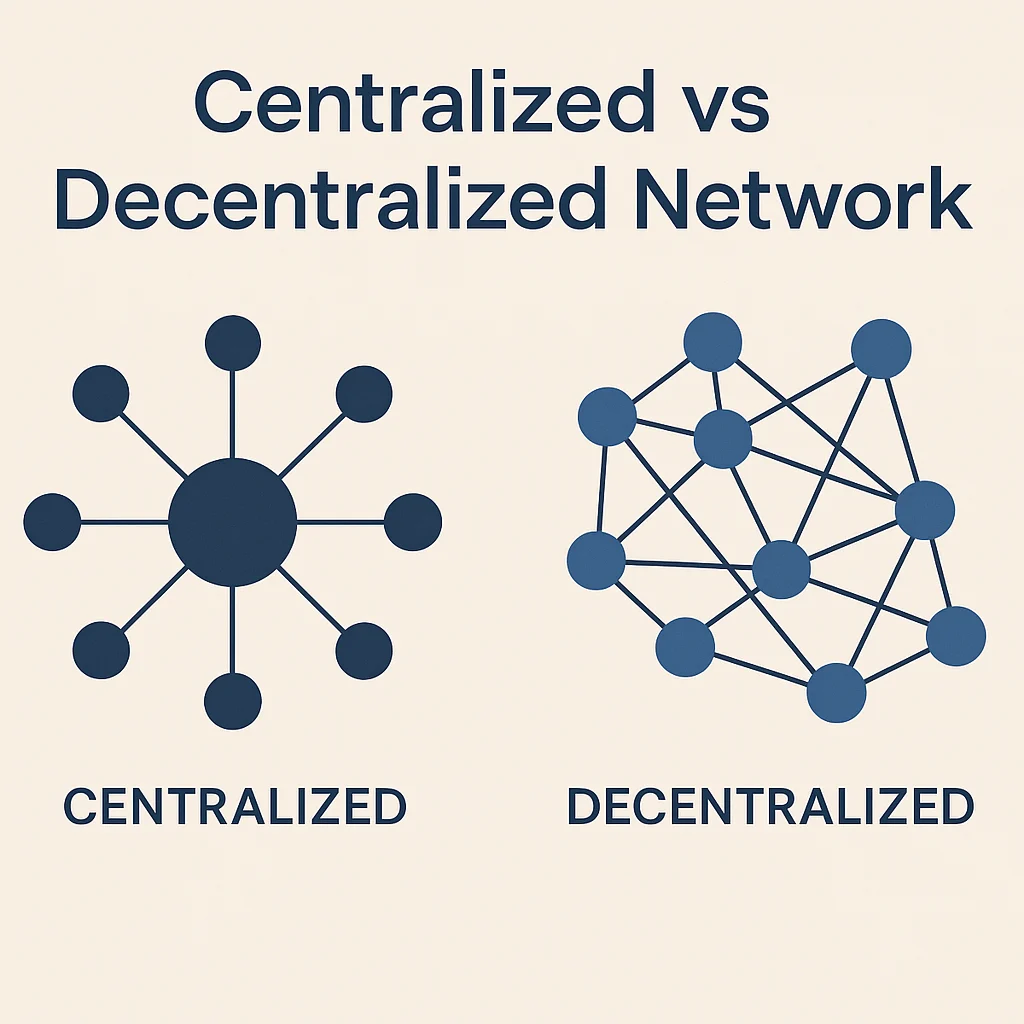
Infographic comparing centralized hub-and-spoke topology with a distributed mesh of interconnected nodes to illustrate decentralization

Real-World Examples

  • Bitcoin network operates through thousands of independent miners and nodes worldwide
  • Ethereum validators secure the network through distributed proof-of-stake consensus
  • Traditional internet vs decentralized protocols like IPFS for file storage

Why Beginners Should Care

Censorship resistance means decentralized networks can operate even when governments or corporations try to shut them down or restrict access.

Reduced single points of failure create more robust systems that continue operating even when some participants go offline or become unreliable.

Trade-off awareness as decentralization often means slower decision-making and coordination compared to centralized systems, but with greater resilience and fairness.

Related Terms: Consensus Mechanism, Node, Peer-to-Peer, Governance

Back to Crypto Glossary

Similar Posts

  • Wallet Integration

    Wallet Integration: Seamless Application ConnectivityWallet integration enables applications to connect with cryptocurrency wallets for user authentication and transaction processing. It's like having a universal credit card reader that works with every type of payment card, making transactions smooth and effortless.Wallet integration refers to the technical implementation that allows decentralized applications to connect with various cryptocurrency…

  • Democratic Governance

    Democratic Governance: Community-Controlled Decision MakingDemocratic governance enables community members to participate in project decisions through voting and proposal systems. It's like having a democracy where token holders are the citizens.Democratic governance refers to decision-making systems where community members have voting rights and influence over project direction, protocol changes, and resource allocation. Token holdings typically determine voting…

  • Chain Split

    Chain Split: Blockchain Network DivisionA chain split occurs when a blockchain network divides into multiple incompatible chains, often due to disagreements about protocol changes. It's like a road splitting into different paths that can't be merged back together.A chain split refers to the division of a blockchain network into two or more incompatible chains, typically…

  • Block Confirmation

    Block Confirmation: Transaction Security VerificationBlock confirmation refers to the number of blocks added to the blockchain after a transaction, indicating its security level. It's like waiting for concrete to fully harden before considering construction complete.Block confirmation is the number of blocks that have been added to the blockchain after the block containing a specific transaction. More…

  • FUD (Fear, Uncertainty, Doubt)

    FUD: Fear, Uncertainty, and Doubt FUD is FOMO’s evil twin. While FOMO makes you buy at peaks, FUD makes you sell at bottoms. Understanding FUD helps you think clearly when markets panic. FUD stands for Fear, Uncertainty, and Doubt – negative sentiment spread to influence crypto prices downward. Sometimes it’s legitimate concerns, often it’s manufactured…

  • Token Allocation

    Token Allocation: Distributing Digital AssetsToken allocation determines how cryptocurrency tokens are distributed among different stakeholders like teams, investors, and communities. It's the blueprint for who gets what in crypto projects.Token allocation refers to the distribution plan for cryptocurrency tokens among various stakeholder groups including development teams, early investors, community members, and ecosystem development funds. This distribution…