
Consensus Mechanism

Consensus Mechanism: How Networks Agree

Consensus mechanisms solve the fundamental problem of getting thousands of independent computers to agree on a single version of truth without central authority.

A consensus mechanism is the process by which a distributed network of nodes agrees on the validity of transactions and the current state of the blockchain. It ensures all participants have the same version of the ledger without needing to trust each other.

How Consensus Mechanisms Work

Byzantine Fault Tolerance addresses the challenge of reaching agreement when some network participants might be malicious or unreliable. Consensus protocols must work even with bad actors present.

Economic incentives encourage honest behavior through rewards for following protocol rules and penalties for attempting to cheat or attack the network.

Different approaches trade off between security, speed, and energy consumption. No consensus mechanism is perfect – each makes compromises based on network priorities.
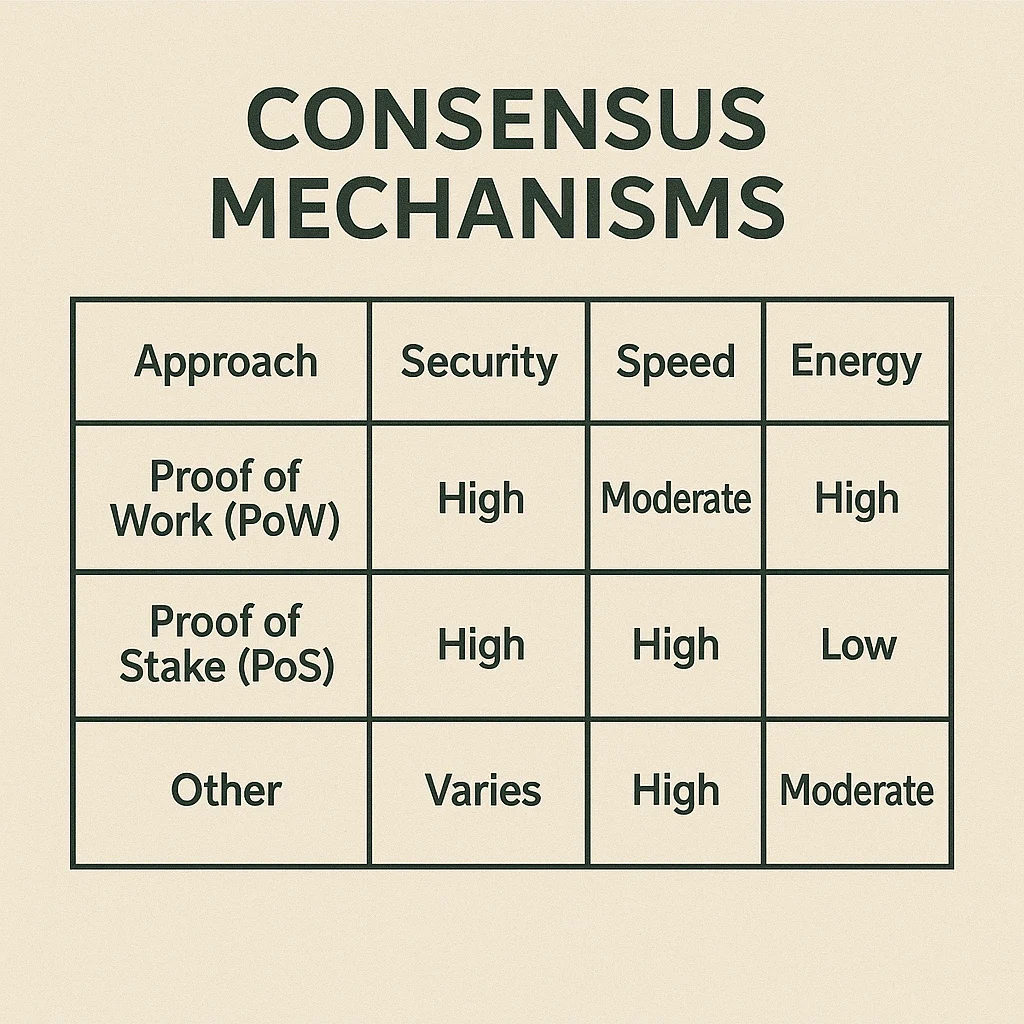
Infographic table comparing Proof of Work (PoW), Proof of Stake (PoS), and Other consensus mechanisms by security, speed, and energy usage

Real-World Examples

  • Proof of Work – Bitcoin’s energy-intensive but proven secure consensus mechanism
  • Proof of Stake – Ethereum’s switch to more energy-efficient validation through economic staking
  • Delegated Proof of Stake – EOS and other networks using representative validation systems

Why Beginners Should Care

Consensus choice fundamentally affects a blockchain’s security, decentralization, and environmental impact. Understanding these trade-offs helps evaluate different cryptocurrency projects.

Network security depends on consensus mechanism design and adoption. Newer or experimental consensus methods may have undiscovered vulnerabilities.

Energy debates often center on consensus mechanisms, with Proof of Work consuming significant electricity while alternatives use far less energy but have different security assumptions.

Related Terms: Proof of Work, Proof of Stake, Validator, Mining

Back to Crypto Glossary

Similar Posts

  • Circulating Supply

    Circulating Supply: Tokens Available for TradingCirculating supply represents the number of cryptocurrency tokens currently available for public trading and use. It's like counting how much money is actually in circulation versus locked away.Circulating supply refers to the number of cryptocurrency tokens that are publicly available and actively trading in the market. This excludes tokens that are…

  • Capital Preservation

    Capital Preservation: Protecting Investment PrincipalCapital preservation focuses on protecting the original investment amount rather than maximizing returns. It's like choosing a safe over a lottery ticket for your money.Capital preservation is an investment strategy that prioritizes protecting the original principal amount over generating high returns. This conservative approach minimizes downside risk while accepting lower potential upside.How…

  • Price Impact

    Price Impact: Trade Size Effect on Market PricesPrice impact refers to how trading activity affects cryptocurrency prices, particularly when large orders move markets significantly. It's like how jumping into a small pool creates bigger waves than jumping into an ocean.Price impact is the effect that trading activity has on cryptocurrency prices, with larger trades typically…

  • Satoshi

    Satoshi: Bitcoin's Smallest UnitA satoshi is the smallest unit of bitcoin, equal to 0.00000001 BTC. It's named after Bitcoin's pseudonymous creator and makes bitcoin divisible for everyday transactions.A satoshi (sat) is the smallest divisible unit of bitcoin, representing one hundred millionth of a bitcoin. This granular divisibility enables bitcoin to function as digital cash for transactions…

  • Validator Jailing

    Validator Jailing: Temporary Network Punishment Validator jailing temporarily removes misbehaving validators from consensus participation while allowing them to return after penalties. It’s like being sent to the penalty box in hockey. Validator jailing is a punishment mechanism that temporarily excludes validators from consensus participation and rewards due to violations like extended downtime or rule infractions….

  • ENS

    ENS: Ethereum Name ServiceENS provides human-readable names for Ethereum addresses, making cryptocurrency transactions more user-friendly. It's like having domain names for websites instead of remembering IP addresses.Ethereum Name Service (ENS) is a decentralized naming system that maps human-readable names to Ethereum addresses, smart contracts, and other identifiers. ENS makes blockchain interactions more accessible by replacing complex…