
Layer 1

Layer 1: The Foundation Blockchain

Layer 1 refers to the base blockchain protocol that processes transactions and maintains consensus. It’s the foundation that everything else builds on top of.

Layer 1 (L1) is the main blockchain network that handles transaction processing, consensus, and security independently without relying on other blockchains. These are the foundational networks like Bitcoin and Ethereum that other solutions build upon.

How Layer 1 Blockchains Work

Complete functionality includes transaction processing, consensus mechanisms, security validation, and native token economics all within the base protocol.

Independence means L1 networks operate without requiring other blockchains for basic functionality like transaction settlement or security.

Scalability limitations often exist as L1s prioritize security and decentralization over transaction throughput, leading to development of Layer 2 solutions.
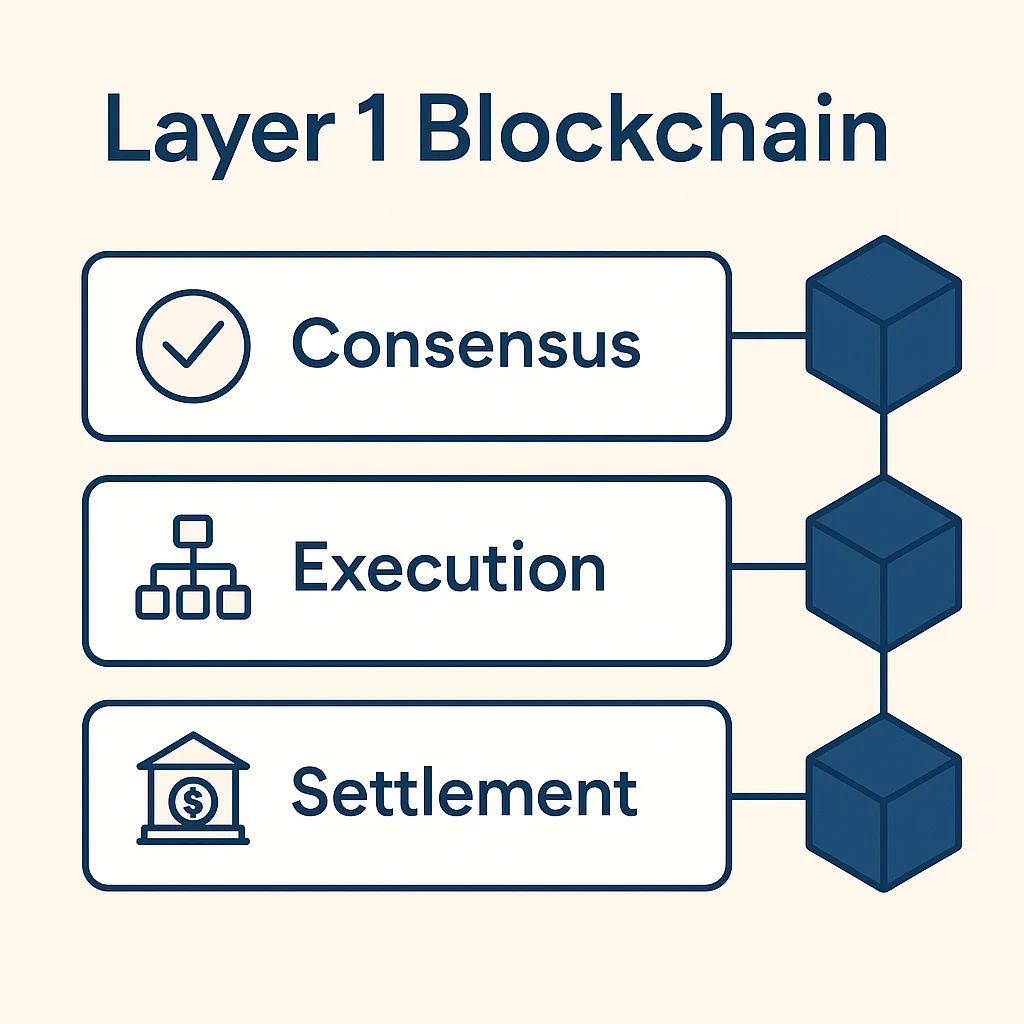
Infographic showing Layer 1 blockchain architecture with consensus, execution, and settlement integrated into a single stack

Real-World Examples

  • Bitcoin – The original Layer 1 focused on peer-to-peer digital payments
  • Ethereum – Smart contract platform that enabled DeFi and NFT ecosystems
  • Solana – High-performance L1 optimized for speed and low costs

Why Beginners Should Care

Foundation understanding helps explain why different blockchains have different capabilities, costs, and security models.

Investment considerations as Layer 1 tokens often represent bets on which fundamental blockchain infrastructure will succeed long-term.

Ecosystem effects since applications built on specific L1s inherit their security, performance, and economic characteristics.

Related Terms: Layer 2, Consensus Mechanism, Base Layer, Blockchain Trilemma

Back to Crypto Glossary

Similar Posts

  • FUD (Fear, Uncertainty, Doubt)

    FUD: Fear, Uncertainty, and Doubt FUD is FOMO’s evil twin. While FOMO makes you buy at peaks, FUD makes you sell at bottoms. Understanding FUD helps you think clearly when markets panic. FUD stands for Fear, Uncertainty, and Doubt – negative sentiment spread to influence crypto prices downward. Sometimes it’s legitimate concerns, often it’s manufactured…

  • Stealth Address

    Stealth Address: Private Payment DestinationsStealth addresses create unique, one-time addresses for each transaction to enhance privacy by breaking the link between payments and recipient identities. They're like using a different PO box for every package delivery so no one can track all your mail to the same location.Stealth addresses are unique, one-time payment destinations generated…

  • Timelock

    Timelock: Time-Based Access ControlTimelock mechanisms prevent access to funds or functions until predetermined time conditions are met. It's like having a safe that only opens at specific times.A timelock is a smart contract feature that restricts access to funds, functions, or actions until a specified time period has elapsed. These mechanisms provide security through delayed execution…

  • Liquidity Bootstrapping

    Liquidity Bootstrapping: Fair Token Launch Mechanism Liquidity bootstrapping uses gradually declining prices to enable fair token distribution while building trading liquidity. It’s like having a reverse auction that creates a fair market price. Liquidity bootstrapping is a token launch mechanism that starts with high prices that gradually decrease over time, allowing market forces to discover…

  • HODL

    HODL: The Art of Doing Nothing HODL started as a typo but became crypto’s most important investment strategy. Sometimes the best move is not moving at all. HODL means holding cryptocurrency long-term regardless of short-term price volatility, derived from a misspelled “hold” in a 2013 Bitcoin forum post. It represents the strategy of buying and…

  • Reputation System

    Reputation System: Building Digital TrustReputation systems track and score user behavior to enable trust and coordination in decentralized environments. They're like credit scores but for overall trustworthiness and competence.A reputation system records and evaluates user actions, contributions, and behavior to create trustworthiness scores that enable cooperation in decentralized systems. These systems help identify reliable participants without…