
Mining

Mining: How New Bitcoins Are Created

Bitcoin mining is the process that creates new bitcoins and secures the network. It’s like a global lottery where miners compete to solve mathematical puzzles for rewards.

Mining is the computational process of validating transactions and adding new blocks to a blockchain while earning newly created cryptocurrency as rewards. Miners use specialized hardware to compete for the right to create the next block.

How Mining Works

Proof of Work requires miners to find a specific number (called a nonce) that, when combined with transaction data, produces a hash starting with a certain number of zeros. This requires massive computational power and energy.

Block rewards compensate miners for their work – currently 6.25 Bitcoin per block, plus transaction fees. This reward halves every 210,000 blocks (roughly every 4 years).

Mining difficulty automatically adjusts every 2,016 blocks to maintain 10-minute block times regardless of total network computing power.
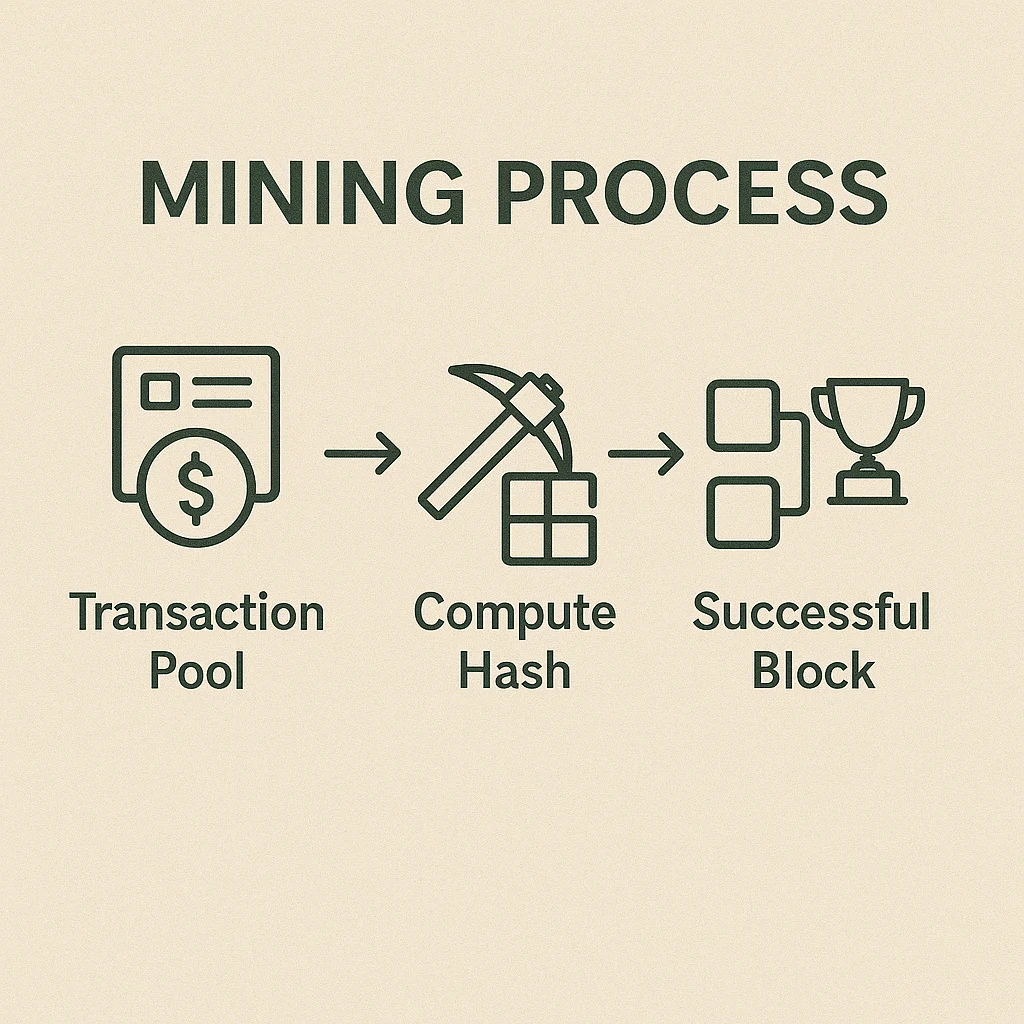
Infographic showing the mining process from transaction pool to hash computation and successful block creation with reward

Real-World Examples

  • ASIC miners like the Antminer S19 Pro can hash at 110 TH/s while consuming 3,250 watts
  • Mining pools combine individual miners’ power to increase chances of earning rewards
  • Large mining farms in countries with cheap electricity dominate hash rate distribution

Why Beginners Should Care

Mining secures the Bitcoin network through decentralized consensus. The more miners participate, the more secure and censorship-resistant Bitcoin becomes.

Individual mining is no longer profitable for most people due to competition from industrial operations. Most retail miners join pools to earn steady, smaller rewards rather than hoping for rare big wins.

Related Terms: Hash Rate, Proof of Work, Block Reward, Mining Pool

Back to Crypto Glossary

Similar Posts

  • Smart Contract Analysis

    Smart Contract Analysis: Code Security EvaluationSmart contract analysis involves examining blockchain code for vulnerabilities, bugs, and security issues before deployment. It's like having a building inspector check the foundation before construction begins.Smart contract analysis refers to the systematic examination of smart contract code to identify security vulnerabilities, logic errors, and potential attack vectors. This process helps…

  • Economic Security

    Economic Security: Financial Incentive ProtectionEconomic security refers to protection mechanisms that use financial incentives and penalties to secure blockchain networks and protocols. It's like having a security system where guards are paid well for protecting property and fined heavily for allowing break-ins.Economic security describes protection mechanisms that use financial incentives, stake requirements, and economic penalties…

  • Storage Rent

    Storage Rent: Pay-per-Use Blockchain StorageStorage rent is a proposed mechanism where users pay ongoing fees for maintaining data on blockchain networks. It's like paying monthly rent for keeping files in cloud storage instead of a one-time purchase.Storage rent refers to fee mechanisms that charge users for ongoing blockchain storage rather than allowing permanent storage after…

  • Hash Function

    Hash Function: One-Way Mathematical TransformationHash functions are mathematical algorithms that convert input data into fixed-size output strings in a way that's easy to compute forward but practically impossible to reverse. They're like digital fingerprints for data.A hash function is a mathematical algorithm that takes input data of any size and produces a fixed-size output (hash)…

  • Algorithmic Trading

    Algorithmic Trading: Automated Trading StrategiesAlgorithmic trading uses computer programs to execute trades based on predetermined rules and market conditions. It's like having a robot trader that never sleeps and follows your strategy perfectly.Algorithmic trading involves using computer algorithms to automatically execute cryptocurrency trades based on predefined strategies, market signals, and risk parameters. These systems can operate…

  • Sovereignty

    Sovereignty: Independent Control and GovernanceSovereignty in blockchain refers to independent control over governance, economics, and technical decisions without external interference. It's like having your own country with its own rules.Sovereignty refers to complete independence and self-governance for blockchain networks, applications, or communities without requiring permission from or dependence on external authorities. This includes technical, economic, and…