
Mining Pool

Mining Pool: Collaborative Block Mining

Mining pools combine computational power from multiple miners to increase chances of finding blocks and earning rewards. It’s like joining a lottery syndicate to improve your odds.

A mining pool is a collaborative group of cryptocurrency miners who combine their computational resources to increase their chances of successfully mining blocks and earning rewards. Pool participants share rewards proportionally based on their contributed computing power.

How Mining Pools Work

Resource pooling combines hash power from many individual miners to compete more effectively against large mining operations.

Reward distribution splits block rewards and transaction fees among pool participants based on their proportional contribution to the pool’s total hash rate.

Consistent payouts provide more regular income compared to solo mining, where individual miners might wait months between successful blocks.
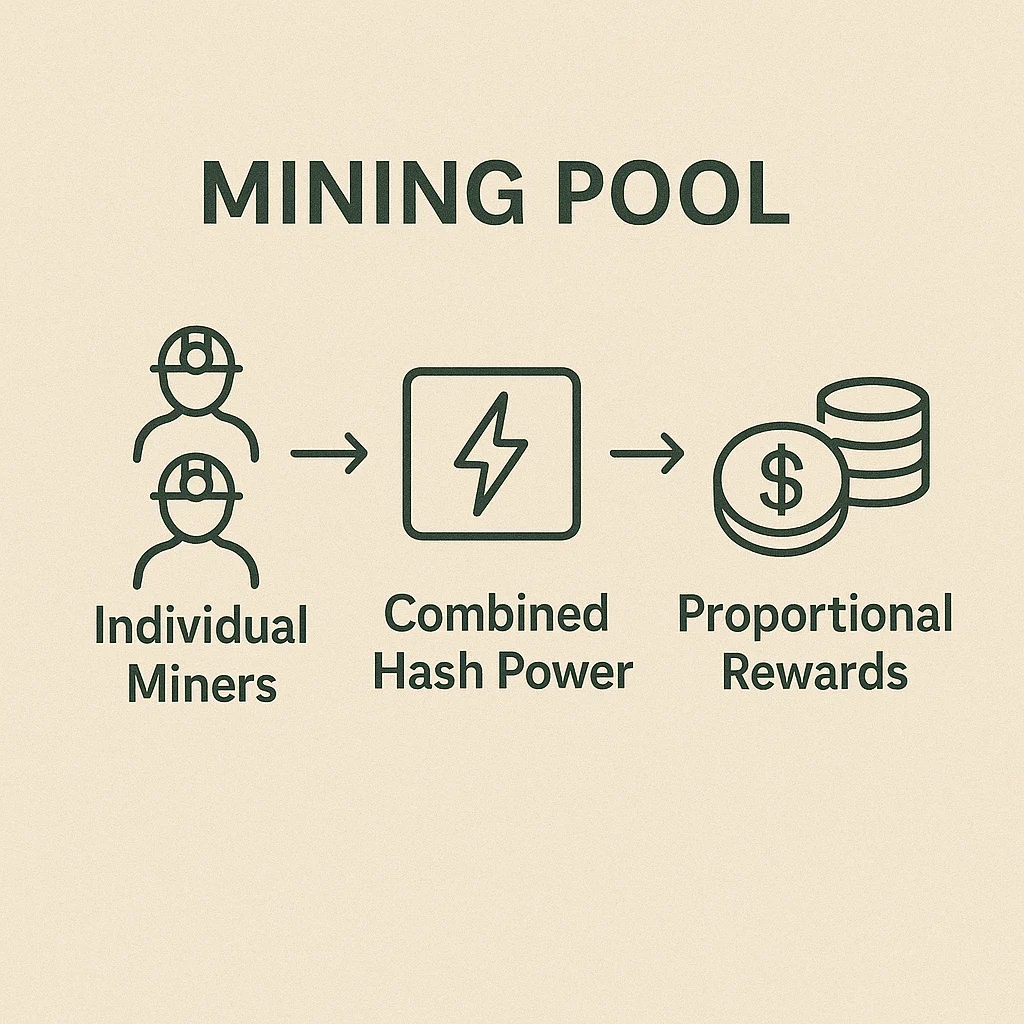
Infographic showing mining pool process from individual miners combining hash power to proportional reward distribution

Real-World Examples

  • Antpool and F2Pool are among the largest Bitcoin mining pools by hash rate
  • Ethereum mining pools like Ethermine dominated before the Proof of Stake transition
  • Small miners typically join pools to receive steady income rather than gambling on solo mining

Why Beginners Should Care

Income stability through pooled mining provides predictable returns rather than the feast-or-famine nature of solo mining.

Lower barriers to mining participation since small miners can earn proportional rewards without needing massive infrastructure investments.

Centralization concerns as large pools could theoretically coordinate to attack networks, though economic incentives discourage this behavior.

Related Terms: Mining, Hash Rate, Block Reward, Proof of Work

Back to Crypto Glossary

Similar Posts

  • Scaling

    Scaling: Handling More TransactionsScaling refers to increasing a blockchain network's capacity to handle more transactions per second without sacrificing security or decentralization. It's the holy grail of blockchain development.Scaling in blockchain technology involves improving transaction throughput, reducing costs, and maintaining performance as networks grow in size and usage. This typically requires technical solutions that balance speed,…

  • Sandwich Attack

    Sandwich Attack: Extracting Value from Your Trades Sandwich attacks place trades before and after your transaction to manipulate prices and extract profit from your slippage. It’s like cutting in line twice – once in front of you and once behind you. A sandwich attack involves placing a buy order immediately before a victim’s trade and…

  • Transaction Privacy

    Transaction Privacy: Protecting Financial InformationTransaction privacy involves keeping cryptocurrency transaction details confidential while maintaining network security and functionality. It's like having a private bank account in a transparent financial system.Transaction privacy refers to techniques and technologies that protect the confidentiality of cryptocurrency transaction details including amounts, participants, and transaction history. This enables financial privacy while maintaining…

  • Consensus Mechanism

    Consensus Mechanism: How Networks Agree Consensus mechanisms solve the fundamental problem of getting thousands of independent computers to agree on a single version of truth without central authority. A consensus mechanism is the process by which a distributed network of nodes agrees on the validity of transactions and the current state of the blockchain. It…

  • Rebase Token

    Rebase Token: Algorithmic Supply Adjustment Rebase tokens automatically adjust their total supply to maintain target prices or economic conditions. It’s like having money that multiplies or divides to keep its buying power constant. A rebase token automatically increases or decreases the total token supply held by all users proportionally to achieve specific economic targets like…

  • Decentralized Identity (DID)

    Decentralized Identity (DID): Self-Sovereign Digital Identity DIDs give users control over their digital identity without relying on centralized authorities like governments or tech companies. It’s like having a passport that you issue and control yourself. Decentralized Identity (DID) is a digital identity framework that gives individuals control over their personal data and identity verification without…