
51% Attack

51% Attack: When Consensus Gets Hijacked

A 51% attack occurs when a single entity controls the majority of a network’s mining power or stake, allowing them to manipulate transactions and double-spend coins.

A 51% attack is when an individual or group controls more than half of a blockchain network’s mining hash rate or staking power, giving them the ability to reverse transactions and manipulate the blockchain. It’s the digital equivalent of hijacking the entire banking system.

How 51% Attacks Work

Majority control allows attackers to mine or validate blocks faster than the honest network, eventually creating a longer chain that becomes the “true” blockchain according to consensus rules.

Double spending becomes possible when attackers reverse their own transactions after receiving goods or services, effectively spending the same coins twice.

Network disruption can halt transaction processing as attackers refuse to include certain transactions in blocks or reorganize the blockchain to exclude them.
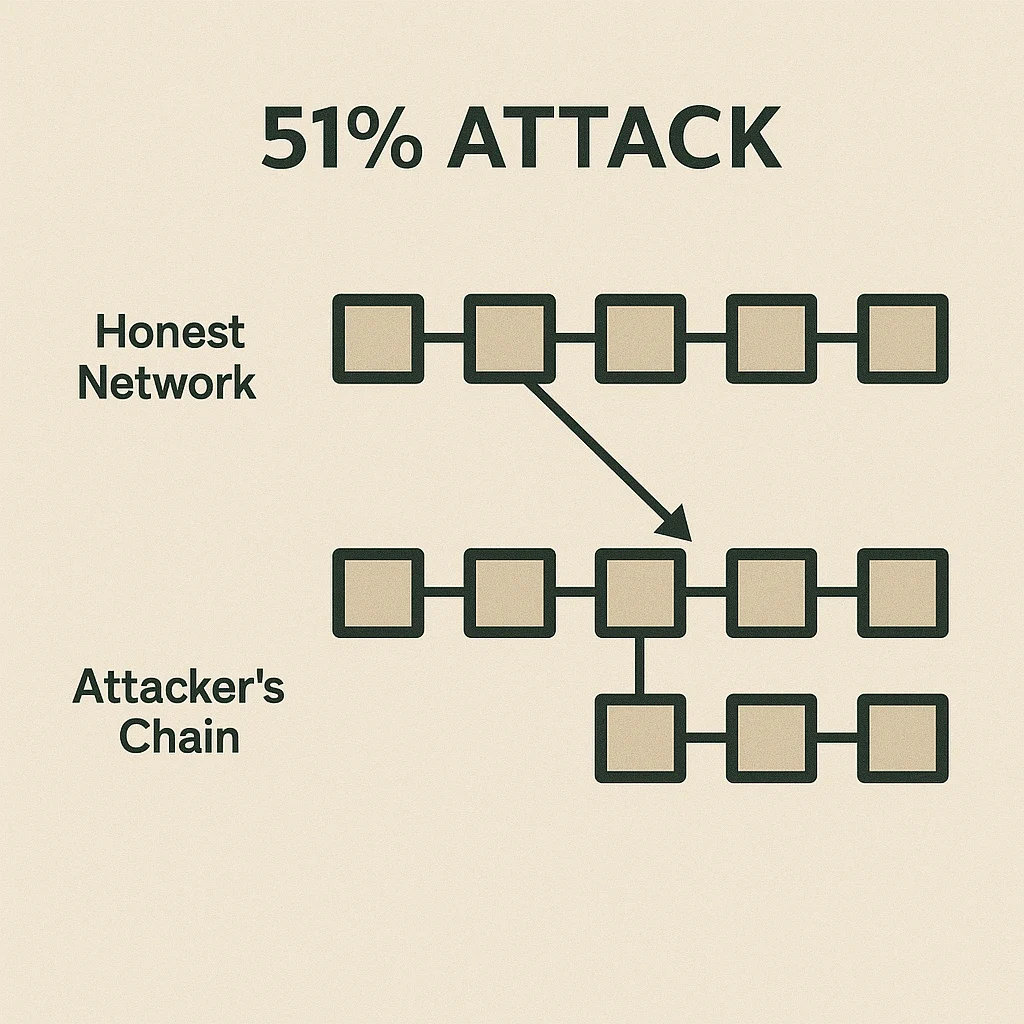
Infographic showing a 51% attack with an honest network and an attacker’s chain that eventually overtakes the main chain

Real-World Examples

  • Bitcoin Gold suffered multiple 51% attacks resulting in millions in double-spent coins
  • Ethereum Classic experienced several attacks after major miners moved to Ethereum mainnet
  • Smaller altcoins are frequent targets due to lower hash rates and cheaper attack costs

Why Beginners Should Care

Network size matters for security. Bitcoin’s massive hash rate makes 51% attacks prohibitively expensive, while smaller networks remain vulnerable to well-funded attackers.

Exchange risks increase during 51% attacks as attackers often target high-value transactions on exchanges through double-spending schemes.

Recovery challenges exist after successful attacks. Networks must decide whether to reverse attacker transactions, which can undermine immutability principles.

Related Terms: Hash Rate, Mining, Consensus Mechanism, Double Spending

Back to Crypto Glossary

Similar Posts

  • Token Sale

    Token Sale: Cryptocurrency Fundraising EventA token sale is an event where new cryptocurrency projects sell tokens to raise funds for development and operations. It's like a crowdfunding campaign but with digital tokens instead of traditional rewards.A token sale is a fundraising mechanism where cryptocurrency projects offer tokens to investors in exchange for capital to fund…

  • Exploit

    Exploit: Taking Advantage of VulnerabilitiesAn exploit is an attack that takes advantage of vulnerabilities in smart contracts or protocols to steal funds or manipulate systems. It's like finding a secret backdoor in a building.An exploit refers to successfully taking advantage of vulnerabilities, bugs, or design flaws in smart contracts, protocols, or systems to extract value…

  • Wallet Drainer

    Wallet Drainer: Malicious Fund Extraction Wallet drainers are malicious smart contracts or applications designed to steal all assets from connected wallets through deceptive transaction approvals. They’re digital pickpockets with smart contract superpowers. A wallet drainer is malicious software that tricks users into signing transactions that grant unlimited access to their cryptocurrency holdings. These attacks often…

  • Permit (EIP-2612)

    Permit (EIP-2612): Gasless Approvals Permit functionality allows token approvals through signatures instead of transactions, enabling gasless user experiences for DeFi interactions. It’s like signing a check instead of going to the bank. Permit (EIP-2612) is a token standard that enables gasless approvals through cryptographic signatures rather than on-chain transactions. Users can authorize token spending without…

  • Autonomous World (AW)

    Autonomous World (AW): Persistent Virtual Realities Autonomous worlds are persistent virtual environments that continue existing and evolving even when no players are actively participating. They’re like having a Minecraft world that keeps running and changing forever. An Autonomous World (AW) is a virtual environment that operates independently through blockchain infrastructure, maintaining state and enabling interactions…

  • Over-Collateralization

    Over-Collateralization: Excess Security DepositsOver-collateralization requires borrowers to deposit assets worth more than their loan amount as security against default. It's like putting down a $15,000 deposit to borrow $10,000, ensuring the lender is protected even if asset values decline.Over-collateralization refers to requiring collateral deposits that exceed the value of loans or borrowed assets, providing additional…