
Autonomous World (AW)

Autonomous World (AW): Persistent Virtual Realities

Autonomous worlds are persistent virtual environments that continue existing and evolving even when no players are actively participating. They’re like having a Minecraft world that keeps running and changing forever.

An Autonomous World (AW) is a virtual environment that operates independently through blockchain infrastructure, maintaining state and enabling interactions without requiring central servers or active management. These worlds persist and evolve according to their programmed rules.

How Autonomous Worlds Work

Blockchain persistence ensures the virtual world continues existing as long as the underlying blockchain operates, independent of any company or server infrastructure.

Player-driven evolution allows inhabitants to modify the world through their actions, with changes permanently recorded on-chain.

Economic sovereignty enables native economies with real value exchange, ownership rights, and governance systems controlled by world inhabitants.
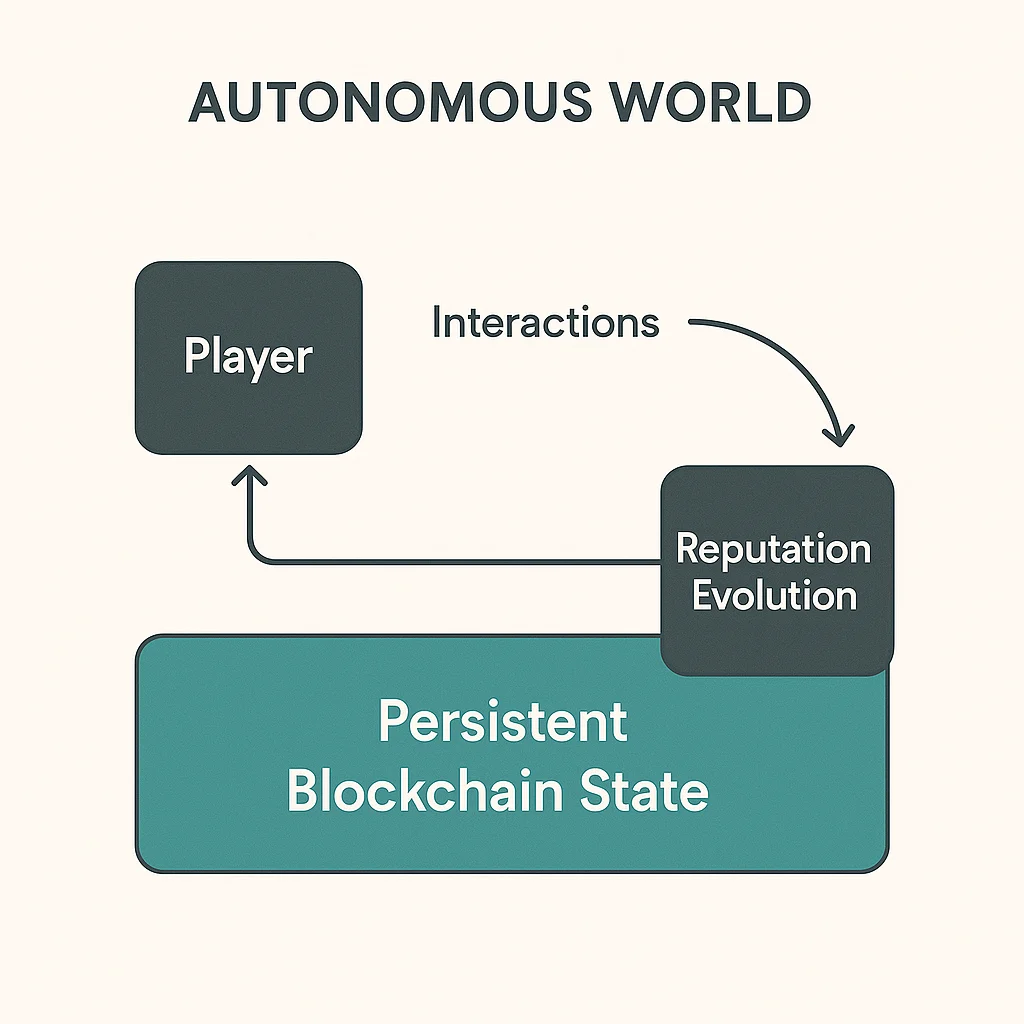
Autonomous world architecture showing player interactions, reputation evolution, and persistent blockchain state enabling independent system behavior.

Real-World Examples

  • Dark Forest – Space exploration game that runs entirely on-chain with hidden information
  • Loot derivatives creating persistent fantasy worlds based on text-based NFTs
  • MUD engine provides infrastructure for building complex autonomous worlds

Why Beginners Should Care

True ownership of virtual assets and land that can’t be taken away by game companies going out of business or changing policies.

Persistent value creation where time and effort invested in virtual worlds retains value indefinitely through blockchain permanence.

Experimental economics as autonomous worlds become laboratories for testing new forms of governance, economics, and social organization.

Related Terms: Metaverse, On-Chain Gaming, Virtual Real Estate, Persistence

Back to Crypto Glossary

Similar Posts

  • Cross Chain Communication

    Cross Chain Communication: Blockchain Network MessagingCross-chain communication enables different blockchain networks to exchange information and coordinate actions. It's like having universal translators that help different blockchain languages understand each other.Cross-chain communication refers to protocols and technologies that enable different blockchain networks to exchange data, verify states, and coordinate actions across network boundaries. This enables interoperability and…

  • zk-SNARKs

    zk-SNARKs: Zero-Knowledge Proof Technologyzk-SNARKs are cryptographic proofs that verify information without revealing the underlying data. They're like proving you know a secret without telling anyone what the secret actually is.zk-SNARKs (Zero-Knowledge Succinct Non-Interactive Arguments of Knowledge) are cryptographic proofs that allow verification of computations without revealing the inputs or intermediate steps. This enables privacy and scalability…

  • Multichain Router

    Multichain Router: Cross-Chain Navigation Multichain routers find optimal paths for moving assets between different blockchain networks. They’re like GPS for cross-chain transactions, finding the cheapest and fastest routes. A multichain router is a protocol that automatically finds the best path for transferring assets between different blockchain networks. It compares routes across multiple bridges and chains…

  • Liquidity Pool

    Liquidity Pool: The Fuel That Powers DEX Trading Liquidity pools are why decentralized exchanges work. They’re shared pots of tokens that enable trading without traditional buyers and sellers. A liquidity pool is a collection of tokens locked in a smart contract that provides liquidity for decentralized trading. Instead of matching buy and sell orders, traders…

  • Democratic Governance

    Democratic Governance: Community-Controlled Decision MakingDemocratic governance enables community members to participate in project decisions through voting and proposal systems. It's like having a democracy where token holders are the citizens.Democratic governance refers to decision-making systems where community members have voting rights and influence over project direction, protocol changes, and resource allocation. Token holdings typically determine voting…

  • Verifiable Credentials

    Verifiable Credentials: Tamper-Proof Digital DocumentsVerifiable credentials are digital documents that can be cryptographically verified without contacting the issuing authority. They're like diplomas that anyone can authenticate instantly.Verifiable credentials are digital documents that use cryptographic techniques to enable instant verification of authenticity without requiring contact with the issuing organization. These credentials enable trusted digital identity and qualification…