
Slippage

Slippage: The Cost of Market Impact

Slippage is the difference between expected and actual trade prices. It’s the tax you pay for moving markets when your trade is large relative to available liquidity.

Slippage occurs when the execution price of a trade differs from the expected price due to market movement or insufficient liquidity. Large trades relative to available liquidity create more slippage as they consume multiple price levels.

How Slippage Works

Order book depth determines slippage for traditional exchanges. Large trades consume multiple price levels, with each level offering worse prices than the previous one.

AMM slippage follows mathematical curves where larger trades cause more price impact. A $1000 swap might have 0.1% slippage while a $100,000 swap has 5% slippage.

Market volatility can cause slippage even on small trades when prices move significantly between order submission and execution.
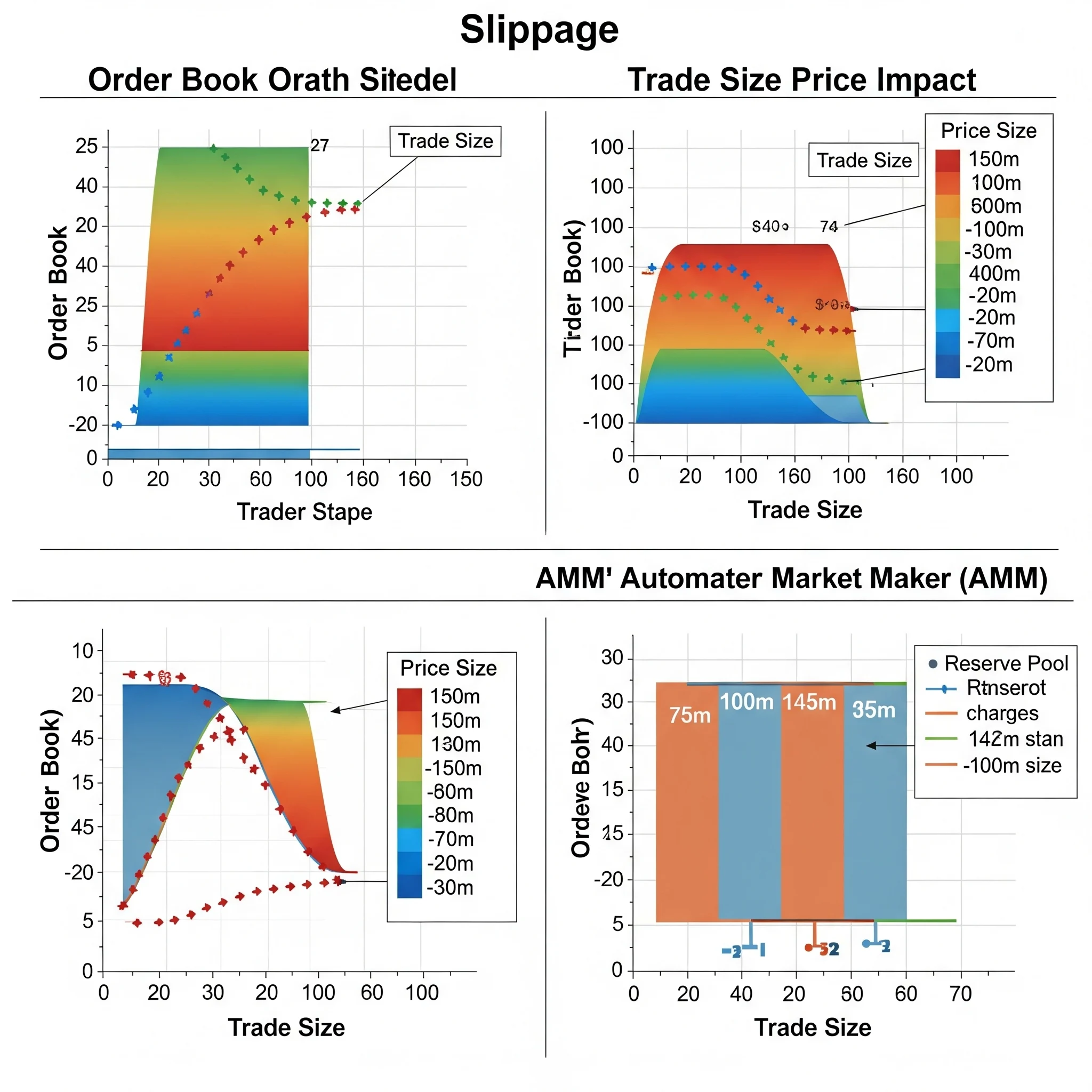
Visualization showing slippage in crypto trading, comparing price impact on order book and AMM models for different trade sizes.

Real-World Examples

  • Large DEX trades on Uniswap can face 5-10% slippage during low liquidity periods
  • Memecoin trading often has extreme slippage due to shallow liquidity pools
  • Front-running bots can increase slippage by trading ahead of pending transactions

Why Beginners Should Care

Hidden costs from slippage can exceed visible trading fees, especially for larger trades or illiquid token pairs with shallow liquidity.

Slippage tolerance settings protect against excessive price impact but may cause transaction failures if markets move beyond acceptable ranges.

Timing matters for reducing slippage – trading during high liquidity periods or splitting large orders into smaller chunks can minimize price impact.

Related Terms: Liquidity, AMM, Price Impact, MEV

Back to Crypto Glossary

Similar Posts

  • Token Incentives

    Token Incentives: Rewarding Desired BehaviorToken incentives use cryptocurrency rewards to encourage specific behaviors or participation in networks and protocols. They're like loyalty points that actually have real value and utility.Token incentives refer to mechanisms that distribute cryptocurrency tokens to users who perform desired actions or contribute value to networks and protocols. These align user behavior with…

  • Token Distribution

    Token Distribution: Allocating Digital AssetsToken distribution refers to how cryptocurrency tokens are allocated among different stakeholders and released into circulation. It's like deciding how to divide up a pie among various groups of people.Token distribution encompasses the initial allocation and ongoing release of cryptocurrency tokens to various stakeholder groups including founders, investors, community members, and…

  • Cross-Chain Communication

    Cross-Chain Communication: Blockchain InteroperabilityCross-chain communication enables different blockchain networks to exchange information and coordinate actions seamlessly. It's like having universal translators that allow people speaking completely different languages to have detailed conversations and work together on complex projects.Cross-chain communication refers to protocols and technologies that enable different blockchain networks to share data, transfer assets, and…

  • Value Capture

    Value Capture: Extracting Economic BenefitsValue capture refers to mechanisms that extract and redirect economic value from ecosystem activity to specific stakeholders or protocols. It's like having toll booths that collect fees from traffic flowing through valuable infrastructure.Value capture describes mechanisms that extract economic value from ecosystem activity and redirect it to token holders, protocols, or…

  • VPN

    VPN: Virtual Private Network for Crypto PrivacyA VPN creates secure, encrypted connections between your device and the internet to protect privacy and bypass restrictions. It's like having a private tunnel through the public internet highway.A Virtual Private Network (VPN) encrypts internet traffic and routes it through remote servers to hide user location and protect online…

  • Market Cycle

    Market Cycle: Recurring Price PatternsMarket cycles are recurring patterns of price movements in cryptocurrency markets driven by investor psychology and market dynamics. They're like seasons that markets go through repeatedly over time.Market cycles refer to recurring patterns of price appreciation and depreciation in cryptocurrency markets driven by alternating periods of optimism and pessimism among investors. These…