
Bonding Curve

Bonding Curve: Algorithmic Token Pricing

Bonding curves use mathematical formulas to automatically price tokens based on supply. As more tokens get bought, prices increase predictably according to the curve’s formula.

A bonding curve is an algorithmic pricing mechanism that determines token price based on token supply through a mathematical function. Prices increase as supply grows and decrease as supply shrinks, creating automatic market making without human intervention.

How Bonding Curves Work

Mathematical formulas like y = x² create predictable price relationships where each additional token costs more than the previous one, generating exponential price growth.

Continuous liquidity exists since the curve itself acts as a market maker, always willing to buy or sell tokens at the current curve price without requiring counterparties.

Price discovery happens algorithmically rather than through order book matching, ensuring tokens always have deterministic prices based on current supply levels.
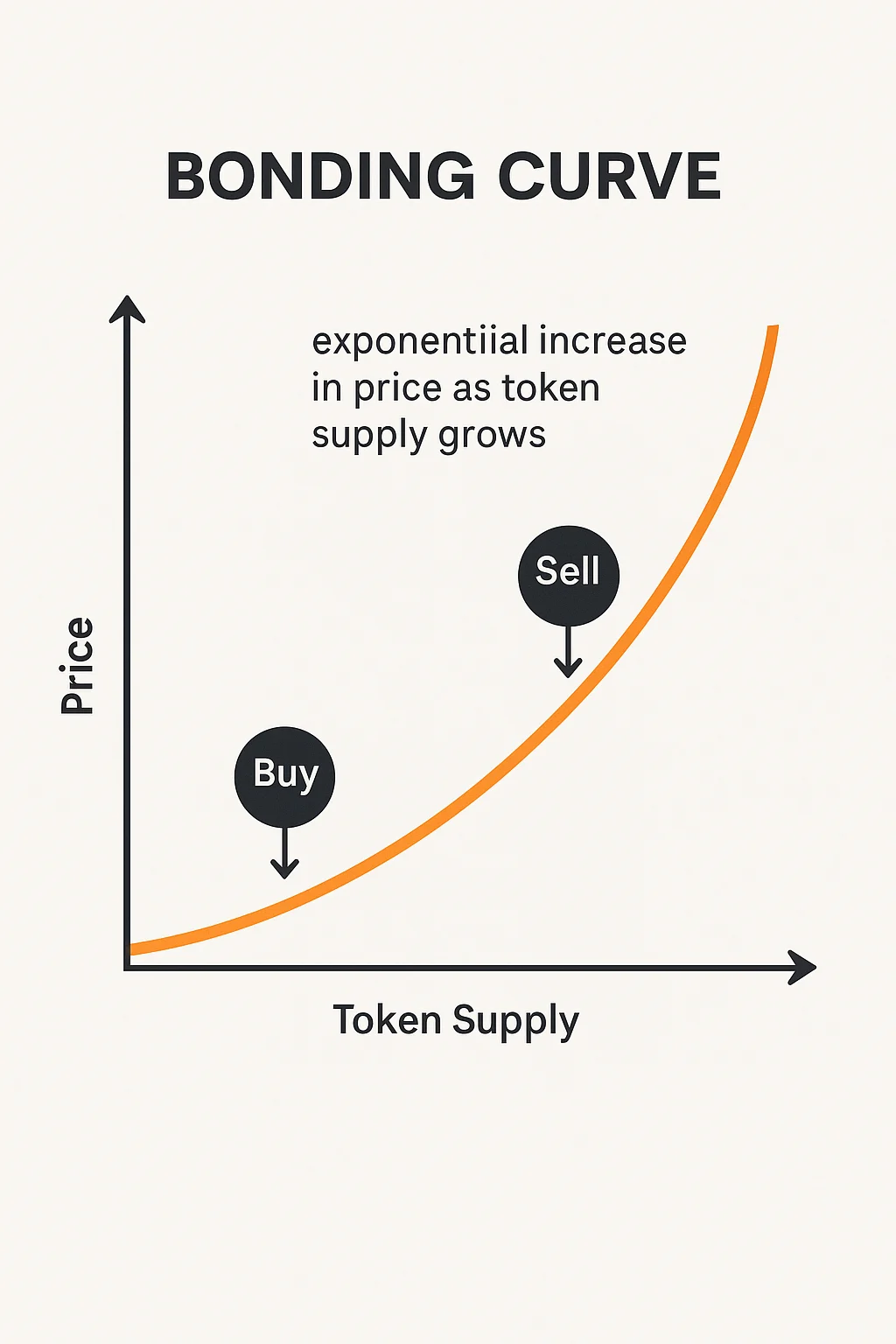
Bonding curve graph showing exponential price increase as token supply grows, with labeled buy and sell points along the curve.

Real-World Examples

  • Bancor protocol pioneered bonding curve AMMs for continuous token liquidity
  • Curation markets use bonding curves to price shares in content or prediction markets
  • Social tokens often launch with bonding curves to bootstrap initial liquidity and price discovery

Why Beginners Should Care

Front-runner advantages exist since early buyers get lower prices while later buyers pay increasingly higher amounts, creating wealth concentration among early adopters.

No liquidity shortages occur with bonding curves since the algorithm always provides liquidity, eliminating concerns about market makers withdrawing support.

Price volatility can be extreme with steep bonding curves where small buy or sell orders create large price movements, especially at low supply levels.

Related Terms: AMM, Price Discovery, Algorithmic Trading, Token Launch

Back to Crypto Glossary

Similar Posts

  • Multi-Signature (Multisig)

    Multi-Signature (Multisig): Shared Control for Enhanced Security Multisig wallets require multiple signatures to authorize transactions. It’s like requiring multiple keys to open a safe – no single person can move funds alone. Multi-signature (multisig) is a wallet configuration that requires signatures from multiple private keys to authorize transactions. Common setups include 2-of-3 (any 2 signatures…

  • Liquidity

    Liquidity: How Easily You Can Buy or Sell Liquidity determines whether you can actually trade your crypto at fair prices. High liquidity means smooth trading. Low liquidity means getting rekt by slippage. Liquidity refers to how easily an asset can be bought or sold without significantly affecting its price. In crypto markets, liquidity comes from…

  • Dispute Resolution

    Dispute Resolution: Solving Blockchain ConflictsDispute resolution mechanisms help resolve conflicts that arise in decentralized systems where no central authority can make binding decisions. It's like having a digital court system.Dispute resolution in blockchain systems refers to mechanisms for resolving conflicts between parties in decentralized environments where traditional legal systems may be inadequate or unavailable. These systems…

  • CoinJoin

    CoinJoin: Bitcoin Transaction MixingCoinJoin combines multiple Bitcoin transactions into single transactions to obscure the connection between inputs and outputs. It's like mixing your laundry with other people's to make it harder to tell which clothes belong to whom.CoinJoin is a Bitcoin privacy technique that combines multiple transactions from different users into a single transaction, making…

  • Wei

    Wei: Ethereum's Smallest UnitWei is the smallest denomination of Ethereum, similar to how cents are the smallest unit of dollars. It's like measuring distances in millimeters when you need precision, even though we usually think in meters or kilometers.Wei represents the smallest possible unit of Ethereum (ETH), with one ETH equal to 1,000,000,000,000,000,000 (10^18) wei. This…

  • Protocol Security

    Protocol Security: Protecting Blockchain InfrastructureProtocol security involves designing and maintaining blockchain networks to resist attacks, prevent exploits, and ensure reliable operation. It's like building a fortress with multiple defensive layers.Protocol security encompasses all measures taken to protect blockchain networks from technical attacks, economic manipulation, and operational failures. This includes consensus security, smart contract auditing, and network…