
Cross-Chain Messaging

Cross-Chain Messaging: Inter-Blockchain Communication

Cross-chain messaging enables smart contracts on different blockchains to communicate and trigger actions across networks. It’s like having a universal translator for blockchain conversations.

Cross-chain messaging allows smart contracts on different blockchain networks to send data, trigger functions, and coordinate actions across multiple chains. This enables true interoperability beyond simple asset transfers.

How Cross-Chain Messaging Works

Message protocols standardize how different blockchains can communicate, including data formats, verification methods, and delivery confirmation.

Relay networks transport messages between chains through validators, oracles, or specialized infrastructure that monitors multiple networks.

Verification systems ensure message authenticity and prevent manipulation through cryptographic proofs, multi-signature schemes, or consensus mechanisms.
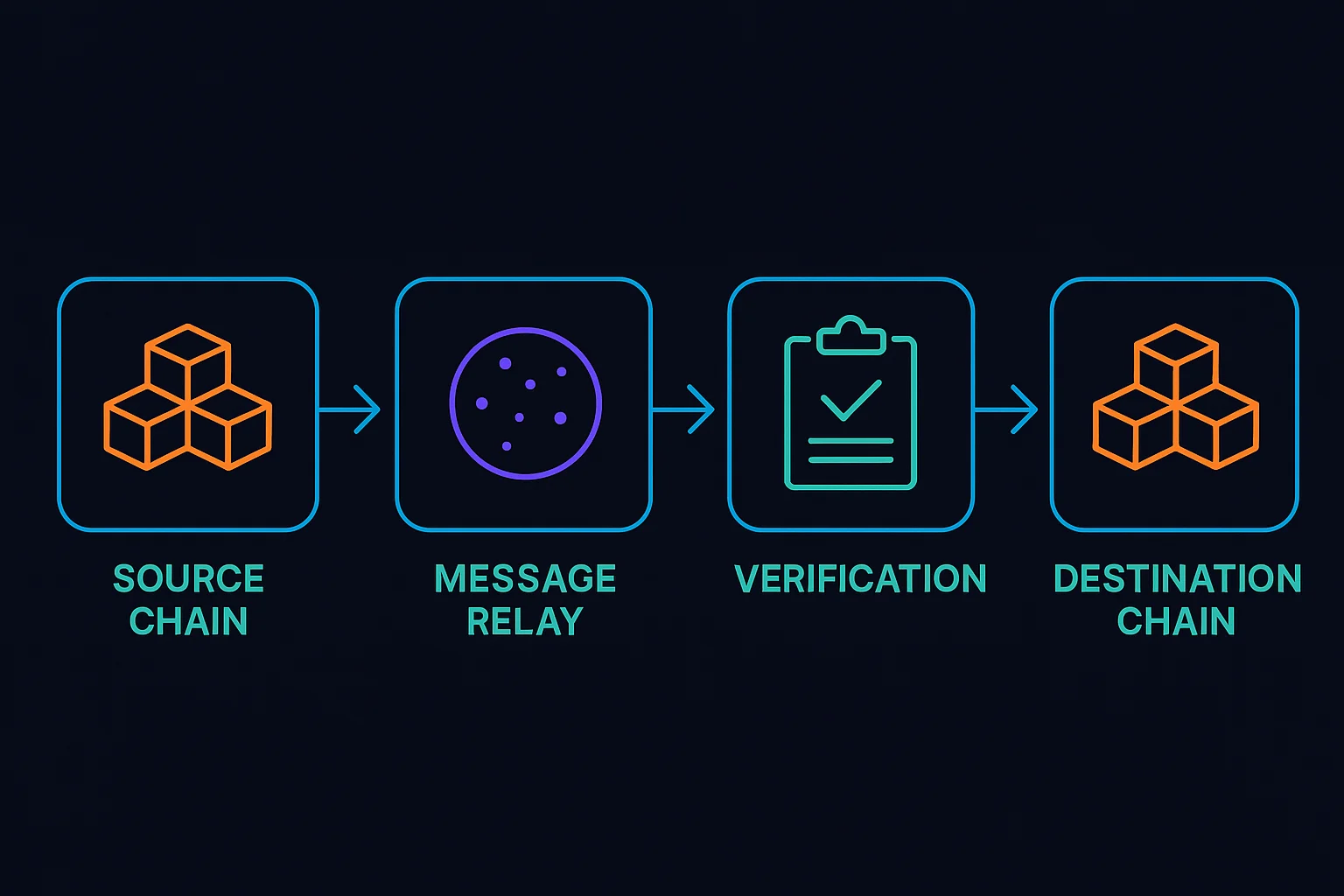
Cross-chain messaging flow showing source chain, message relay, verification, and destination chain execution

Real-World Examples

  • LayerZero enables omnichain applications through standardized messaging protocols
  • Axelar provides secure cross-chain communication with proof-of-stake validation
  • IBC (Inter-Blockchain Communication) connects Cosmos ecosystem chains natively

Why Beginners Should Care

Unified experiences enable applications that work seamlessly across multiple blockchains without users managing complex multi-chain interactions.

Expanded possibilities for developers to build applications that leverage the best features of different blockchain networks simultaneously.

Security dependencies on cross-chain infrastructure that could become single points of failure for multi-chain applications.

Related Terms: Interoperability, Cross-Chain Protocol, Omnichain, Message Relay

Back to Crypto Glossary

Similar Posts

  • Social Token

    Social Token: Community-Powered Digital CurrencySocial tokens represent value within communities and enable creators to monetize their audience directly. They're like membership cards that have real value and can be traded.Social tokens are cryptocurrencies created by individuals, communities, or organizations to represent membership, access rights, or value within specific social ecosystems. These tokens enable direct monetization and…

  • Governance Participation

    Governance Participation: Active Protocol InvolvementGovernance participation involves actively engaging in decision-making processes for cryptocurrency projects and protocols. It's like being an active citizen who votes and participates in community decisions.Governance participation refers to active involvement in protocol decision-making through voting, proposal creation, delegation, and other governance mechanisms. This enables community members to influence project direction and…

  • Derivatives

    Derivatives: Financial Contracts Based on Underlying AssetsCryptocurrency derivatives are financial contracts whose value depends on underlying crypto assets. They're like betting on sports outcomes instead of playing the game yourself.Derivatives are financial instruments that derive their value from underlying cryptocurrency assets, enabling trading, hedging, and speculation without direct ownership of the base assets. These include futures,…

  • Cryptography

    Cryptography: Mathematical Security FoundationCryptography is the mathematical science of securing information through encryption, digital signatures, and other techniques. It's the foundation that makes cryptocurrencies and blockchain technology secure and trustworthy.Cryptography refers to mathematical techniques for securing information, enabling authentication, and protecting data confidentiality through algorithms and protocols. Modern cryptocurrency systems depend entirely on cryptographic security for…

  • Transaction Cost

    Transaction Cost: The Price of Blockchain OperationsTransaction cost refers to the total expense of executing operations on blockchain networks, including fees, gas, and opportunity costs. It's the price you pay for using decentralized financial infrastructure.Transaction cost encompasses all expenses associated with executing blockchain operations, including network fees, gas costs, slippage, and time value. Understanding total transaction…

  • Address Clustering

    Address Clustering: Connecting Wallet IdentitiesAddress clustering analyzes blockchain transactions to identify which addresses likely belong to the same user or entity. It's like detective work for digital money trails.Address clustering is a blockchain analysis technique that groups cryptocurrency addresses believed to belong to the same user or entity based on transaction patterns and shared inputs. This…