
REKT

REKT: When Trades Go Wrong

REKT is what happens when your confident trade turns into a financial disaster. It’s crypto slang for getting completely wrecked by bad investment decisions.

REKT is slang for “wrecked” – suffering severe financial losses from cryptocurrency trading or investing. It describes the aftermath of leveraged positions gone wrong, rug pulls, exchange collapses, or any situation where someone loses most or all of their crypto.

How People Get REKT

Leverage trading amplifies both gains and losses. A 10x leveraged position can liquidate your entire account with just a 10% price move in the wrong direction.

FOMO buying at market tops followed by panic selling at bottoms creates the classic “buy high, sell low” pattern that destroys retail wealth systematically.

Scam projects including rug pulls, fake DeFi protocols, and worthless tokens promoted by influencers can completely wipe out investments overnight.
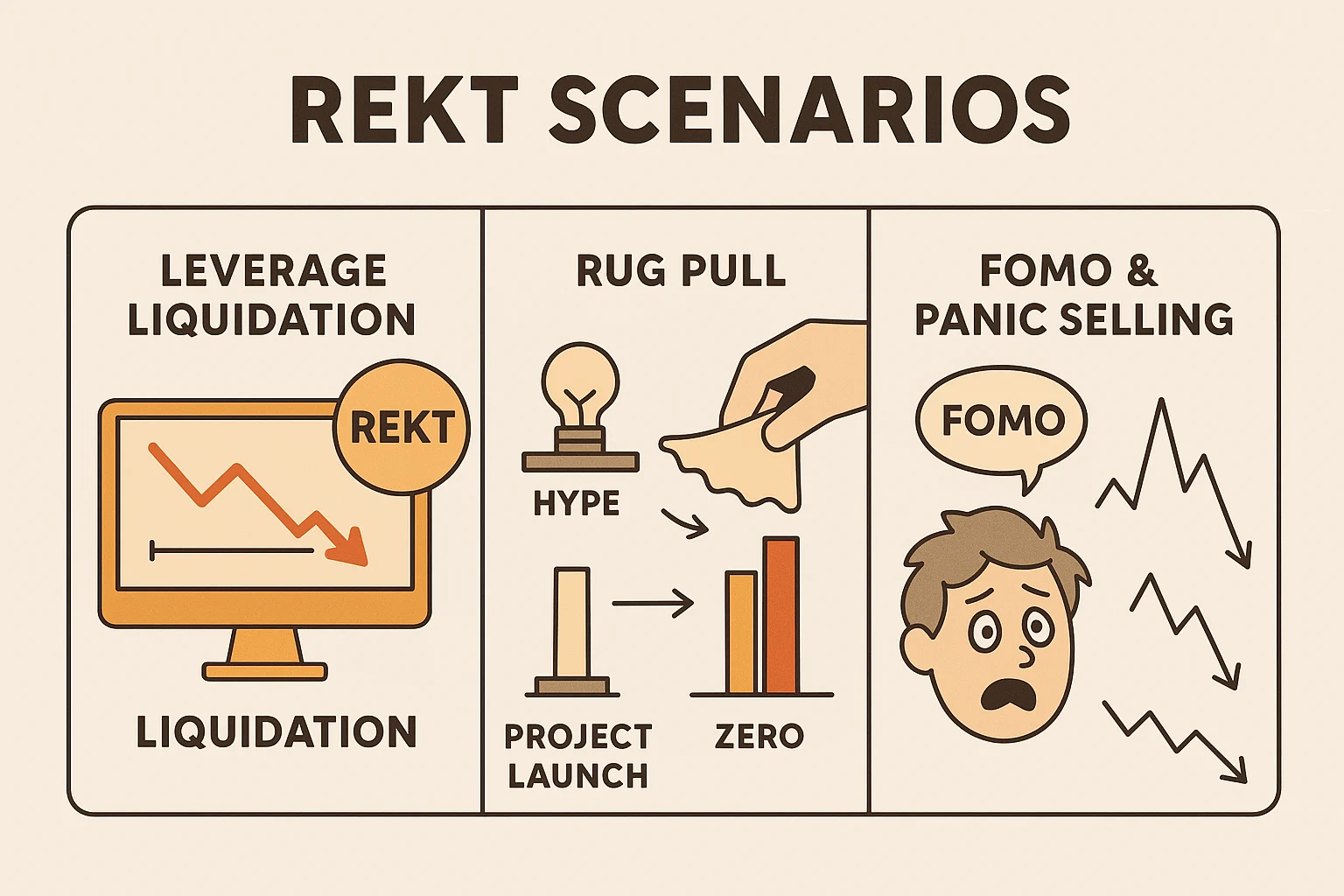
Infographic showing three REKT scenarios: leverage liquidation, rug pulls, and FOMO-induced panic selling with charts, icons, and emotional expressions

Real-World Examples

  • Terra Luna collapse – Investors lost 99.9% as LUNA went from $85 to essentially zero
  • FTX bankruptcy – Users with funds on exchange lost billions when platform collapsed
  • Leverage liquidations during flash crashes wipe out millions in minutes

Why Beginners Should Care

Getting REKT is educational but expensive. Learning from others’ mistakes costs less than experiencing them personally through poor risk management.

Position sizing prevents total REKT scenarios. Never invest more than you can afford to lose completely, especially in high-risk plays.

Emotional preparation for potential losses helps prevent panic decisions that turn temporary drawdowns into permanent REKT situations.

Related Terms: Liquidation, Leverage, Rug Pull, FOMO

Back to Crypto Glossary

Similar Posts

  • Liquidity Mining

    Liquidity Mining: Earning Rewards for Providing Liquidity Liquidity mining rewards users who provide capital to DeFi protocols with governance tokens. It’s like getting paid to be the house money at a casino. Liquidity mining is a DeFi incentive mechanism where protocols distribute governance tokens to users who provide liquidity to their platforms. Users earn both…

  • Single-Sided Staking

    Single-Sided Staking: Simplified Yield Farming Single-sided staking lets you earn yield on individual tokens without providing liquidity pairs or facing impermanent loss. It’s like earning interest on a savings account without loan risk. Single-sided staking allows users to stake individual tokens to earn rewards without needing to provide paired assets or manage liquidity pool positions….

  • Protocol Security

    Protocol Security: Protecting Blockchain InfrastructureProtocol security involves designing and maintaining blockchain networks to resist attacks, prevent exploits, and ensure reliable operation. It's like building a fortress with multiple defensive layers.Protocol security encompasses all measures taken to protect blockchain networks from technical attacks, economic manipulation, and operational failures. This includes consensus security, smart contract auditing, and network…

  • Real Yield

    Real Yield: Sustainable Return GenerationReal yield refers to returns generated from actual economic activity and revenue rather than token emissions or inflationary rewards. It's like earning interest from a bank's profitable lending operations instead of them just printing more money to pay you.Real yield describes investment returns generated from genuine economic activity, protocol revenue, or…

  • Protocol Revenue

    Protocol Revenue: Earning from Network ActivityProtocol revenue refers to income generated by blockchain protocols through transaction fees, service charges, or other value capture mechanisms. It's like toll roads that collect fees from everyone who uses the infrastructure.Protocol revenue encompasses all income streams generated by blockchain protocols including transaction fees, service charges, governance fees, and other…

  • On-Chain Gaming

    On-Chain Gaming: Fully Decentralized Games On-chain gaming runs game logic entirely on blockchain networks rather than traditional servers. It’s like having board games where the rules are enforced by mathematics instead of human referees. On-chain gaming executes all game logic, state management, and interactions through smart contracts on blockchain networks. Unlike traditional games with centralized…