
Zero-Knowledge Proof (ZKP)

Zero-Knowledge Proof (ZKP): Proving Without Revealing

Zero-knowledge proofs let you prove you know something without revealing what you know. It’s like proving you’re over 21 without showing your birth date, address, or any other personal information.

A zero-knowledge proof (ZKP) is a cryptographic method that allows one party to prove they possess certain information without revealing the information itself. The verifier learns nothing except that the prover’s claim is true.

How Zero-Knowledge Proofs Work

Mathematical magic creates proofs that are computationally infeasible to fake but easy to verify. The prover demonstrates knowledge through complex calculations that would be impossible without the secret information.

Three properties define valid zero-knowledge proofs: completeness (honest provers can convince verifiers), soundness (dishonest provers cannot convince verifiers), and zero-knowledge (verifiers learn nothing beyond claim validity).

Practical applications include proving account balances without revealing amounts, demonstrating identity without sharing personal data, or validating transaction history without exposing details.
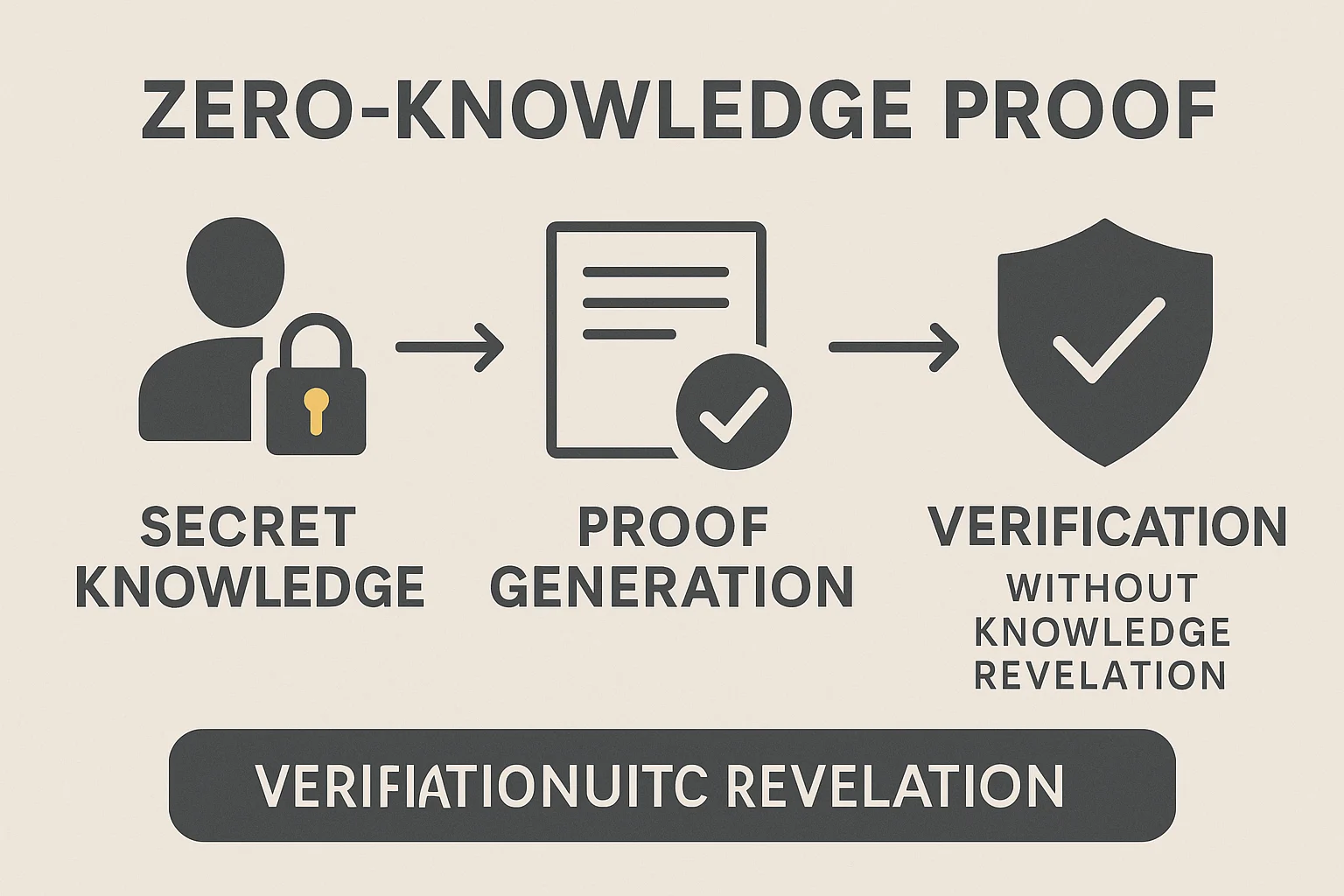
Infographic showing the zero-knowledge proof process: secret knowledge, proof generation, and verification without revealing the underlying data

Real-World Examples

  • Zcash transactions use zk-SNARKs to prove transaction validity without revealing amounts or addresses
  • Polygon Hermez uses zero-knowledge rollups for scalable Ethereum transactions
  • Age verification systems prove you’re over 18 without revealing your exact age or birthday

Why Beginners Should Care

Privacy revolution potential exists as ZKPs enable verification systems that don’t require sharing sensitive personal or financial information.

Scalability solutions like zk-rollups use zero-knowledge proofs to batch thousands of transactions while maintaining security and reducing costs.

Technical complexity makes ZKPs challenging to implement correctly, but user-facing applications hide this complexity behind simple interfaces.

Related Terms: Privacy Coin, zk-SNARKs, zk-STARKs, Rollups

Back to Crypto Glossary

Similar Posts

  • Tornado Cash

    Tornado Cash: The Controversial Privacy Protocol Tornado Cash was Ethereum’s most popular mixing service until U.S. sanctions shut it down. It used zero-knowledge proofs to enable private transactions on a transparent blockchain. Tornado Cash was a decentralized mixing protocol on Ethereum that used zero-knowledge proofs to enable private transactions by breaking the link between sender…

  • Meta Transactions

    Meta Transactions: Gasless User InteractionsMeta transactions enable users to interact with blockchain applications without paying gas fees directly. It's like having someone else pay your transaction fees while you control the actual operations.Meta transactions are blockchain transactions where the gas fees are paid by a third party (relayer) while the user maintains control over the…

  • Flash Loan Attack

    Flash Loan Attack: Exploiting DeFi with Borrowed CapitalFlash loan attacks use uncollateralized loans to exploit vulnerabilities in DeFi protocols for profit extraction. They're like using borrowed money to pull off elaborate heists in seconds.A flash loan attack is an exploit that uses flash loans to manipulate DeFi protocols, typically by borrowing large amounts, executing complex…

  • DPoS

    DPoS: Democratic Blockchain GovernanceDelegated Proof of Stake (DPoS) is a consensus mechanism where token holders vote for representatives who validate transactions on their behalf. It's like electing politicians to make decisions for the community.Delegated Proof of Stake (DPoS) is a consensus mechanism where token holders vote for a limited number of delegates who are responsible…

  • Delegation

    Delegation: Assigning Voting or Staking RightsDelegation allows token holders to assign their voting power or staking rights to other participants while retaining ownership. It's like giving someone your vote without giving them your tokens.Delegation refers to assigning voting rights, staking authority, or other token-based powers to third parties while maintaining ownership of the underlying tokens. This…

  • Parabolic

    Parabolic: Exponential Price MovementParabolic describes extremely rapid price increases that follow exponential growth curves, often unsustainable in the long term. It's like a rocket shooting straight up into the sky – impressive to watch but likely to come back down eventually.Parabolic refers to price movements that follow exponential growth patterns, characterized by accelerating increases that…