
Privacy Coin

Privacy Coin: Digital Cash That Actually Hides

Privacy coins use advanced cryptography to hide transaction details like amounts, senders, and receivers. They’re what Bitcoin was supposed to be before everyone realized blockchain transactions are completely transparent.

Privacy coins are cryptocurrencies designed to provide anonymous or untraceable transactions through advanced cryptographic techniques. Unlike Bitcoin where all transactions are publicly visible, privacy coins obscure transaction details to protect user financial privacy.

How Privacy Coins Work

Ring signatures mix your transaction with others, making it impossible to determine which participant actually sent the funds. It’s like having multiple people sign a document with identical handwriting.

Stealth addresses generate unique one-time addresses for each transaction, preventing outside observers from linking multiple payments to the same recipient.

Zero-knowledge proofs verify transaction validity without revealing amounts, addresses, or other sensitive information to network validators or blockchain observers.
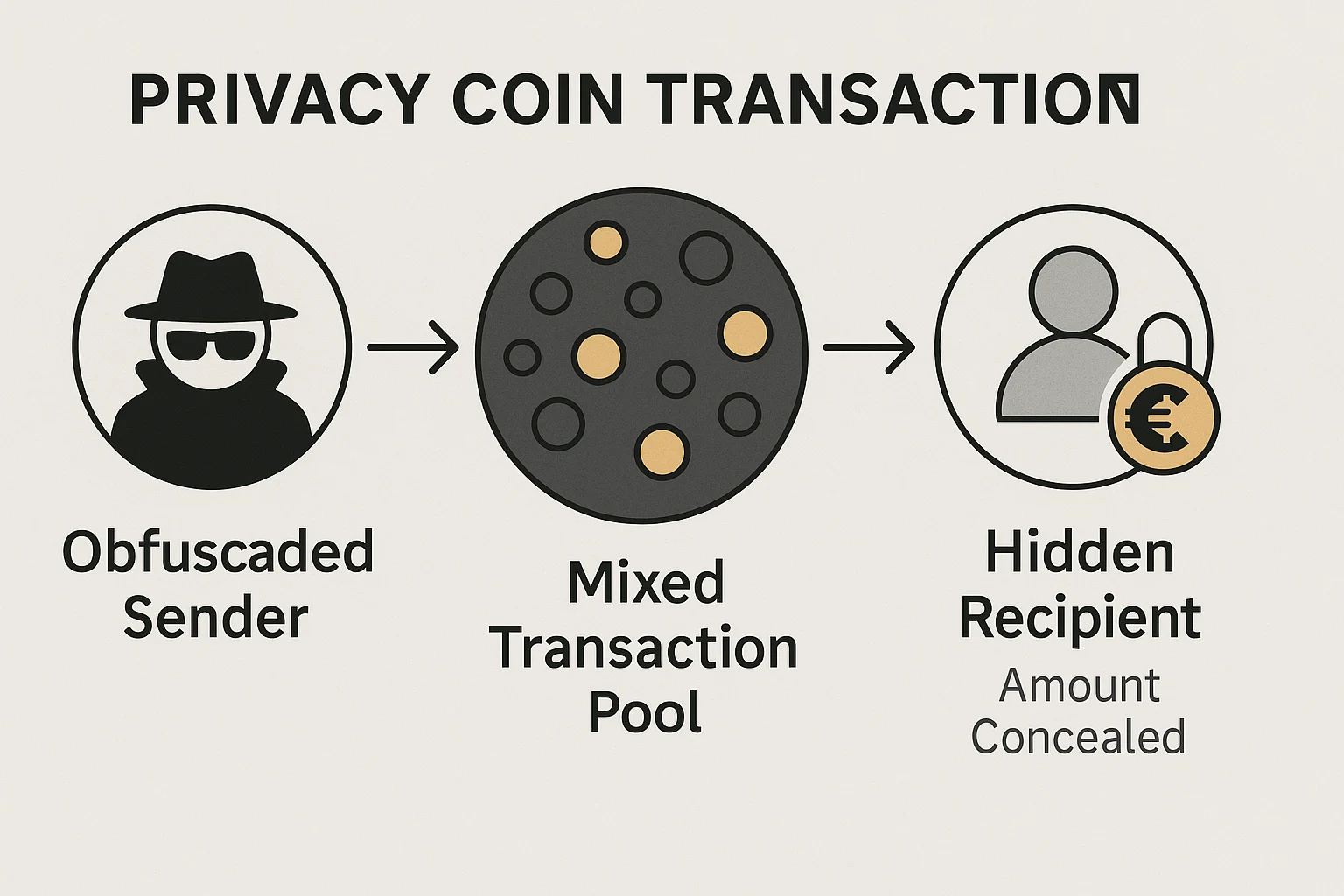
Infographic showing a privacy coin transaction flow with obfuscated sender, mixed transaction pool, and hidden recipient with concealed amount

Real-World Examples

  • Monero (XMR) – Uses ring signatures, stealth addresses, and RingCT for comprehensive privacy
  • Zcash (ZEC) – Offers optional privacy through zero-knowledge proofs called zk-SNARKs
  • Dash – Provides mixing services through CoinJoin-style transactions

Why Beginners Should Care

Financial privacy matters for legitimate reasons like preventing targeted theft, business confidentiality, and protection from authoritarian surveillance.

Regulatory pressure has forced many exchanges to delist privacy coins, limiting liquidity and adoption despite growing demand for financial privacy.

Enhanced security protects users from physical attacks since transaction histories can’t be used to identify wealthy targets for robbery or extortion.

Related Terms: Zero-Knowledge Proof, Ring Signatures, Stealth Address, Mixing Service

Back to Crypto Glossary

Similar Posts

  • Gas Refund Token

    Gas Refund Token: Optimizing Transaction Costs Gas refund tokens exploit Ethereum’s gas refund mechanism to reduce transaction costs by clearing unused storage. They’re like getting paid to clean up the blockchain. A gas refund token uses Ethereum’s gas refund mechanism to partially offset transaction costs by clearing unused contract storage during token transfers. The protocol…

  • Hash Rate

    Hash Rate: Network Security Measurement Hash rate measures how much computational power secures a blockchain network. Higher hash rates mean stronger security against attacks and manipulation. Hash rate is the total computational power used by miners to process transactions and secure a proof-of-work blockchain network. It’s measured in hashes per second – calculations attempting to…

  • Market Stability

    Market Stability: Reducing Price VolatilityMarket stability refers to conditions where asset prices experience relatively small fluctuations over time. It's like having calm seas instead of stormy waters for your investments.Market stability describes market conditions characterized by relatively low volatility, predictable price movements, and reduced extreme fluctuations. Stable markets enable better planning and reduce risks for participants.How…

  • MetaMask

    MetaMask: Your Gateway to Web3 MetaMask is the browser extension wallet that connects you to the decentralized web. It’s like having a crypto wallet built into your browser that talks to every DeFi protocol. MetaMask is a browser extension and mobile wallet that enables interaction with Ethereum-based applications directly through web browsers. It manages private…

  • Web3

    Web3: The Decentralized Internet Dream Web3 promises an internet where users own their data, identity, and digital assets instead of tech giants controlling everything. It’s part vision, part reality, part marketing buzzword. Web3 refers to a decentralized version of the internet built on blockchain technology where users control their own data, identity, and assets rather…

  • Back Running

    Back Running: Following Profitable TransactionsBack running involves placing transactions immediately after profitable transactions to capture secondary opportunities. It's like following successful traders to pick up the crumbs they leave behind.Back running is a MEV extraction strategy where bots place transactions immediately after profitable transactions to capture residual value or secondary opportunities. This technique exploits the predictable…