
Ring Signatures

Ring Signatures: Anonymous Signatures in Groups

Ring signatures let any member of a group sign a message without revealing which specific member created the signature. It’s like having a family photo where you know someone took it, but can’t tell who.

A ring signature is a cryptographic signature scheme where any member of a group can produce a signature that verifies as coming from the group, but observers cannot determine which specific member signed. It provides anonymity within known sets.

How Ring Signatures Work

Group formation includes the actual signer plus other group members (called “decoys”) whose public keys are used to create the signature without their permission or knowledge.

Mathematical mixing combines the signer’s private key with decoys’ public keys in a way that produces a valid signature that could have been created by any group member.

Verification process confirms the signature came from someone in the group but provides no information about which specific member created it.
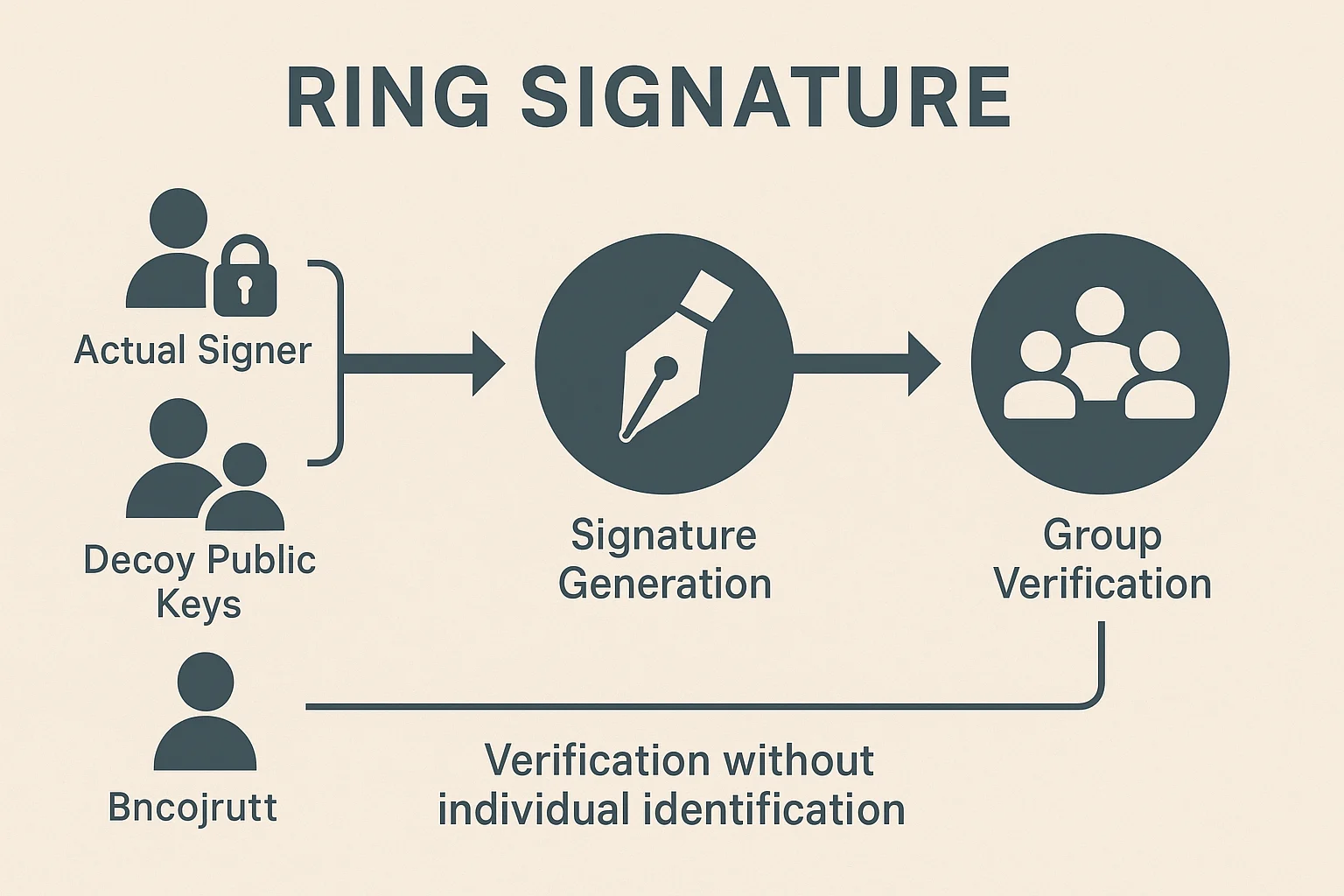
Infographic showing the ring signature process with actual signer and decoy public keys used to generate a group signature that is verifiable without revealing the individual signer

Real-World Examples

  • Monero transactions use ring signatures to hide which outputs are being spent in each transaction
  • Cryptonote protocol family implements ring signatures for privacy-focused cryptocurrencies
  • Political dissidents could use ring signatures for anonymous group statements without revealing individual identities

Why Beginners Should Care

Financial privacy benefits from ring signatures by making it impossible to determine which specific wallet outputs were spent in transactions.

Plausible deniability exists since any group member could have created the signature, protecting individual privacy even if group membership is known.

Computational overhead makes ring signatures more expensive than regular signatures, requiring balance between privacy levels and transaction costs.

Related Terms: Privacy Coin, Monero, Mixing, Anonymity Set

Back to Crypto Glossary

Similar Posts

  • Challenge Period

    Challenge Period: Dispute Resolution WindowA challenge period is a time window during which participants can dispute or challenge proposed changes before they become final. It's like a cooling-off period for important decisions.A challenge period is a predetermined time frame that allows network participants to dispute transactions, withdrawals, or governance proposals before they become irreversible. This mechanism…

  • Custom Blockchain

    Custom Blockchain: Purpose-Built NetworksA custom blockchain is a network designed for specific use cases rather than general-purpose applications. It's like building a specialized tool for a particular job instead of using a multi-purpose tool.A custom blockchain is a purpose-built blockchain network designed to meet specific requirements for particular applications or use cases. These networks optimize for…

  • Wallet Integration

    Wallet Integration: Seamless Application ConnectivityWallet integration enables applications to connect with cryptocurrency wallets for user authentication and transaction processing. It's like having a universal credit card reader that works with every type of payment card, making transactions smooth and effortless.Wallet integration refers to the technical implementation that allows decentralized applications to connect with various cryptocurrency…

  • Custodial Wallet

    Custodial Wallet: Someone Else Holds Your Keys Custodial wallets store your cryptocurrency private keys for you, like having a bank hold your money. Convenient but risky – if they go down, your crypto might go with them. A custodial wallet is a cryptocurrency storage service where a third party (like an exchange or wallet provider)…

  • Token Delisting

    Token Delisting: Removal from Trading PlatformsToken delisting occurs when exchanges remove cryptocurrencies from their trading platforms. It's like a store deciding to stop selling a particular product and removing it from their shelves.Token delisting refers to the removal of cryptocurrency tokens from exchange trading platforms, making them unavailable for purchase or sale on those specific…

  • Block Reward

    Block Reward: Miner and Validator Compensation Block rewards are the cryptocurrency payments that miners and validators receive for successfully adding new blocks to the blockchain. It’s how networks incentivize security without charging transaction fees. Block reward is the amount of cryptocurrency awarded to miners or validators for successfully creating and validating a new block on…