
Mixing Service

Mixing Service: Shuffling Coins for Privacy

Mixing services (or tumblers) pool cryptocurrencies from multiple users then redistribute different coins to break transaction links. It’s like exchanging your marked bills for unmarked ones.

A mixing service is a privacy tool that pools cryptocurrencies from multiple users and redistributes them to break the link between sending and receiving addresses. Users deposit coins and receive different coins of equal value, obscuring transaction histories.

How Mixing Services Work

Pooling deposits from multiple users creates a large pool of mixed funds where individual contributions become indistinguishable from each other.

Random delays and amount splitting prevent timing analysis or amount correlation that could be used to link deposits with withdrawals.

Fresh outputs come from different sources than inputs, making it difficult for blockchain analysts to trace funds through the mixing process.
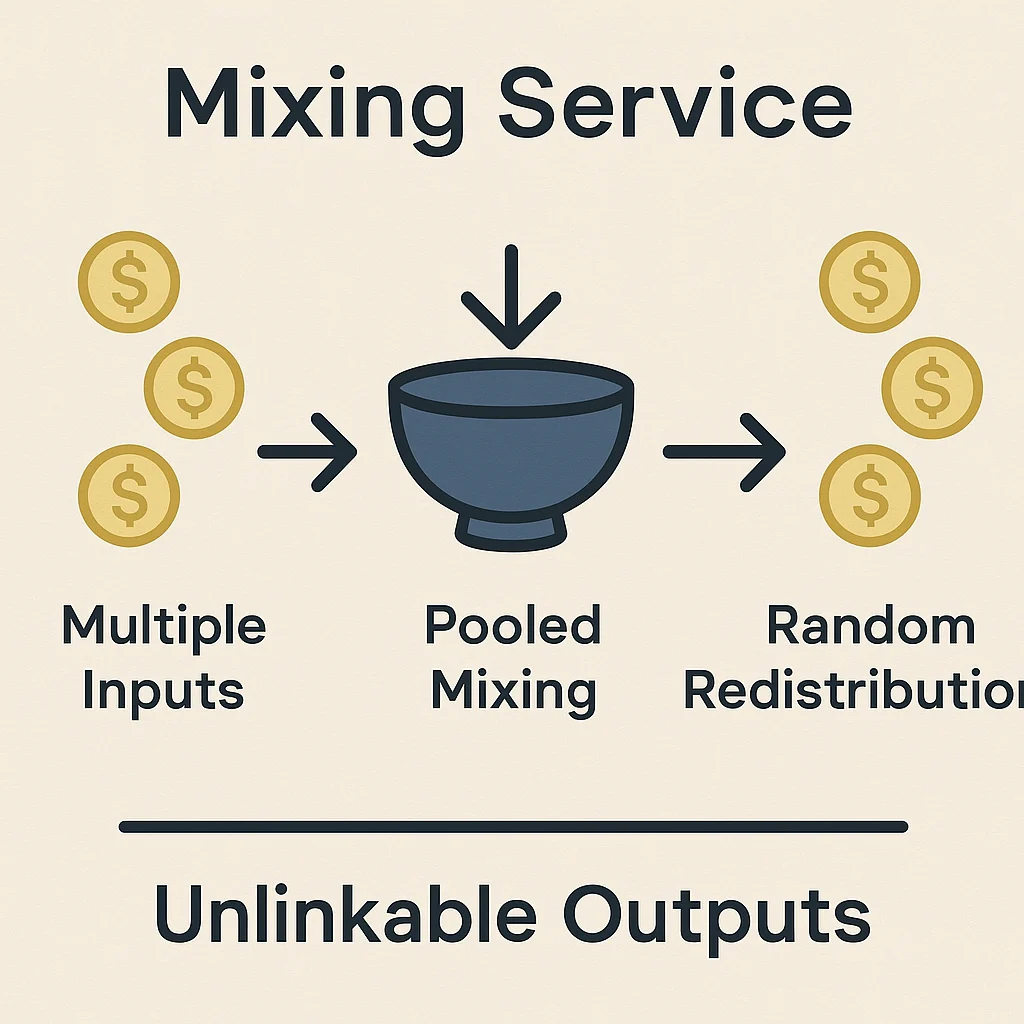
Infographic showing cryptocurrency mixing service with multiple inputs, pooled mixing, random redistribution, and unlinkable outputs

Real-World Examples

  • Tornado Cash – Ethereum mixing protocol using zero-knowledge proofs for enhanced privacy
  • CoinJoin – Bitcoin mixing technique that combines multiple users’ transactions
  • Wasabi Wallet – Bitcoin wallet with built-in CoinJoin mixing functionality

Why Beginners Should Care

Privacy protection helps prevent transaction surveillance and protects users from targeted attacks based on blockchain analysis of their spending patterns.

Regulatory scrutiny has led to sanctions against some mixing services and exchange policies against mixed funds, limiting practical utility.

Legitimate uses include protecting business privacy, preventing targeted theft, and maintaining financial confidentiality that most people expect from traditional banking.

Related Terms: Privacy Coin, CoinJoin, Tornado Cash, Transaction Privacy

Back to Crypto Glossary

Similar Posts

  • Bagholder

    Bagholder: Stuck with Worthless Tokens A bagholder is someone stuck holding cryptocurrency that has lost most of its value with little hope of recovery. It’s crypto’s version of being left holding the bag. A bagholder is an investor who continues holding a cryptocurrency that has significantly decreased in value, often because they’re unable or unwilling…

  • Intent-Centric Protocols

    Intent-Centric Protocols: What You Want, Not How Intent-centric protocols let users specify desired outcomes while the system figures out how to achieve them. Instead of manually executing swap steps, you just say “I want USDC” and the protocol handles everything. Intent-centric protocols allow users to express desired end states rather than specific transaction sequences. Users…

  • Transaction Analysis

    Transaction Analysis: Blockchain Data InvestigationTransaction analysis involves examining blockchain data to understand patterns, track funds, and investigate suspicious activities. It's like being a detective who follows money trails in the digital world.Transaction analysis refers to the systematic examination of blockchain transaction data to identify patterns, trace fund flows, and investigate potential illegal or suspicious activities. This…

  • Metadata

    Metadata: Data About DataMetadata provides information about other data, such as describing what an NFT represents, when it was created, or what properties it has. It's like the label on a file folder that tells you what's inside.Metadata refers to descriptive information about digital assets, transactions, or other data that provides context, properties, and characteristics…

  • Parabolic

    Parabolic: Exponential Price MovementParabolic describes extremely rapid price increases that follow exponential growth curves, often unsustainable in the long term. It's like a rocket shooting straight up into the sky – impressive to watch but likely to come back down eventually.Parabolic refers to price movements that follow exponential growth patterns, characterized by accelerating increases that…

  • Ring Signatures

    Ring Signatures: Anonymous Signatures in Groups Ring signatures let any member of a group sign a message without revealing which specific member created the signature. It’s like having a family photo where you know someone took it, but can’t tell who. A ring signature is a cryptographic signature scheme where any member of a group…