
Tornado Cash

Tornado Cash: The Controversial Privacy Protocol

Tornado Cash was Ethereum’s most popular mixing service until U.S. sanctions shut it down. It used zero-knowledge proofs to enable private transactions on a transparent blockchain.

Tornado Cash was a decentralized mixing protocol on Ethereum that used zero-knowledge proofs to enable private transactions by breaking the link between sender and receiver addresses. Users could deposit ETH or tokens and later withdraw equivalent amounts from different addresses.

How Tornado Cash Worked

Smart contract pools held deposits of fixed amounts (0.1, 1, 10, or 100 ETH) where users could deposit funds and receive cryptographic commitments proving their deposit without revealing identity.

Zero-knowledge proofs allowed users to prove they had made a valid deposit without revealing which specific deposit was theirs, enabling private withdrawals to fresh addresses.

Anonymity sets grew larger with more users, improving privacy as it became harder to correlate deposits and withdrawals through timing or amount analysis.
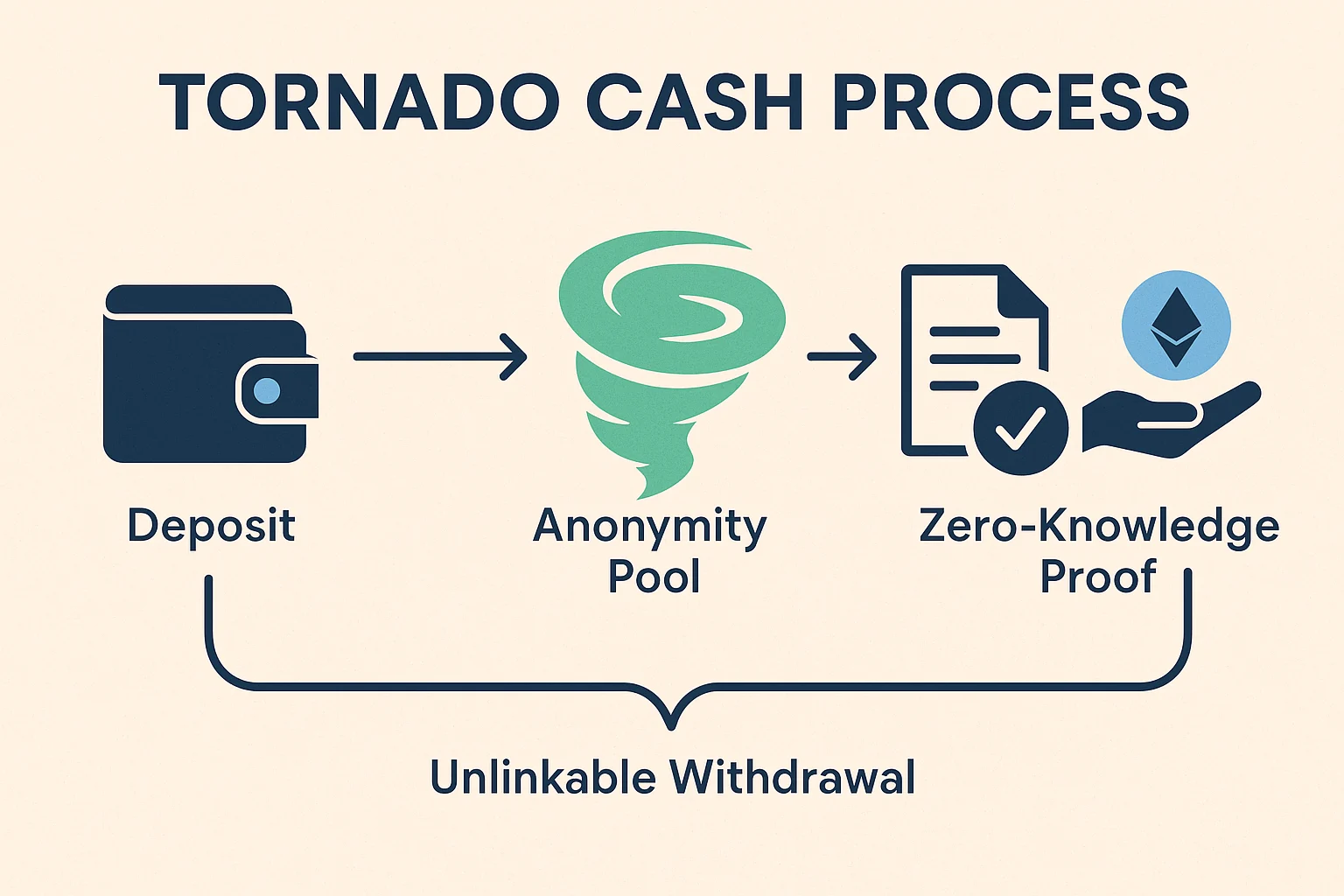
Infographic showing Tornado Cash process: deposit, anonymity pool, zero-knowledge proof, and unlinkable withdrawal

Real-World Examples

  • Privacy-conscious users mixed legitimate funds to prevent transaction surveillance and protect financial privacy
  • Criminal activity also used the service, leading to regulatory scrutiny and eventual sanctions
  • North Korean hackers reportedly used Tornado Cash to launder stolen cryptocurrency

Why Beginners Should Care

Regulatory precedent from Tornado Cash sanctions affects the entire crypto privacy space, potentially criminalizing privacy-enhancing technologies regardless of legitimate use cases.

Code vs. usage debates center on whether privacy tools themselves should be banned or only their illegal applications should be prosecuted.

Chilling effects on privacy development may result as developers avoid creating tools that could face similar regulatory action, reducing financial privacy options for law-abiding users.

Related Terms: Mixing Service, Zero-Knowledge Proof, Privacy Coin, Sanctions

Back to Crypto Glossary

Similar Posts

  • Proof of Work (PoW)

    Proof of Work (PoW): Bitcoin’s Security Model Proof of Work is how Bitcoin solves the double-spending problem without trusted authorities. It’s energy-intensive by design – that’s a feature, not a bug. Proof of Work is a consensus mechanism where miners compete to solve computationally difficult puzzles to validate transactions and create new blocks. The winning…

  • Consensus Mechanism

    Consensus Mechanism: How Networks Agree Consensus mechanisms solve the fundamental problem of getting thousands of independent computers to agree on a single version of truth without central authority. A consensus mechanism is the process by which a distributed network of nodes agrees on the validity of transactions and the current state of the blockchain. It…

  • EVM (Ethereum Virtual Machine)

    EVM (Ethereum Virtual Machine): The World Computer The EVM is the runtime environment where Ethereum smart contracts execute. It’s like having one giant computer that runs the same programs across thousands of machines worldwide. The Ethereum Virtual Machine (EVM) is a decentralized computing environment that executes smart contracts on the Ethereum blockchain. Every Ethereum node…

  • Decentralization

    Decentralization: Power to the People Decentralization distributes control away from single authorities across many independent participants. It’s the difference between having one king versus a thousand voters making decisions. Decentralization refers to the distribution of power, control, and decision-making away from central authorities to a network of independent participants. In blockchain systems, this means no…

  • Private Key Security

    Private Key Security: Protecting Your Digital IdentityPrivate key security involves protecting the cryptographic keys that control cryptocurrency access from theft, loss, or compromise. It's like safeguarding the master key to your digital vault.Private key security encompasses all practices and technologies used to protect cryptographic private keys from unauthorized access, theft, or loss. These keys are the…

  • Atomic Swap

    Atomic Swap: Trustless Cross-Chain Trading Atomic swaps enable direct trading between different cryptocurrencies without exchanges or intermediaries. Either both trades complete successfully, or neither happens – no middle ground. An atomic swap is a smart contract technology that enables the exchange of cryptocurrencies from different blockchains without requiring a trusted third party. The swap either…