
Hard Fork

Hard Fork: Splitting the Blockchain

Hard forks create permanent splits in blockchain networks, often resulting in two separate cryptocurrencies. They’re like corporate divorces – messy, dramatic, and usually involving lots of arguing about money.

A hard fork is a permanent change to a blockchain’s protocol that makes previously invalid blocks valid, or vice versa, requiring all nodes to upgrade to the new rules. Nodes that don’t upgrade continue following the old chain, potentially creating two separate networks.

How Hard Forks Work

Incompatible changes to blockchain rules require hard forks. This might include changing block size limits, consensus mechanisms, or fundamental protocol features that older software can’t understand.

Network consensus determines which fork becomes the “main” chain. Usually, the fork with more hash power, developer support, and economic activity becomes dominant while the other dies.

Cryptocurrency splits can result when communities disagree about fork changes. Both chains continue operating with their own tokens, exchanges, and user bases.
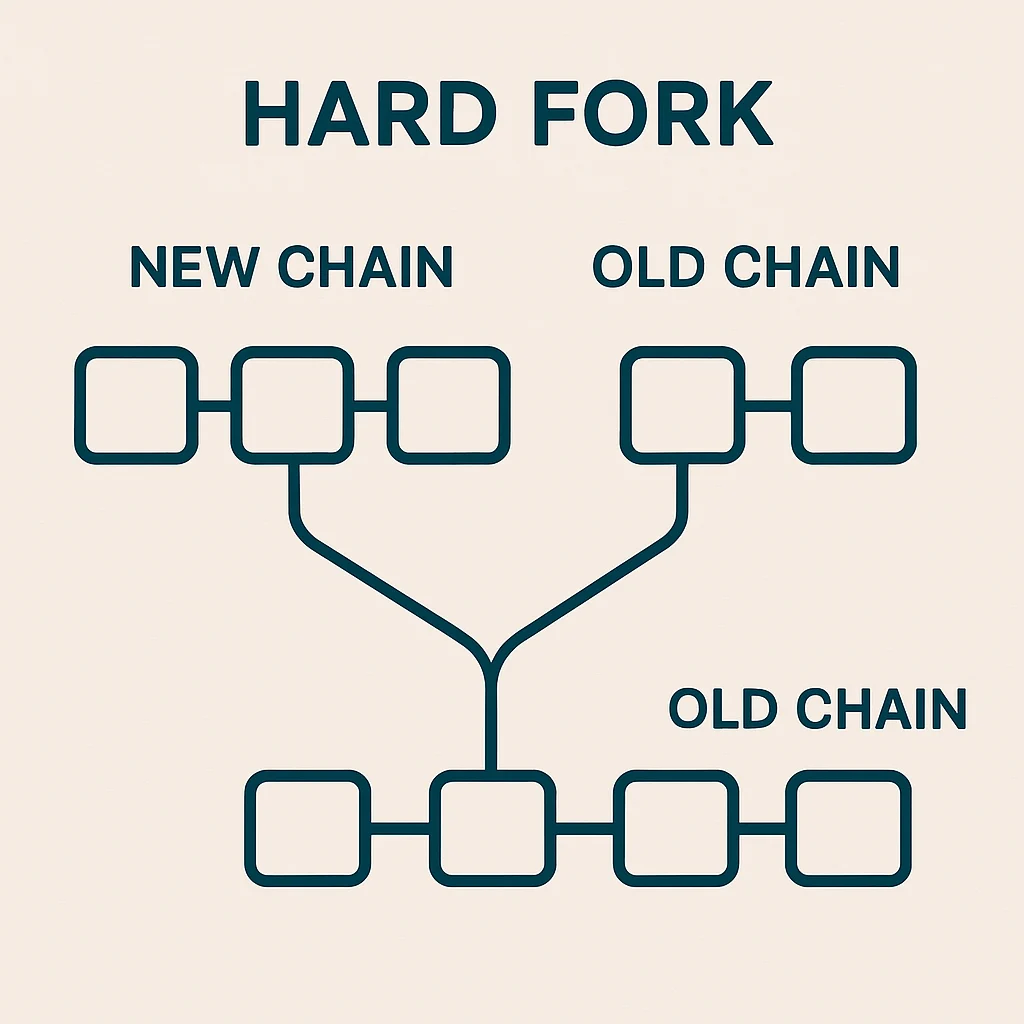
Infographic showing a hard fork with one blockchain splitting into two separate chains labeled "Old Chain" and "New Chain"

Real-World Examples

  • Bitcoin Cash fork – Disagreement over block size led to permanent split creating BCH
  • Ethereum Classic – Original Ethereum chain after the DAO hack hard fork
  • Bitcoin SV – Further split from Bitcoin Cash over technical and philosophical differences

Why Beginners Should Care

Free coins sometimes result from hard forks when you automatically receive tokens on both chains. However, this isn’t guaranteed and requires proper wallet management.

Network disruption during contentious hard forks can cause transaction delays, exchange suspensions, and price volatility as markets figure out which chain has value.

Research required to understand which fork to support, as community splits can be permanent and choosing wrong can mean holding worthless tokens.

Related Terms: Soft Fork, Consensus Mechanism, Node, Chain Split

Back to Crypto Glossary

Similar Posts

  • |

    zkEVM

    zkEVM: Zero-Knowledge Ethereum Virtual Machine zkEVM provides Ethereum compatibility with zero-knowledge proof validation, enabling existing dApps to run on faster, cheaper networks while maintaining security. It’s like having Ethereum that’s been turbocharged with privacy and speed. zkEVM is a zero-knowledge virtual machine that executes Ethereum transactions and smart contracts while generating cryptographic proofs of correct…

  • Smart Contract Compatibility

    Smart Contract Compatibility: Cross-Platform Code ExecutionSmart contract compatibility enables applications to run across different blockchain networks without modification. It's like writing software that works on both Windows and Mac without changes.Smart contract compatibility refers to the ability of smart contract code to execute on multiple blockchain platforms without requiring rewrites or significant modifications. This enables broader…

  • Transaction Verification

    Transaction Verification: Confirming Payment ValidityTransaction verification is the process of confirming that cryptocurrency transactions are valid before adding them to the blockchain. It's like having bank tellers check that signatures match and accounts have sufficient funds before processing checks.Transaction verification refers to the systematic process where network participants validate cryptocurrency transactions by checking digital signatures,…

  • Avatar

    Avatar: Digital Identity RepresentationAn avatar is a digital representation of a user's identity in virtual worlds, games, or online platforms. In crypto, avatars often take the form of NFTs that represent unique digital identities.An avatar is a digital representation of a user's identity or persona, often taking the form of NFTs or profile pictures that…

  • Verifiable Credentials

    Verifiable Credentials: Tamper-Proof Digital DocumentsVerifiable credentials are digital documents that can be cryptographically verified without contacting the issuing authority. They're like diplomas that anyone can authenticate instantly.Verifiable credentials are digital documents that use cryptographic techniques to enable instant verification of authenticity without requiring contact with the issuing organization. These credentials enable trusted digital identity and qualification…

  • Security Token

    Security Token: Regulated Digital AssetsSecurity tokens are cryptocurrency tokens that represent ownership in real-world assets and are subject to securities regulations. They're like digital stock certificates that comply with financial laws.Security tokens are cryptocurrency tokens that represent ownership stakes in real-world assets and are subject to securities regulations and compliance requirements. These bridge traditional finance with…