
Soft Fork

Soft Fork: Backward-Compatible Upgrades

Soft forks tighten blockchain rules without breaking compatibility. They’re the diplomatic approach to network upgrades – everyone can still participate even if they don’t upgrade immediately.

A soft fork is a backward-compatible change to blockchain protocol rules that makes previously valid blocks invalid while keeping previously invalid blocks invalid. Old nodes can still participate in the network without upgrading, though they may not understand new features.

How Soft Forks Work

Rule tightening restricts what’s considered valid without changing fundamental protocol structure. New rules are more restrictive than old ones, so old nodes still accept blocks created under new rules.

Gradual activation often uses signaling mechanisms where miners or validators indicate readiness before rule changes take effect, ensuring smooth transitions.

Feature additions can happen through soft forks by repurposing unused data fields or creating new transaction types that old software treats as valid but doesn’t fully understand.
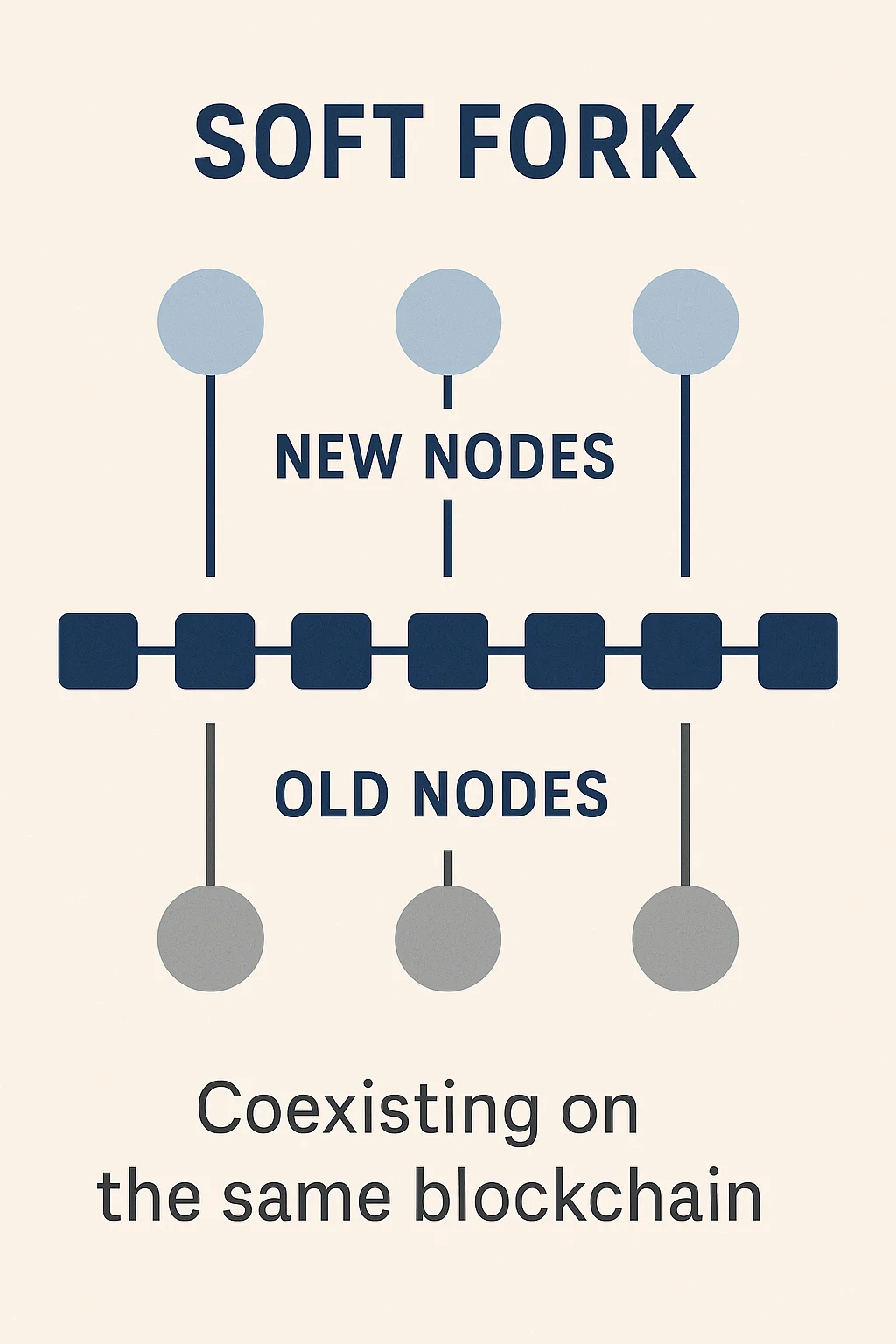
Infographic showing soft fork with old and new blockchain nodes coexisting and interpreting the same chain differently

Real-World Examples

  • SegWit activation on Bitcoin increased transaction capacity through soft fork
  • Taproot upgrade added privacy and smart contract features to Bitcoin
  • EIP-1559 changed Ethereum fee structure through soft fork mechanism

Why Beginners Should Care

Smoother upgrades make soft forks less disruptive than hard forks since the network doesn’t split and old software continues working.

Feature benefits may require wallet or software updates to access, even though the upgrade itself is backward-compatible.

Network security remains intact during soft forks since all nodes continue validating the same blockchain, unlike hard forks that can split hash power.

Related Terms: Hard Fork, SegWit, Network Upgrade, Protocol

Back to Crypto Glossary

Similar Posts

  • Parabolic

    Parabolic: Exponential Price MovementParabolic describes extremely rapid price increases that follow exponential growth curves, often unsustainable in the long term. It's like a rocket shooting straight up into the sky – impressive to watch but likely to come back down eventually.Parabolic refers to price movements that follow exponential growth patterns, characterized by accelerating increases that…

  • Counterparty Risk

    Counterparty Risk: Trusting Others with Your MoneyCounterparty risk is the chance that the other party in a financial transaction won't fulfill their obligations. In crypto, it's the difference between self-custody and hoping someone else doesn't lose your money.Counterparty risk refers to the probability that the other party in a financial transaction will default on their…

  • Yield Farming

    Yield Farming: Crypto’s High-Risk, High-Reward Game Yield farming is DeFi’s answer to traditional investing – except the yields are higher, the risks are bigger, and the game changes daily. Yield farming is the practice of lending, staking, or providing liquidity with your cryptocurrency to earn maximum returns across multiple DeFi protocols. It’s like playing musical…

  • Storage Refund

    Storage Refund: Incentivizing Data CleanupStorage refund mechanisms return gas fees to users who clean up blockchain storage by removing unnecessary data. It's like getting a deposit back when you return empty bottles.Storage refund refers to mechanisms that provide gas fee rebates or payments to users who free up blockchain storage space by deleting data or…

  • Gwei

    Gwei: Ethereum’s Gas Price Unit Gwei is the denomination used for Ethereum gas prices. Understanding gwei helps you avoid overpaying for transactions when the network gets congested. Gwei (gigawei) is a unit of Ethereum’s native currency equal to one billionth of an ETH (10^-9 ETH). It’s the standard unit for expressing gas prices, making it…

  • Reputation System

    Reputation System: Building Digital TrustReputation systems track and score user behavior to enable trust and coordination in decentralized environments. They're like credit scores but for overall trustworthiness and competence.A reputation system records and evaluates user actions, contributions, and behavior to create trustworthiness scores that enable cooperation in decentralized systems. These systems help identify reliable participants without…