
Atomic Swap

Atomic Swap: Trustless Cross-Chain Trading

Atomic swaps enable direct trading between different cryptocurrencies without exchanges or intermediaries. Either both trades complete successfully, or neither happens – no middle ground.

An atomic swap is a smart contract technology that enables the exchange of cryptocurrencies from different blockchains without requiring a trusted third party. The swap either completes entirely for both parties or fails completely, preventing partial execution.

How Atomic Swaps Work

Hash time-locked contracts (HTLCs) create conditional payments that require cryptographic proof to unlock funds within specific time limits. This ensures both parties fulfill their obligations.

Cross-chain compatibility requires both cryptocurrencies to support the same hashing algorithm and basic smart contract functionality for the swap mechanism to work.

Time locks prevent one party from receiving funds without completing their side of the trade. If the swap isn’t completed within the time limit, both parties can reclaim their original funds.
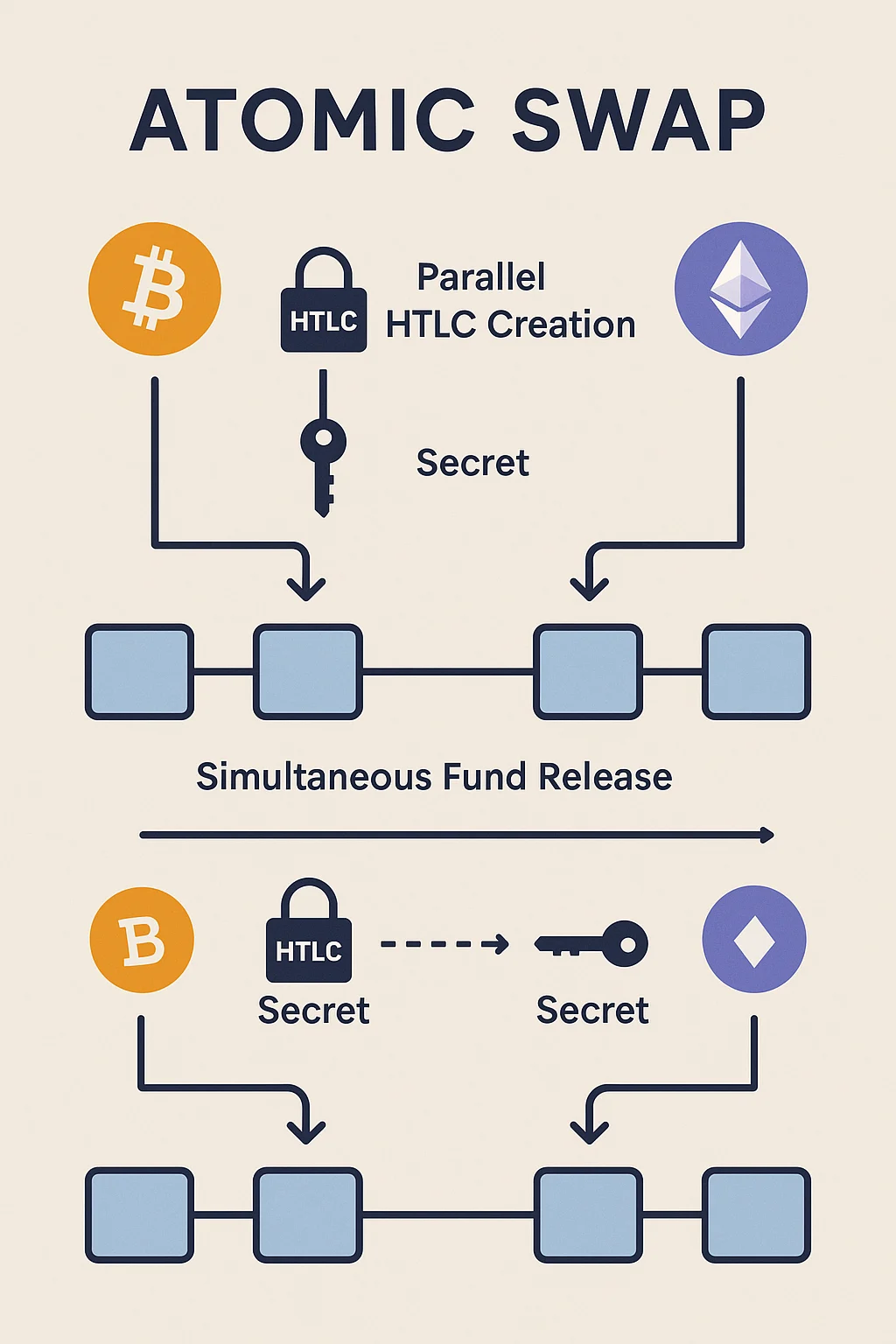
Infographic showing the atomic swap process: parallel HTLC creation, secret revelation, and simultaneous fund release on two blockchains

Real-World Examples

  • Lightning Network enables Bitcoin atomic swaps with compatible cryptocurrencies
  • Komodo pioneered atomic swap technology for cross-chain decentralized exchange
  • Ethereum-Bitcoin swaps require specialized implementations due to different scripting capabilities

Why Beginners Should Care

Decentralized trading eliminates counterparty risk from centralized exchanges while enabling direct peer-to-peer cryptocurrency exchanges across different blockchains.

Technical limitations currently restrict atomic swaps to cryptocurrencies with compatible features, excluding many popular tokens from direct swap capabilities.

User experience remains complex compared to centralized exchanges, requiring technical knowledge and longer settlement times for successful swaps.

Related Terms: Smart Contract, Cross-Chain, HTLC, DEX

Back to Crypto Glossary

Similar Posts

  • Ledger

    Ledger: Hardware Wallet Security Leader Ledger is a leading hardware wallet company that provides secure offline storage for cryptocurrency private keys. They’re like the Fort Knox of crypto storage devices. Ledger is a hardware wallet manufacturer that creates secure devices for storing cryptocurrency private keys offline, protecting them from online threats and hacking attempts. These…

  • Atomic Transaction

    Atomic Transaction: All-or-Nothing OperationsAn atomic transaction either completes entirely or fails completely, with no partial execution possible. It's like a package deal where you get everything or nothing at all.An atomic transaction is an operation that either succeeds completely or fails entirely, ensuring that all components of a complex transaction execute together or none execute…

  • Token Sale

    Token Sale: Cryptocurrency Fundraising EventA token sale is an event where new cryptocurrency projects sell tokens to raise funds for development and operations. It's like a crowdfunding campaign but with digital tokens instead of traditional rewards.A token sale is a fundraising mechanism where cryptocurrency projects offer tokens to investors in exchange for capital to fund…

  • Layer Separation

    Layer Separation: Modular Blockchain ArchitectureLayer separation divides blockchain functionality into distinct layers that can be optimized independently. It's like having specialized departments in a company that each focus on what they do best.Layer separation refers to blockchain architectures that divide functionality into distinct layers such as consensus, execution, and data availability, enabling independent optimization and…

  • Smart Order Routing

    Smart Order Routing: Optimal Trade Execution Smart order routing automatically finds the best prices across multiple exchanges and liquidity sources for each trade. It’s like having a shopping bot that checks every store for the best deal. Smart order routing is an algorithmic system that automatically splits and routes orders across multiple trading venues to…

  • DAO (Decentralized Autonomous Organization)

    DAO (Decentralized Autonomous Organization): Democracy Meets Code DAOs are how crypto communities govern themselves without traditional corporate structures. They’re experiments in digital democracy where token holders vote on everything. A Decentralized Autonomous Organization (DAO) is a community-governed entity where decisions are made collectively by token holders through blockchain-based voting. Smart contracts execute the community’s decisions…