
Smart Order Routing

Smart Order Routing: Optimal Trade Execution

Smart order routing automatically finds the best prices across multiple exchanges and liquidity sources for each trade. It’s like having a shopping bot that checks every store for the best deal.

Smart order routing is an algorithmic system that automatically splits and routes orders across multiple trading venues to achieve optimal execution prices and minimize market impact. This technology maximizes value for traders by finding the best available liquidity.

How Smart Order Routing Works

Liquidity aggregation scans multiple exchanges, DEXs, and market makers to identify the best available prices for required trade sizes.

Order splitting divides large trades into smaller pieces distributed across multiple venues to reduce price impact and improve overall execution.

Real-time optimization continuously adjusts routing decisions based on changing market conditions, fees, and liquidity availability.
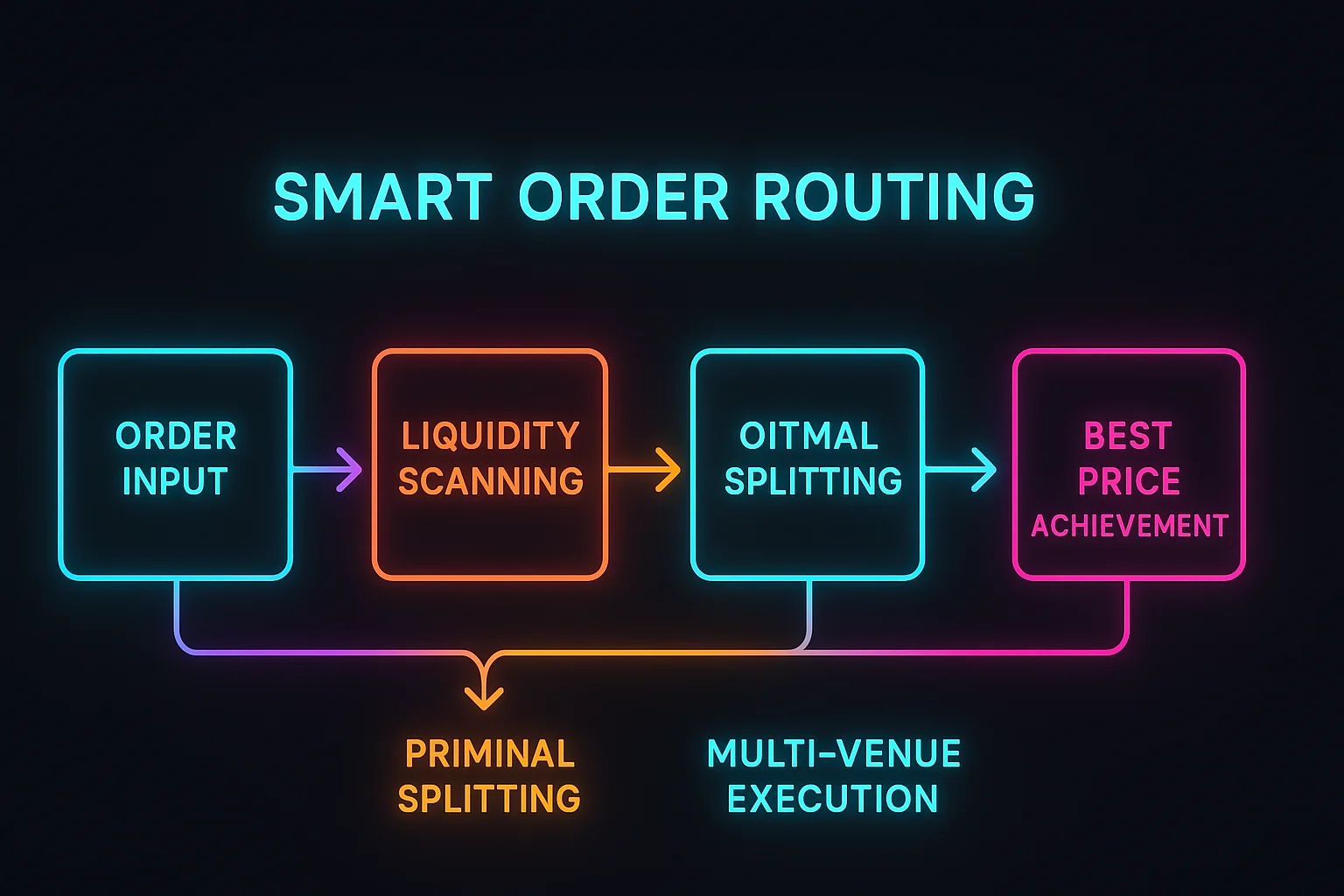
Smart order routing diagram showing order input, liquidity scanning, optimal splitting, multi-venue execution, and best price achievement

Real-World Examples

  • 1inch aggregates DEX liquidity to find optimal trading routes across DeFi protocols
  • CoW Protocol uses batch auctions and routing to improve execution quality
  • Traditional finance has used smart order routing for decades to optimize institutional trading

Why Beginners Should Care

Better prices through automatic optimization that individual traders couldn’t achieve manually across multiple platforms.

Reduced slippage by splitting large orders and finding optimal liquidity sources rather than dumping orders on single exchanges.

Complexity abstraction hides sophisticated routing logic behind simple trading interfaces that anyone can use.

Related Terms: DEX Aggregator, Slippage, Liquidity, Price Impact

Back to Crypto Glossary

Similar Posts

  • Layer 1

    Layer 1: The Foundation Blockchain Layer 1 refers to the base blockchain protocol that processes transactions and maintains consensus. It’s the foundation that everything else builds on top of. Layer 1 (L1) is the main blockchain network that handles transaction processing, consensus, and security independently without relying on other blockchains. These are the foundational networks…

  • Order Book

    Order Book: Market Trading QueueAn order book displays all buy and sell orders for a trading pair, showing market depth and price discovery. It's like a transparent auction house where everyone can see all bids and offers.An order book is a real-time list of buy and sell orders for a specific trading pair, organized by…

  • Fraud Proof

    Fraud Proof: Detecting Invalid TransactionsFraud proofs are cryptographic evidence that demonstrate when invalid transactions or state changes have occurred. They're like mathematical receipts that prove someone broke the rules.Fraud proofs are cryptographic evidence that can demonstrate when invalid state transitions or transactions have occurred in blockchain systems. These proofs enable efficient verification and dispute resolution in…

  • Community

    Community: Decentralized Project StakeholdersCommunity refers to the users, developers, investors, and supporters who participate in and contribute to cryptocurrency projects. They're like the citizens of a digital nation working toward common goals.Community encompasses all stakeholders who participate in cryptocurrency projects including users, developers, investors, validators, and supporters who collectively contribute to project success. Strong communities drive…

  • Verifiable Randomness

    Verifiable Randomness: Provably Fair Random NumbersVerifiable randomness provides cryptographically secure random numbers that can be independently verified for fairness. It's like having dice that everyone can mathematically confirm are not loaded.Verifiable randomness refers to random number generation systems that produce unpredictable outputs while providing cryptographic proofs that the randomness is fair and unbiased. This enables trustless…

  • Wallet Security

    Wallet Security: Protecting Cryptocurrency AccessWallet security encompasses all measures taken to protect cryptocurrency wallets from theft, loss, or unauthorized access. It's like comprehensive security for your digital bank account.Wallet security refers to practices, technologies, and procedures used to protect cryptocurrency wallets and their contents from various threats including hacking, phishing, and user error. Proper security is…