
Proof of Humanity

Proof of Humanity: Verifying Human Uniqueness

Proof of Humanity creates registries of verified unique humans to prevent Sybil attacks in voting and distribution systems. It’s like having a bouncer who knows everyone isn’t wearing a disguise.

Proof of Humanity is a system for creating verifiable registries of unique human beings to prevent individuals from claiming multiple identities in democratic or distribution systems. It aims to enable “one person, one vote” in digital contexts.

How Proof of Humanity Works

Identity verification through video submissions, vouching systems, and social verification to establish that each registration represents a unique human being.

Continuous validation requires periodic renewal and community challenges to maintain registry accuracy and remove fake or duplicate entries.

Application integration enables other protocols to use humanity verification for fair voting, airdrops, or governance participation.
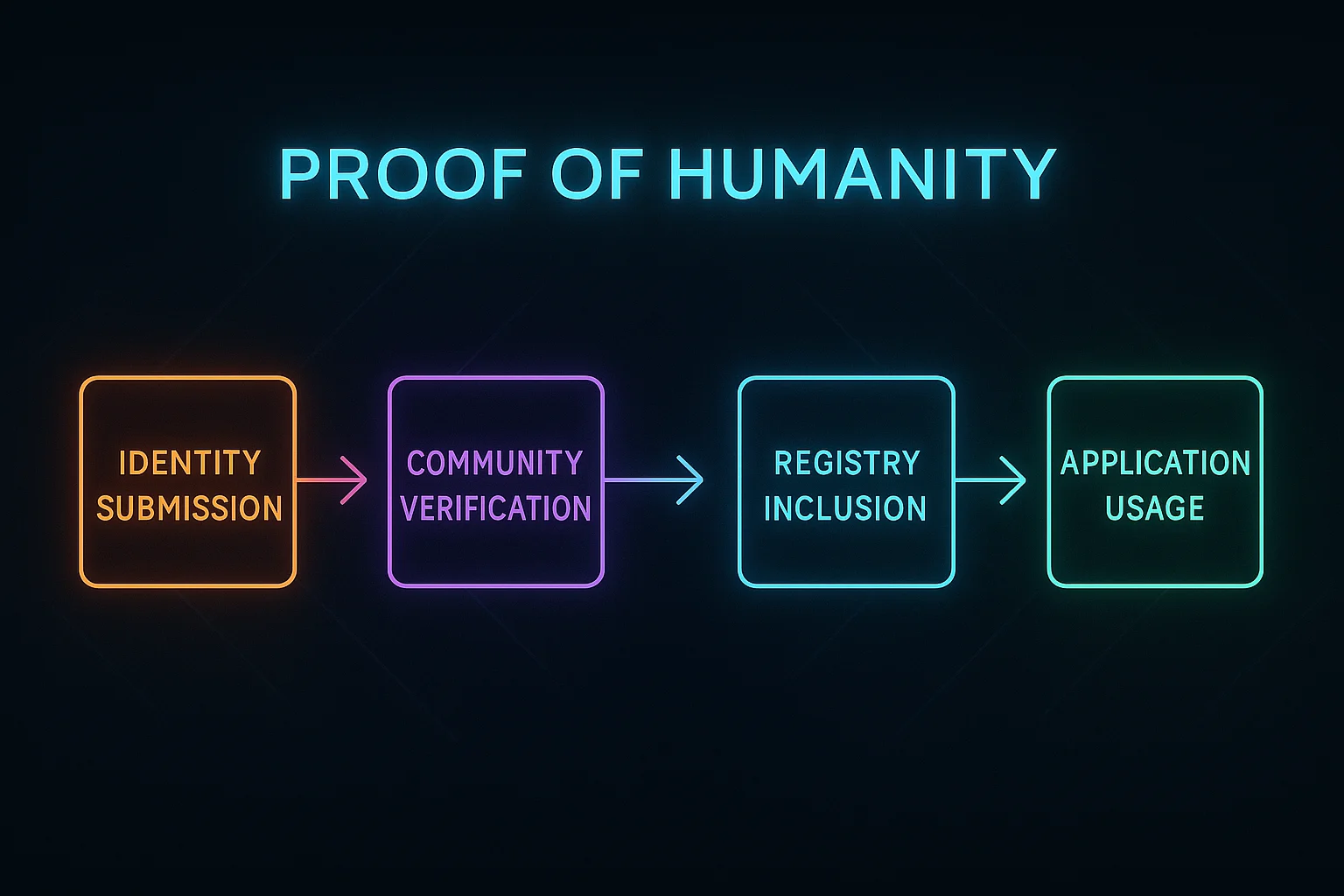
Proof of Humanity flow showing identity submission, community verification, registry inclusion, and application usage

Real-World Examples

  • Proof of Humanity protocol creates Ethereum-based registries of verified humans
  • Worldcoin uses biometric iris scanning for humanity verification
  • BrightID relies on social graph analysis to identify unique humans

Why Beginners Should Care

Democratic participation in crypto governance systems that need to prevent wealthy individuals from claiming multiple votes through fake identities.

Fair distribution mechanisms for airdrops and universal basic income programs that should reach real people rather than bot farms.

Privacy trade-offs as humanity verification often requires revealing personal information or biometric data to prove uniqueness.

Related Terms: Sybil Attack, Anti-Sybil Mechanism, Democratic Governance

Back to Crypto Glossary

Similar Posts

  • Recursive Proofs

    Recursive Proofs: Self-Verifying Cryptographic SystemsRecursive proofs are cryptographic proofs that can verify other proofs of the same type, enabling compression and scalability. They're like mathematical matryoshka dolls where each proof contains and verifies other proofs.Recursive proofs are cryptographic systems where proofs can verify other instances of the same proof system, enabling compression of multiple proofs…

  • Consensus Layer

    Consensus Layer: Network Agreement FoundationThe consensus layer handles how blockchain networks achieve agreement on valid transactions and network state. It's the democratic voting system that keeps everyone on the same page.The consensus layer is the component of blockchain architecture responsible for coordinating agreement among network participants about transaction validity and blockchain state. This layer ensures all…

  • Digital Securities

    Digital Securities: Blockchain-Based Financial InstrumentsDigital securities are traditional financial instruments like stocks and bonds represented as tokens on blockchain networks. They're like digitizing paper stock certificates to work on the internet.Digital securities are blockchain-based tokens that represent ownership in traditional financial instruments such as stocks, bonds, or real estate, subject to securities regulations. These bridge conventional…

  • Fractional Ownership

    Fractional Ownership: Shared Asset OwnershipFractional ownership enables multiple people to own portions of expensive assets that would be difficult to purchase individually. It's like buying a slice of expensive real estate instead of the whole property.Fractional ownership refers to dividing ownership of assets into smaller portions that can be owned by multiple parties, typically enabled…

  • Block Building

    Block Building: Transaction Assembly ProcessBlock building is the process of selecting and organizing transactions into blocks that will be added to the blockchain. It's like a chef choosing ingredients and assembling them into a complete meal that satisfies both taste and nutritional requirements.Block building refers to the process where miners or validators select, order, and…

  • Public Key

    Public Key: Cryptographic Identity VerificationA public key is the openly shareable part of a cryptographic key pair that enables others to send you cryptocurrency or verify your digital signatures. It's like your mailing address that you can give to anyone who wants to send you mail.Public key refers to the cryptographic component of a key…