
Real Yield

Real Yield: Sustainable Revenue-Based Returns

Real yield comes from actual protocol revenue rather than token emissions or inflationary rewards. It’s the difference between earning from productive business activity versus printing more money.

Real yield refers to returns generated from genuine protocol revenue, fees, or value creation rather than token inflation or emissions. These yields can theoretically continue indefinitely since they’re backed by actual economic activity.

How Real Yield Works

Revenue generation from protocol fees, transaction costs, or service charges creates income that gets distributed to token holders or stakers.

Fee sharing mechanisms redirect a portion of protocol revenue to participants who provide value like liquidity, governance, or security services.

Sustainable economics enable long-term yield generation without depending on new money entering the system to pay existing participants.
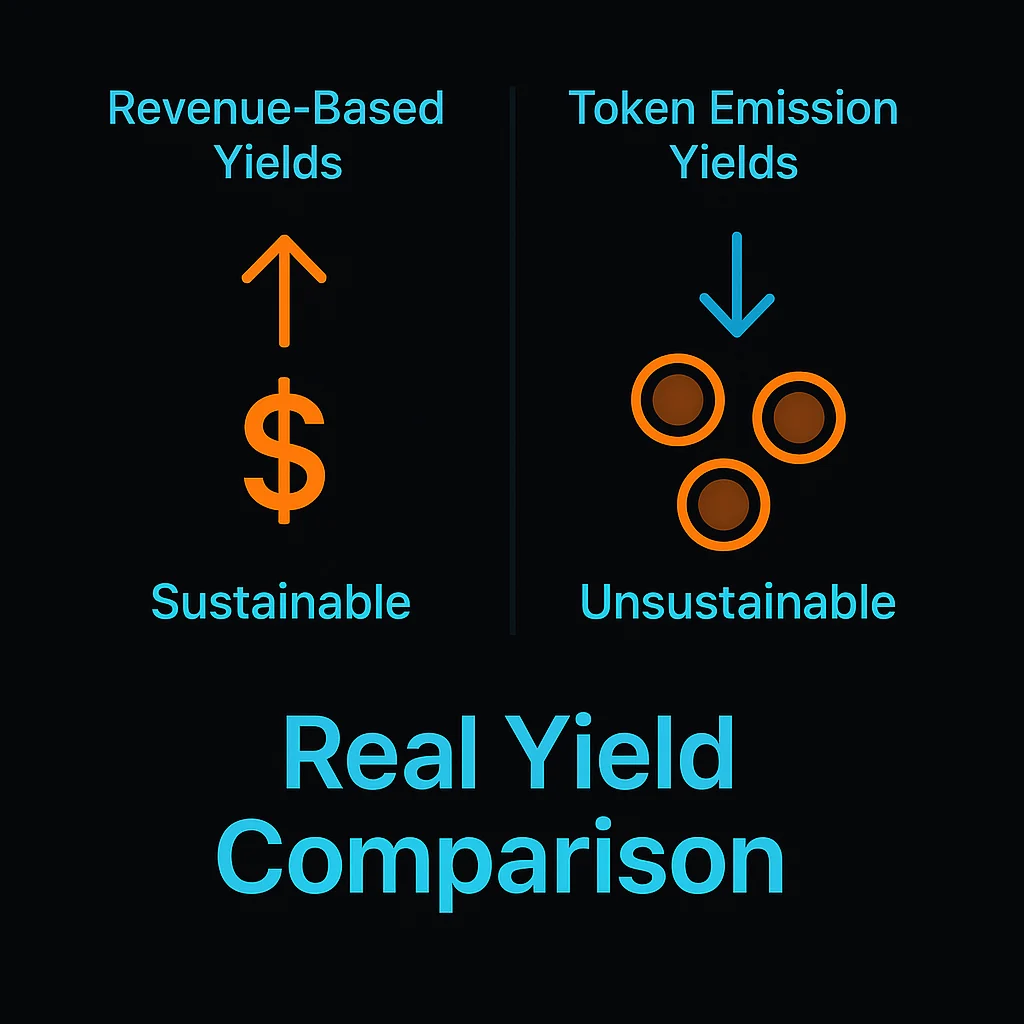
Real yield comparison showing revenue-based sustainable yields versus token emission-based unsustainable yields

Real-World Examples

  • GMX distributes trading fees to token stakers from actual platform revenue
  • Synthetix shares trading fees from synthetic asset exchanges with SNX stakers
  • MakerDAO distributes stability fees from DAI borrowing to MKR holders

Why Beginners Should Care

Sustainability assessment helps distinguish between temporary incentive programs and genuinely profitable protocols that can maintain yields long-term.

Lower but stable returns compared to high-emission farming programs that typically decrease as token prices fall or incentives end.

Business model validation as real yield demonstrates that protocols create genuine value worth paying for rather than existing purely for speculation.

Related Terms: Protocol Revenue, Fee Sharing, Sustainable Yield, Token Emissions

Back to Crypto Glossary

Similar Posts

  • Fee Market

    Fee Market: Transaction Cost EconomicsA fee market determines transaction costs through supply and demand dynamics between users and network capacity. It's like surge pricing for blockchain transactions during busy periods.A fee market is an economic system where transaction fees are determined by competition between users for limited blockchain processing capacity. Higher demand relative to supply drives…

  • Market Cap

    Market Cap: How to Value Crypto Projects Market cap tells you how much the entire crypto market values a project. It’s the most important number for comparing different cryptocurrencies. Market capitalization is the total value of all coins in circulation, calculated by multiplying the current price by the circulating supply. It shows the relative size…

  • ZK-EVM

    ZK-EVM: Zero-Knowledge Ethereum Compatibility ZK-EVM provides Ethereum compatibility while using zero-knowledge proofs for scalability and privacy. It’s like having Ethereum that’s faster, cheaper, and more private. ZK-EVM is a zero-knowledge rollup that maintains full compatibility with Ethereum’s execution environment while using ZK proofs for validation. This enables existing Ethereum applications to run without modification while…

  • Sunk Cost

    Sunk Cost: Irretrievable Past InvestmentsSunk cost refers to money already spent that cannot be recovered, which shouldn't influence future investment decisions. It's like refusing to leave a terrible movie halfway through just because you already paid for the ticket.Sunk cost describes past investments or expenditures that cannot be recovered and should not factor into future…

  • Chain Abstraction

    Chain Abstraction: Invisible Multi-Chain Experience Chain abstraction hides blockchain complexity from users, making multi-chain interactions feel like using a single network. It’s like having universal currency that works everywhere without exchange rates. Chain abstraction creates user experiences where interactions with multiple blockchains happen seamlessly without users needing to understand or manage different networks, tokens, or…

  • Intent-Centric Protocols

    Intent-Centric Protocols: What You Want, Not How Intent-centric protocols let users specify desired outcomes while the system figures out how to achieve them. Instead of manually executing swap steps, you just say “I want USDC” and the protocol handles everything. Intent-centric protocols allow users to express desired end states rather than specific transaction sequences. Users…