
Liquidity Bootstrapping

Liquidity Bootstrapping: Fair Token Launch Mechanism

Liquidity bootstrapping uses gradually declining prices to enable fair token distribution while building trading liquidity. It’s like having a reverse auction that creates a fair market price.

Liquidity bootstrapping is a token launch mechanism that starts with high prices that gradually decrease over time, allowing market forces to discover fair value while building trading liquidity. This prevents bots from capturing all tokens at launch.

How Liquidity Bootstrapping Works

Descending price auctions start with high token prices that automatically decrease until market demand matches the declining price curve.

Automated market making provides continuous liquidity throughout the price discovery process rather than relying on order book matching.

Bot resistance through high initial prices and gradual decreases makes it unprofitable for bots to extract value from early price inefficiencies.
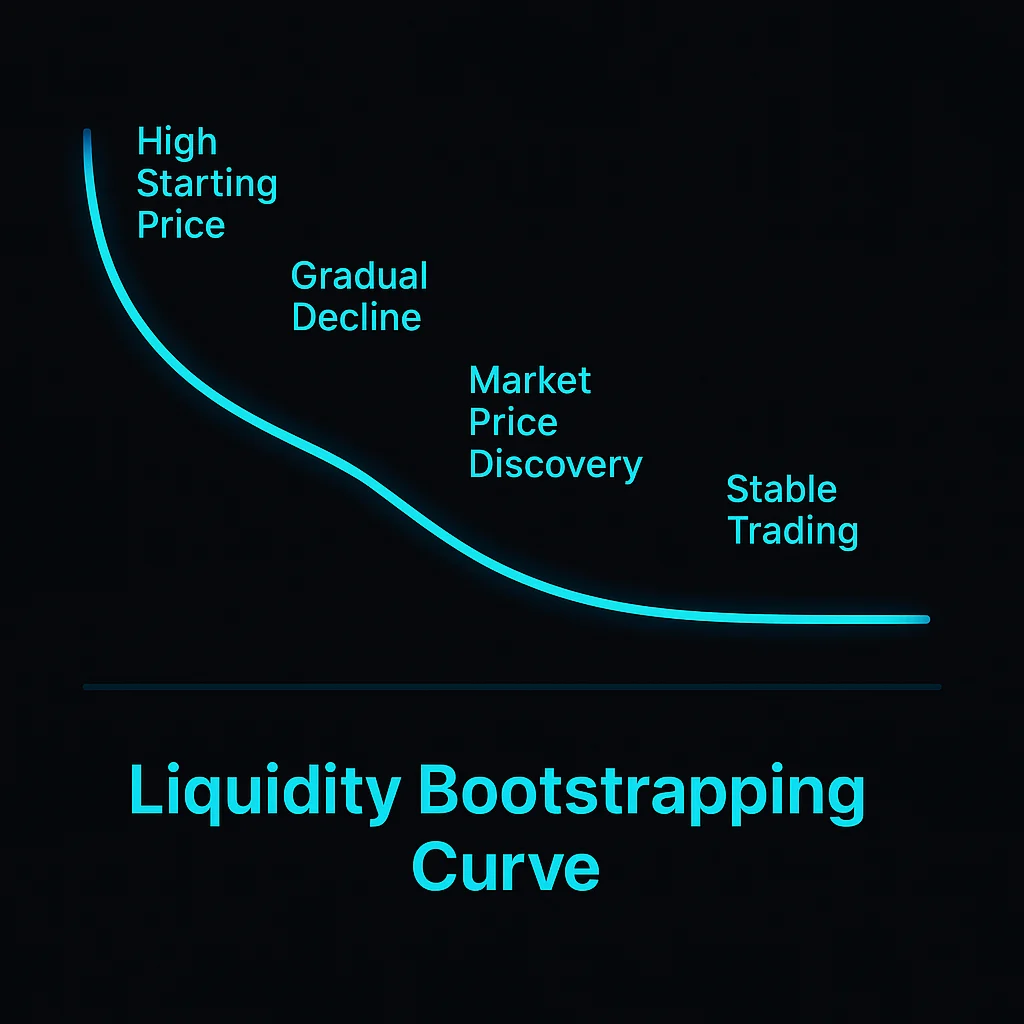
Liquidity bootstrapping curve showing high starting price, gradual decline, market price discovery, and stable trading

Real-World Examples

  • Balancer LBPs have launched hundreds of projects with fair price discovery mechanisms
  • Copper Launch provides liquidity bootstrapping infrastructure for new tokens
  • Major DeFi projects use LBPs to avoid the problems of traditional fixed-price token sales

Why Beginners Should Care

Fairer distribution compared to fixed-price sales where bots often capture most tokens before regular users can participate.

Price discovery through market mechanisms rather than arbitrary pricing by project teams who may not understand market demand.

Participation timing flexibility allows users to buy at any point during the bootstrap period rather than competing for limited fixed-price allocations.

Related Terms: Token Launch, Price Discovery, Fair Distribution, Automated Market Maker

Back to Crypto Glossary

Similar Posts

  • NFT (Non-Fungible Token)

    NFT (Non-Fungible Token): Digital Ownership Certificates NFTs transformed JPEGs into million-dollar assets and made digital ownership mainstream. Love them or hate them, they’re reshaping how we think about digital property. A Non-Fungible Token (NFT) is a unique digital certificate stored on a blockchain that proves ownership of a specific digital asset. Unlike cryptocurrencies where each…

  • Decentralized Computing

    Decentralized Computing: Distributed Processing PowerDecentralized computing distributes computational tasks across networks of independent computers rather than relying on centralized data centers. It's like having a supercomputer made of everyone's spare processing power.Decentralized computing refers to distributed systems where computational tasks are processed across multiple independent nodes rather than centralized servers or data centers. This creates more…

  • Verification

    Verification: Confirming Accuracy and AuthenticityVerification is the process of confirming that information, transactions, or claims are accurate and authentic without requiring trust in the information source. It's like being able to personally test that a diamond is real using scientific instruments instead of just believing the jeweler's word.Verification refers to the mathematical and cryptographic processes…

  • Monero

    Monero: Privacy-Focused CryptocurrencyMonero is a privacy-focused cryptocurrency that hides transaction details by default. It's like having a completely private bank account where no one can see your balance or transaction history.Monero is a privacy-focused cryptocurrency that uses advanced cryptographic techniques to hide transaction amounts, sender addresses, and recipient addresses by default. This provides strong financial privacy…

  • Cryptography

    Cryptography: Mathematical Security FoundationCryptography is the mathematical science of securing information through encryption, digital signatures, and other techniques. It's the foundation that makes cryptocurrencies and blockchain technology secure and trustworthy.Cryptography refers to mathematical techniques for securing information, enabling authentication, and protecting data confidentiality through algorithms and protocols. Modern cryptocurrency systems depend entirely on cryptographic security for…

  • Exploit

    Exploit: Taking Advantage of VulnerabilitiesAn exploit is an attack that takes advantage of vulnerabilities in smart contracts or protocols to steal funds or manipulate systems. It's like finding a secret backdoor in a building.An exploit refers to successfully taking advantage of vulnerabilities, bugs, or design flaws in smart contracts, protocols, or systems to extract value…