
Ledger

Ledger: Hardware Wallet Security Leader

Ledger is a leading hardware wallet company that provides secure offline storage for cryptocurrency private keys. They’re like the Fort Knox of crypto storage devices.

Ledger is a hardware wallet manufacturer that creates secure devices for storing cryptocurrency private keys offline, protecting them from online threats and hacking attempts. These devices enable secure transaction signing without exposing sensitive information.

How Ledger Devices Work

Secure element chips store private keys in tamper-resistant hardware that prevents extraction even with physical access to the device.

Offline transaction signing enables authorizing cryptocurrency transactions without connecting private keys to internet-connected computers.

Recovery mechanisms through seed phrases allow restoring wallet access if the hardware device is lost, stolen, or damaged.
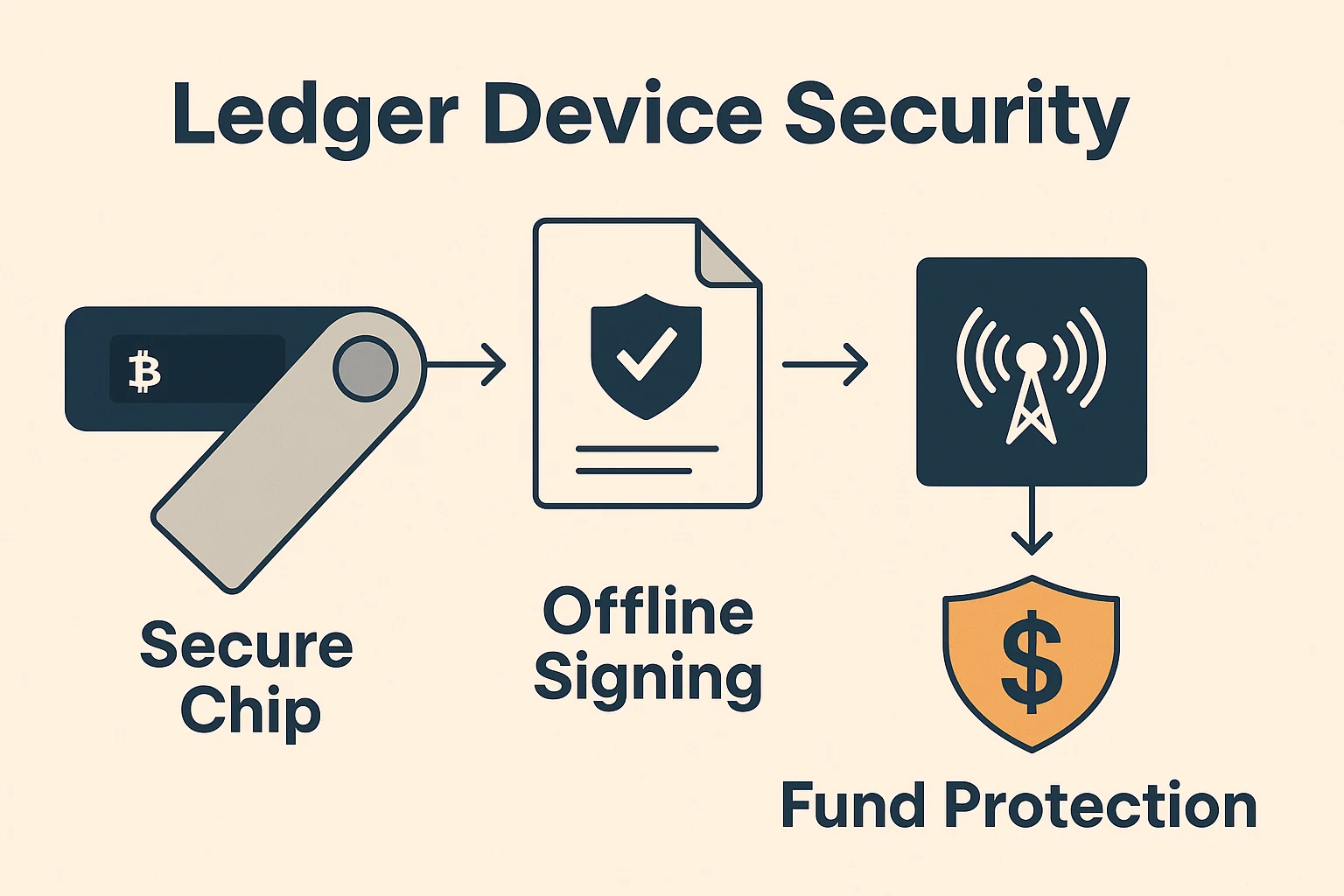
Infographic showing Ledger device flow: secure chip, offline signing, transaction broadcast, and fund protection

Real-World Examples

  • Ledger Nano S Plus provides affordable cold storage for multiple cryptocurrencies
  • Ledger Nano X offers Bluetooth connectivity for mobile device integration
  • Ledger Stax features advanced display and user interface capabilities

Why Beginners Should Care

Security enhancement over software wallets by keeping private keys offline and away from potential malware or hacking attempts.

Multi-currency support enables storing various cryptocurrencies on a single device with official wallet applications.

Industry reputation as Ledger devices are widely trusted by both beginners and institutional users for secure cryptocurrency storage.

Related Terms: Hardware Wallet, Cold Storage, Private Key, Secure Element

Back to Crypto Glossary

Similar Posts

  • Bonding Curve

    Bonding Curve: Algorithmic Token Pricing Bonding curves use mathematical formulas to automatically price tokens based on supply. As more tokens get bought, prices increase predictably according to the curve’s formula. A bonding curve is an algorithmic pricing mechanism that determines token price based on token supply through a mathematical function. Prices increase as supply grows…

  • Smart Contract Audit

    Smart Contract Audit: Code Security ReviewSmart contract audits involve professional security reviews of blockchain code to identify vulnerabilities before deployment. It's like having building inspectors for digital architecture.A smart contract audit is a comprehensive security review of blockchain application code conducted by experts to identify vulnerabilities, bugs, and potential attack vectors before public deployment. These reviews…

  • Wei

    Wei: Ethereum's Smallest UnitWei is the smallest denomination of Ethereum, similar to how cents are the smallest unit of dollars. It's like measuring distances in millimeters when you need precision, even though we usually think in meters or kilometers.Wei represents the smallest possible unit of Ethereum (ETH), with one ETH equal to 1,000,000,000,000,000,000 (10^18) wei. This…

  • Sanctions

    Sanctions: Government Financial RestrictionsCryptocurrency sanctions involve government restrictions on specific addresses, entities, or services to prevent them from accessing financial systems. They're economic weapons adapted for the digital age.Sanctions refer to government-imposed restrictions that prohibit individuals, entities, or services from accessing financial systems or conducting specific activities. In crypto, this includes blocking addresses and restricting access…

  • ENS

    ENS: Ethereum Name ServiceENS provides human-readable names for Ethereum addresses, making cryptocurrency transactions more user-friendly. It's like having domain names for websites instead of remembering IP addresses.Ethereum Name Service (ENS) is a decentralized naming system that maps human-readable names to Ethereum addresses, smart contracts, and other identifiers. ENS makes blockchain interactions more accessible by replacing complex…

  • Governance Token

    Governance Token: Voting Rights in Digital Form Governance tokens turn users into stakeholders with voting power over protocol decisions. It’s democracy meets DeFi, with mixed results. A governance token grants holders voting rights on protocol decisions like parameter changes, upgrade proposals, treasury spending, and strategic direction. Token weight typically determines voting power – more tokens…