
Gas Limit

Gas Limit: Setting Your Transaction Budget

Gas limit is the maximum amount of gas you’re willing to spend on a transaction. Set it too low and your transaction fails. Set it too high and you overpay for simple operations.

Gas limit is the maximum amount of computational work (measured in gas units) that a user is willing to pay for when submitting a transaction to the Ethereum network. It acts as a safety mechanism preventing runaway smart contracts from draining your wallet.

How Gas Limit Works

Computational budgeting ensures transactions can’t consume unlimited resources. Each operation in smart contracts has a predefined gas cost, and the total can’t exceed your set limit.

Transaction failure occurs if operations require more gas than your limit allows. You still pay for gas consumed up to the failure point, but the transaction doesn’t complete.

Estimation tools in wallets automatically suggest appropriate gas limits based on transaction complexity, though users can adjust these recommendations manually.
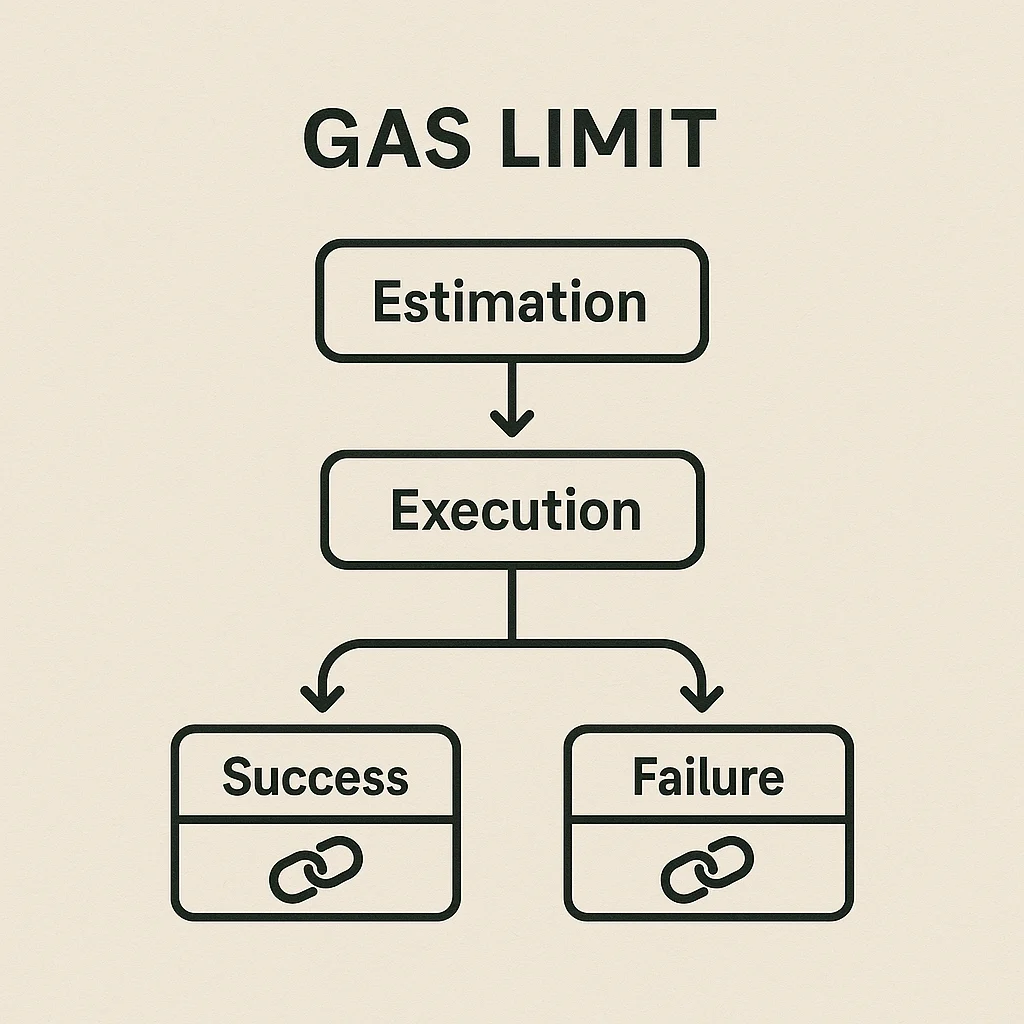
Infographic showing gas limit transaction flow from estimation to execution and outcome of success or failure

Real-World Examples

  • Simple ETH transfers typically need 21,000 gas limit
  • DEX swaps might require 150,000-300,000 gas depending on complexity
  • Complex DeFi operations can need 500,000+ gas for multi-step transactions

Why Beginners Should Care

Failed transactions still cost money if they run out of gas, so understanding appropriate limits prevents wasted fees on unsuccessful operations.

Overpaying happens when gas limits are set much higher than needed. Unused gas gets refunded, but setting reasonable limits prevents tying up excess funds.

Network congestion affects optimal gas limit strategies. During high demand, slightly higher limits can prevent failures when network conditions change between submission and execution.

Related Terms: Gas Fees, Gas Price, Smart Contract, Transaction

Back to Crypto Glossary

Similar Posts

  • Total Supply

    Total Supply: Maximum Token QuantityTotal supply refers to the maximum number of cryptocurrency tokens that will ever exist, including those not yet in circulation. It's like knowing how many copies of a collectible item will ever be made.Total supply encompasses all cryptocurrency tokens that exist or will ever be created, including circulating supply, locked tokens,…

  • Solver Network

    Solver Network: Optimized Transaction ExecutionA solver network consists of specialized entities that find optimal execution paths for complex transactions across multiple protocols and chains. They're like GPS systems that find the best routes for your crypto transactions.A solver network comprises specialized services that analyze and execute complex transactions by finding optimal paths across multiple protocols,…

  • Execution Layer

    Execution Layer: Transaction Processing EngineThe execution layer handles transaction processing and smart contract execution within blockchain architectures. It's like the engine that actually does the work in a modular blockchain system.The execution layer is responsible for processing transactions, executing smart contracts, and managing state changes within blockchain networks. In modular architectures, this layer can be optimized…

  • Satoshi

    Satoshi: Bitcoin's Smallest UnitA satoshi is the smallest unit of bitcoin, equal to 0.00000001 BTC. It's named after Bitcoin's pseudonymous creator and makes bitcoin divisible for everyday transactions.A satoshi (sat) is the smallest divisible unit of bitcoin, representing one hundred millionth of a bitcoin. This granular divisibility enables bitcoin to function as digital cash for transactions…

  • Verification

    Verification: Confirming Accuracy and AuthenticityVerification is the process of confirming that information, transactions, or claims are accurate and authentic without requiring trust in the information source. It's like being able to personally test that a diamond is real using scientific instruments instead of just believing the jeweler's word.Verification refers to the mathematical and cryptographic processes…

  • Market Cap

    Market Cap: How to Value Crypto Projects Market cap tells you how much the entire crypto market values a project. It’s the most important number for comparing different cryptocurrencies. Market capitalization is the total value of all coins in circulation, calculated by multiplying the current price by the circulating supply. It shows the relative size…