
Data Availability Layer

Data Availability Layer: Ensuring Information Access

Data availability layers ensure that blockchain data remains accessible for verification without requiring full nodes to store everything. It’s like having a library system where you can verify any book exists without storing them all.

A data availability layer guarantees that blockchain transaction data is published and remains accessible for verification, even if not all nodes store complete copies. This enables scalable architectures while maintaining security guarantees.

How Data Availability Works

Data publication requires block producers to make transaction data publicly available, even if execution happens elsewhere or in summarized form.

Availability proofs use cryptographic techniques like data availability sampling to verify data accessibility without downloading complete datasets.

Fraud prevention ensures malicious actors cannot hide transaction data that would enable verification of incorrect state transitions or invalid blocks.
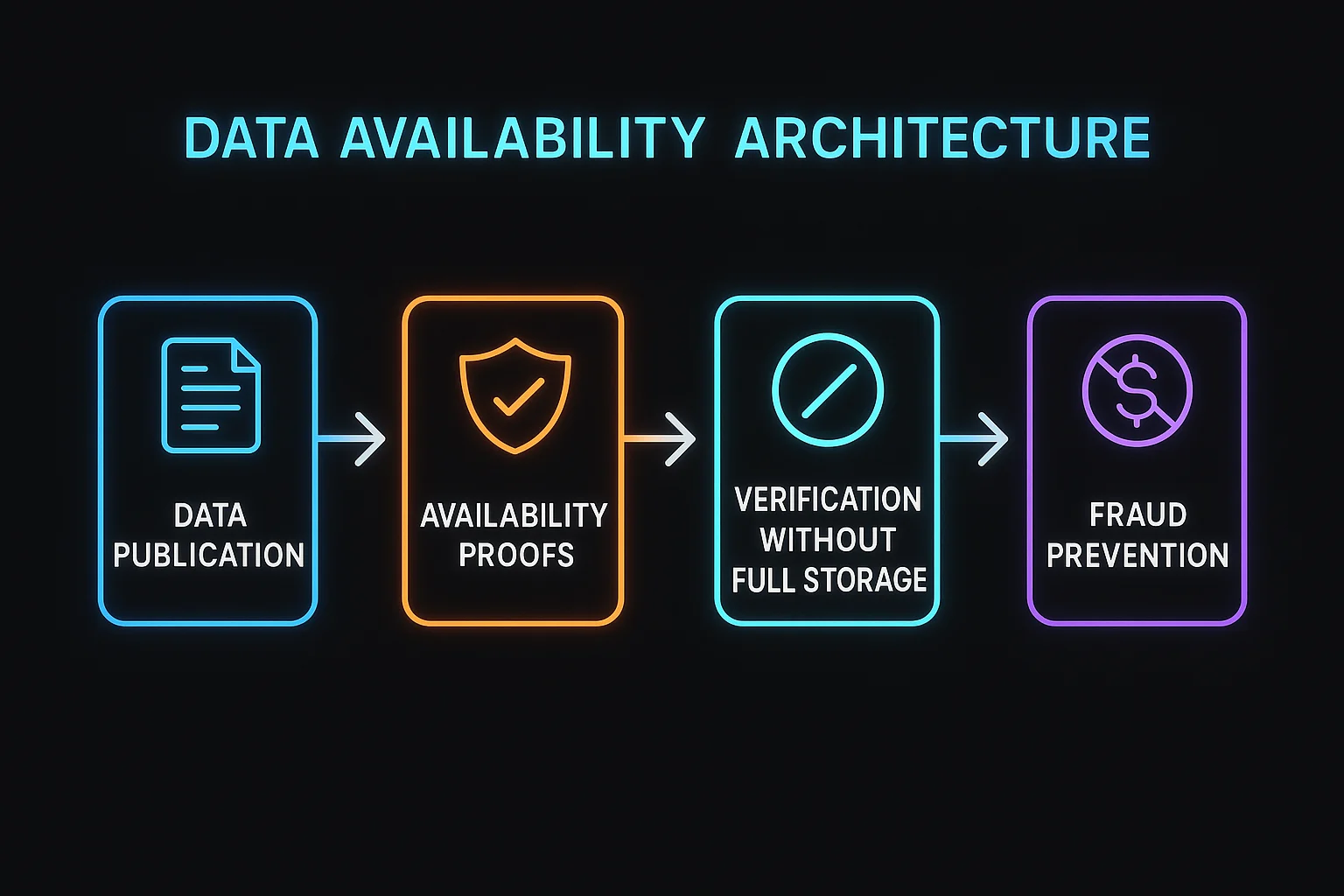
Data availability architecture showing data publication, availability proofs, verification without full storage, and fraud prevention

Real-World Examples

  • Celestia provides dedicated data availability services for modular blockchain architectures
  • Ethereum serves as a data availability layer for various Layer 2 rollup solutions
  • Polygon Avail offers scalable data availability for sovereign blockchain networks

Why Beginners Should Care

Scalability enablement through data availability layers that support much higher transaction throughput than traditional blockchain architectures.

Security preservation maintains verification capabilities and fraud detection without requiring all participants to store complete blockchain histories.

Technical complexity in understanding how data availability relates to overall blockchain security and decentralization properties.

Related Terms: Modular Blockchain, Data Sampling, Fraud Proof, Scalability

Back to Crypto Glossary

Similar Posts

  • DeFi Primitives

    DeFi Primitives: Basic Building BlocksDeFi primitives are fundamental financial functions like lending, borrowing, and trading that serve as building blocks for more complex decentralized finance applications. They're like Lego blocks for financial services.DeFi primitives refer to basic financial functions implemented as smart contracts that can be combined to create more complex financial products and services. These…

  • Team Doxxing

    Team Doxxing: Revealing Anonymous IdentitiesTeam doxxing involves revealing the real identities of previously anonymous cryptocurrency project team members. It's like unmasking superheroes to show who's really behind the project.Team doxxing refers to the disclosure of real identities, backgrounds, and personal information of cryptocurrency project team members who were previously anonymous or pseudonymous. This can be voluntary…

  • Derivatives

    Derivatives: Financial Contracts Based on Underlying AssetsCryptocurrency derivatives are financial contracts whose value depends on underlying crypto assets. They're like betting on sports outcomes instead of playing the game yourself.Derivatives are financial instruments that derive their value from underlying cryptocurrency assets, enabling trading, hedging, and speculation without direct ownership of the base assets. These include futures,…

  • DeFi Insurance

    DeFi Insurance: Protecting Against Smart Contract Risk DeFi insurance provides coverage against smart contract failures, hacks, and protocol exploits. It’s like buying fire insurance for your digital assets in experimental financial protocols. DeFi insurance offers protection against losses from smart contract bugs, hacks, oracle failures, and other technical risks in decentralized finance protocols. Users pay…

  • Node

    Node: The Network’s Backbone Nodes are individual computers that maintain copies of the blockchain and enforce network rules. They’re the distributed infrastructure that makes cryptocurrency possible. A node is a computer that participates in a blockchain network by maintaining a copy of the distributed ledger and relaying transactions. Nodes validate transactions, store blockchain history, and…

  • Challenge Period

    Challenge Period: Dispute Resolution WindowA challenge period is a time window during which participants can dispute or challenge proposed changes before they become final. It's like a cooling-off period for important decisions.A challenge period is a predetermined time frame that allows network participants to dispute transactions, withdrawals, or governance proposals before they become irreversible. This mechanism…