
Liquidity Pool

Liquidity Pool: The Fuel That Powers DEX Trading

Liquidity pools are why decentralized exchanges work. They’re shared pots of tokens that enable trading without traditional buyers and sellers.

A liquidity pool is a collection of tokens locked in a smart contract that provides liquidity for decentralized trading. Instead of matching buy and sell orders, traders swap against these pools using automated market maker (AMM) algorithms.

How Liquidity Pools Work

Liquidity providers deposit equal values of two tokens (like ETH and USDC) into a pool. When traders want to swap ETH for USDC, they trade against this pool rather than with another person.

The pool maintains balance using mathematical formulas. As one token gets scarce, its price automatically increases to encourage arbitrageurs to rebalance the pool.

Liquidity providers earn trading fees proportional to their share of the pool. More trading volume means more fees for providers.
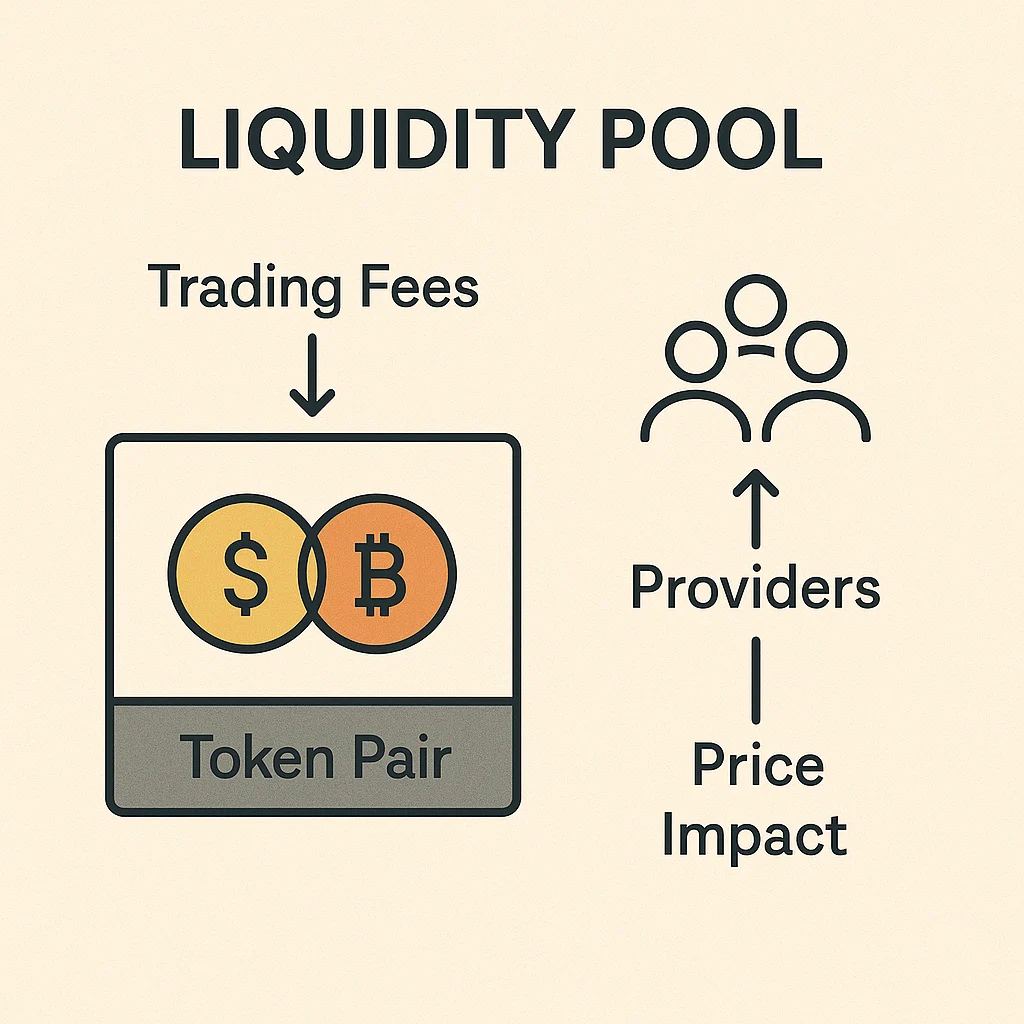
Infographic showing a liquidity pool with token pairs, trading fees flowing to providers, and price impact mechanics

Real-World Examples

  • ETH/USDC pools on Uniswap earn steady fees from high trading volume
  • Stablecoin pools offer lower risk but smaller returns
  • New token pools can be highly profitable but extremely risky

Why Beginners Should Care

Liquidity pools let you earn passive income from your crypto holdings. Instead of holding tokens that do nothing, you can put them to work earning trading fees.

But understand impermanent loss first – if token prices diverge significantly, you might end up with less value than just holding the tokens separately.

Related Terms: DEX, Impermanent Loss, Yield Farming, AMM

Back to Crypto Glossary

Similar Posts

  • Transaction Signing

    Transaction Signing: Authorizing Blockchain OperationsTransaction signing uses private keys to create cryptographic signatures that authorize blockchain transactions. It's like signing a check with an unforgeable signature that proves you approved the payment.Transaction signing is the process of creating cryptographic signatures using private keys to authorize and authenticate blockchain transactions. This process proves ownership and prevents unauthorized…

  • ZK Proof Aggregation

    ZK Proof Aggregation: Scaling Zero-Knowledge Systems ZK proof aggregation combines multiple zero-knowledge proofs into single, more efficient proofs. It’s like having one master key that proves you have access to multiple locked boxes. ZK proof aggregation is a technique that combines multiple zero-knowledge proofs into a single proof that verifies all the original statements simultaneously….

  • Message Passing

    Message Passing: Cross-System CommunicationMessage passing enables different blockchain networks or applications to communicate by transmitting information across system boundaries. It's like having a universal postal service that can deliver letters between different countries with different languages and customs.Message passing refers to communication protocols that enable different blockchain networks, smart contracts, or applications to exchange information…

  • Governance Token

    Governance Token: Voting Rights in CryptoGovernance tokens provide holders with voting rights in decentralized protocols and organizations. They're like shares in a company, but for decentralized projects where the community makes decisions.A governance token is a cryptocurrency that grants holders voting rights over protocol changes, treasury allocation, and other governance decisions in decentralized projects. These tokens…

  • Wallet Address

    Wallet Address: Your Cryptocurrency Bank Account NumberA wallet address is a unique identifier that enables receiving cryptocurrency payments. It's like a bank account number that others can send money to, but it's generated from your private keys.A wallet address is a unique alphanumeric string that serves as a destination for cryptocurrency transactions. These addresses are derived…

  • Token Burn

    Token Burn: Destroying Supply for Value Token burns permanently remove cryptocurrency from circulation by sending it to addresses where it can never be recovered. It’s digital deflation in action. Token burn is the permanent removal of cryptocurrency tokens from circulation by sending them to an unusable address or smart contract that destroys them. This reduces…