
Impermanent Loss

Impermanent Loss: The Hidden Cost of Liquidity Providing

Impermanent loss is the sneaky tax on liquidity providers. Your tokens can lose value even when the pool is profitable. It’s math, not magic – but it feels like getting robbed.

Impermanent loss occurs when the price ratio of tokens in a liquidity pool changes compared to when you deposited them. You end up with less value than if you had simply held the tokens separately, even though you earned trading fees.

How Impermanent Loss Works

Automated Market Makers maintain token ratios through arbitrage. When one token’s price increases, arbitrageurs buy it from the pool until the price matches external markets.

You’re selling winners and buying losers automatically. If ETH pumps 50% against USDC, the pool sells your ETH for USDC to maintain balance, giving you less ETH than you started with.

The loss is “impermanent” because if prices return to original ratios, the loss disappears. But if price divergence persists, the loss becomes very real.
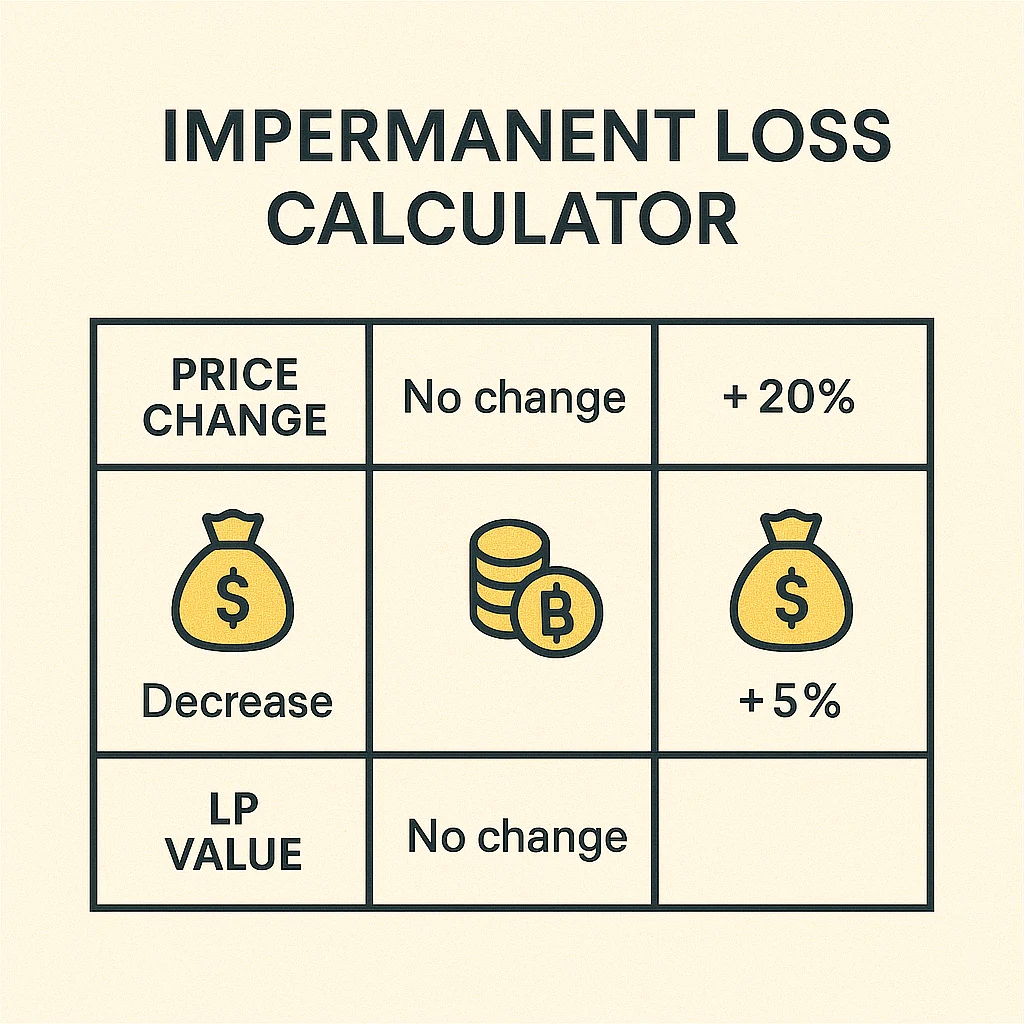
Infographic showing impermanent loss scenarios based on token price changes and their impact on LP value

Real-World Examples

  • ETH/USDC pool during ETH bull run – you miss some ETH gains but earn trading fees
  • Stablecoin pools have minimal impermanent loss but lower fee returns
  • Volatile pairs can create severe impermanent loss that exceeds fee earnings

Why Beginners Should Care

Many new DeFi users discover impermanent loss after the fact, wondering why their “profitable” liquidity position lost money compared to holding tokens.

Calculate the trade-off before providing liquidity. High-fee pools might compensate for impermanent loss, while low-fee pools might not justify the risk.

Stablecoin pairs minimize impermanent loss risk while still earning yield from trading fees and liquidity mining rewards.

Related Terms: Liquidity Pool, Yield Farming, AMM, DEX

Back to Crypto Glossary

Similar Posts

  • Derivatives

    Derivatives: Financial Contracts Based on Underlying AssetsCryptocurrency derivatives are financial contracts whose value depends on underlying crypto assets. They're like betting on sports outcomes instead of playing the game yourself.Derivatives are financial instruments that derive their value from underlying cryptocurrency assets, enabling trading, hedging, and speculation without direct ownership of the base assets. These include futures,…

  • Social Recovery

    Social Recovery: Community-Based Account RecoverySocial recovery allows regaining access to cryptocurrency accounts through trusted contacts rather than relying solely on seed phrases. It's like having friends hold spare keys to your house.Social recovery is a wallet security mechanism that enables account recovery through a network of trusted contacts rather than requiring users to manage seed…

  • zk-Rollup

    zk-Rollup: Zero-Knowledge Scaling Solutionzk-Rollups are Layer 2 scaling solutions that bundle hundreds of transactions into single proofs, dramatically reducing costs while maintaining security. They're like packing many letters into one envelope instead of sending each letter separately, but with mathematical proof that all letters are authentic.zk-Rollup refers to a Layer 2 scaling technology that processes…

  • Sovereignty

    Sovereignty: Independent Control and GovernanceSovereignty in blockchain refers to independent control over governance, economics, and technical decisions without external interference. It's like having your own country with its own rules.Sovereignty refers to complete independence and self-governance for blockchain networks, applications, or communities without requiring permission from or dependence on external authorities. This includes technical, economic, and…

  • Supply

    Supply: Total Token Quantity AvailableSupply refers to the total amount of cryptocurrency tokens available, including those in circulation, locked up, or held by various parties. It's a fundamental economic factor affecting token value.Supply encompasses all cryptocurrency tokens that exist or will exist, including circulating supply available for trading and locked supply held by teams, investors,…

  • Proof of Stake (PoS)

    Proof of Stake (PoS): Energy-Efficient Consensus Proof of Stake secures blockchain networks through economic staking rather than energy-intensive mining. It’s like replacing a gold rush with a security deposit system. Proof of Stake (PoS) is a consensus mechanism where validators are chosen to create new blocks based on their stake in the network rather than…