
Metaverse

Metaverse: Digital Worlds Meet Real Money

The metaverse promises persistent digital worlds where your avatar’s clothes cost more than your real ones. It’s part virtual reality, part speculation, part genuine innovation.

The metaverse refers to interconnected virtual worlds where users can work, play, socialize, and own digital assets through avatars and blockchain-based economies. Think Ready Player One, but with NFT sneakers and play-to-earn jobs.

How the Metaverse Works

Virtual real estate gets bought and sold as NFTs, with prime locations near popular areas commanding premium prices. Some virtual land parcels have sold for millions of dollars.

Digital economies use cryptocurrency for transactions, enabling real income from virtual activities like creating content, providing services, or trading digital goods.

Interoperability goals aim to let users move avatars, items, and identities between different virtual worlds, though technical and business challenges remain significant.
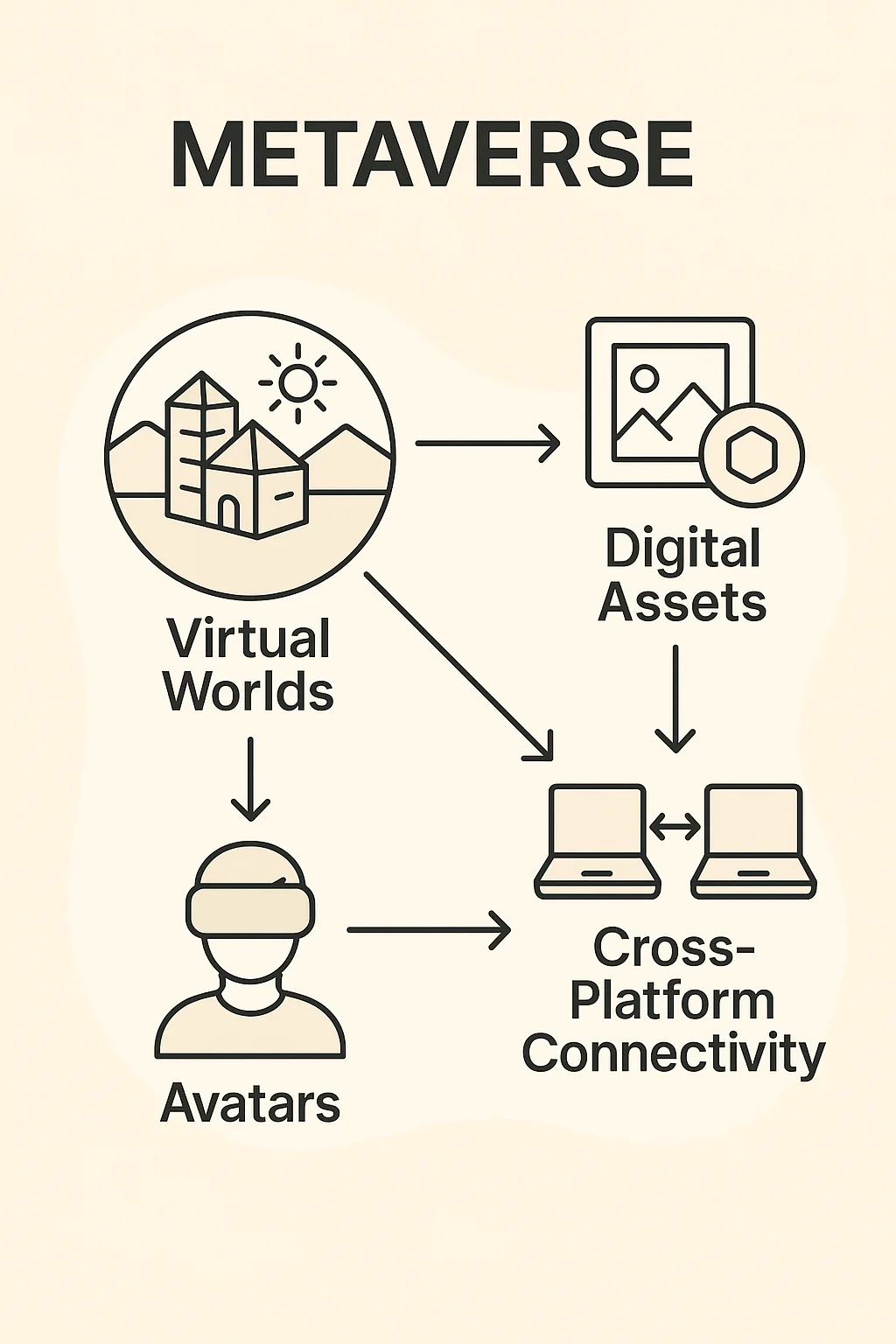
Infographic showing the metaverse ecosystem with elements like virtual worlds, digital assets, avatars, and cross-platform connectivity

Real-World Examples

  • Decentraland – Ethereum-based virtual world with user-owned land and experiences
  • The Sandbox – Gaming-focused metaverse with creation tools and SAND token economy
  • Horizon Worlds – Meta’s VR social platform (though not crypto-native)

Why Beginners Should Care

Metaverse investments are highly speculative. Virtual land and digital assets have no intrinsic value beyond what others will pay for them in these specific virtual environments.

Early adoption opportunities exist for creators who build audiences and businesses in virtual worlds before mainstream adoption arrives.

Technical limitations including VR hardware costs, internet bandwidth requirements, and user experience challenges still prevent mass adoption.

Related Terms: NFT, Virtual Real Estate, Play-to-Earn, Avatar

Back to Crypto Glossary

Similar Posts

  • Hash Function

    Hash Function: One-Way Mathematical TransformationHash functions are mathematical algorithms that convert input data into fixed-size output strings in a way that's easy to compute forward but practically impossible to reverse. They're like digital fingerprints for data.A hash function is a mathematical algorithm that takes input data of any size and produces a fixed-size output (hash)…

  • Blockchain Trilemma

    Blockchain Trilemma: The Impossible TrinityThe blockchain trilemma describes the challenge of simultaneously achieving decentralization, security, and scalability in blockchain networks. It's like trying to be fast, cheap, and high-quality all at the same time.The blockchain trilemma refers to the fundamental trade-off between three key properties: decentralization, security, and scalability, where optimizing for two typically requires…

  • Public Key

    Public Key: Cryptographic Identity VerificationA public key is the openly shareable part of a cryptographic key pair that enables others to send you cryptocurrency or verify your digital signatures. It's like your mailing address that you can give to anyone who wants to send you mail.Public key refers to the cryptographic component of a key…

  • Transaction

    Transaction: Moving Value on the BlockchainA cryptocurrency transaction transfers value from one address to another on a blockchain network. It's like writing a check, but with mathematical guarantees instead of trust.A transaction is a digitally signed transfer of cryptocurrency from one wallet address to another, recorded permanently on the blockchain. Every transaction includes sender information, recipient…

  • Dynamic NFTs (dNFTs)

    Dynamic NFTs (dNFTs): Evolving Digital Assets Dynamic NFTs can change their metadata, appearance, or properties based on external data or on-chain events. They’re like digital collectibles that grow and evolve over time. Dynamic NFTs (dNFTs) are non-fungible tokens that can modify their metadata, attributes, or visual appearance in response to external data feeds, user actions,…

  • Smart Contract Audit

    Smart Contract Audit: Code Security ReviewSmart contract audits involve professional security reviews of blockchain code to identify vulnerabilities before deployment. It's like having building inspectors for digital architecture.A smart contract audit is a comprehensive security review of blockchain application code conducted by experts to identify vulnerabilities, bugs, and potential attack vectors before public deployment. These reviews…