
Merkle Tree

Merkle Tree: Efficient Data Verification

Merkle trees enable efficient verification of large datasets without downloading everything. They’re like having a fingerprint for an entire library that proves any book belongs.

A Merkle tree is a binary tree structure where each leaf represents a data element and each branch contains cryptographic hashes of its children. The root hash summarizes the entire dataset, enabling quick verification of any element’s inclusion.

How Merkle Trees Work

Bottom-up hashing combines pairs of data elements into parent hashes, continuing until a single root hash represents the entire tree structure.

Inclusion proofs require only a small subset of hashes (the “Merkle path”) to prove any specific element exists in the tree without revealing other elements.

Tamper detection makes any change to underlying data immediately visible since it would change the root hash, alerting observers to modifications.
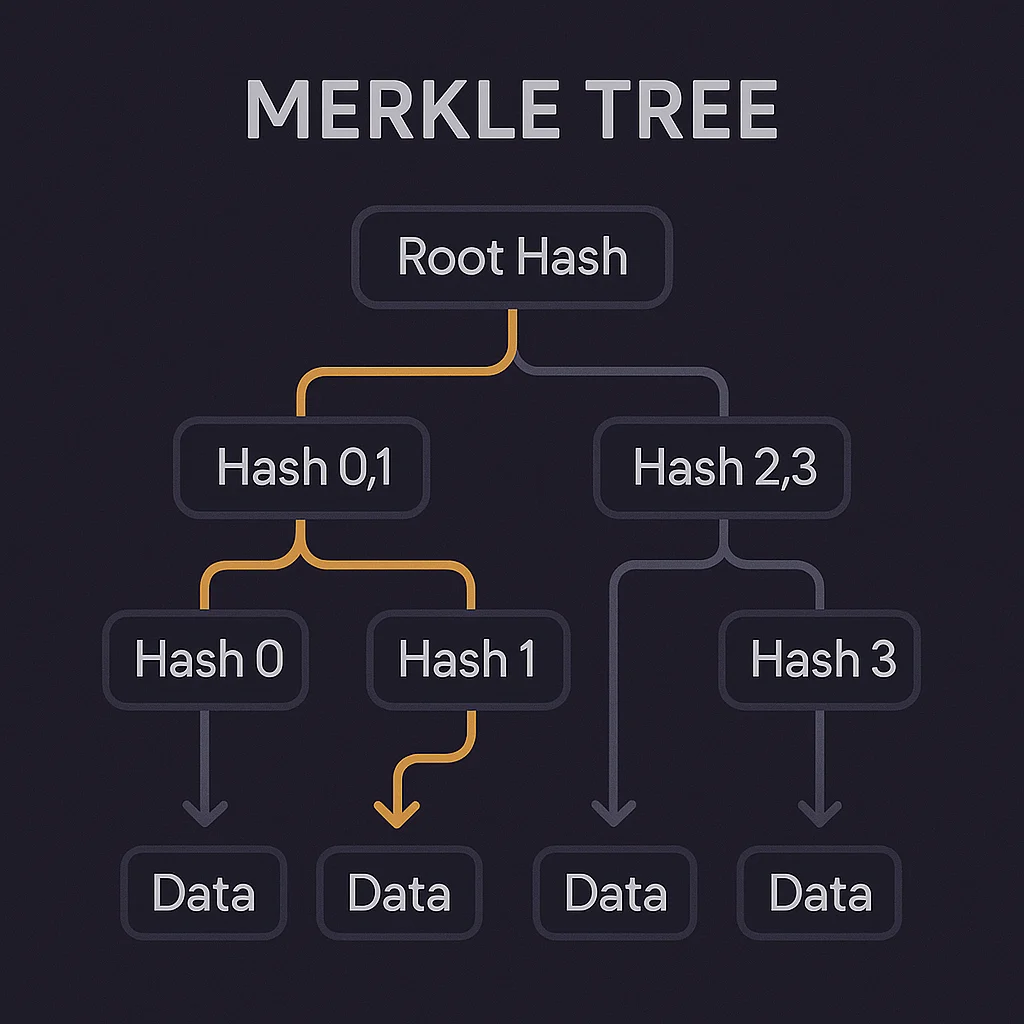
Merkle tree structure showing data blocks at the bottom, combined hashes at each branch, and a root hash at the top with a highlighted path for inclusion proof.]

Real-World Examples

  • Bitcoin blocks use Merkle trees to summarize all transactions in the block header
  • IPFS storage employs Merkle trees for content addressing and verification
  • Airdrop claims often use Merkle trees to efficiently verify eligibility without revealing all addresses

Why Beginners Should Care

Efficient verification allows light clients to verify specific transactions without downloading entire blockchains, enabling mobile and web wallets.

Privacy benefits from Merkle trees let systems prove inclusion without revealing the complete dataset to verifiers.

Scalability foundation for many Layer 2 solutions and blockchain optimizations that need to efficiently prove large amounts of data.

Related Terms: Hash Function, Light Client, Cryptographic Proof

Back to Crypto Glossary

Similar Posts

  • Front Running

    Front Running: Trading Ahead of OthersFront running involves placing trades ahead of known pending transactions to profit from anticipated price movements. It's like cutting in line when you know someone behind you will move the market.Front running is the practice of placing trades based on advance knowledge of pending transactions that will likely affect asset…

  • Token Economy

    Token Economy: Digital Asset EcosystemsToken economies are systems where digital tokens serve as medium of exchange, store of value, and incentive mechanisms within specific ecosystems. They're like creating your own mini-economy with digital money.A token economy refers to an ecosystem where cryptocurrency tokens facilitate economic activity, incentivize participation, and coordinate behavior among participants. These economies can…

  • Paper Hands

    Paper Hands: Quick to Sell, Quick to Regret Paper hands describes investors who sell at the first sign of trouble or take profits too early. It’s crypto’s version of weak stomach syndrome. Paper hands refers to investors who sell their cryptocurrency holdings quickly due to fear, panic, or impatience rather than holding through volatility. The…

  • Buyback

    Buyback: Token Repurchase ProgramsBuyback refers to projects repurchasing their own tokens from the open market, often to reduce supply or return value to token holders. It's like a company buying back its own stock to increase the value of remaining shares.Buyback describes the process where cryptocurrency projects repurchase their own tokens from the open market…

  • Community Governance

    Community Governance: Collective Decision MakingCommunity governance enables token holders and participants to collectively make decisions about project direction and protocol changes. It's like a democracy where community members vote on important issues.Community governance refers to decision-making systems where project participants have input and voting rights over protocol changes, resource allocation, and strategic direction. This distributes control…

  • EVM Compatibility

    EVM Compatibility: Ethereum Code EverywhereEVM compatibility allows blockchain networks to run Ethereum applications without modification. It's like having different computers that can all run the same software.EVM compatibility refers to blockchain networks that can execute Ethereum smart contracts and support Ethereum-based applications without requiring code changes. This enables easy migration and cross-deployment of Ethereum applications.How EVM…