
Flash Mint

Flash Mint: Temporary Token Creation

Flash mints create tokens temporarily within single transactions that must be returned or burned before the transaction completes. It’s like borrowing inventory that must be returned instantly.

Flash minting allows creating large amounts of tokens temporarily within a single transaction, provided they are burned or properly backed before the transaction ends. This enables capital-efficient arbitrage and liquidation strategies.

How Flash Mints Work

Temporary creation mints tokens at the beginning of a transaction without requiring upfront collateral or reserves.

Transaction atomicity ensures that either the entire transaction succeeds (including token burning) or fails completely, preventing permanent token creation without backing.

Use case optimization enables arbitrage, liquidation, and other strategies that require temporary access to large token amounts without permanent supply expansion.
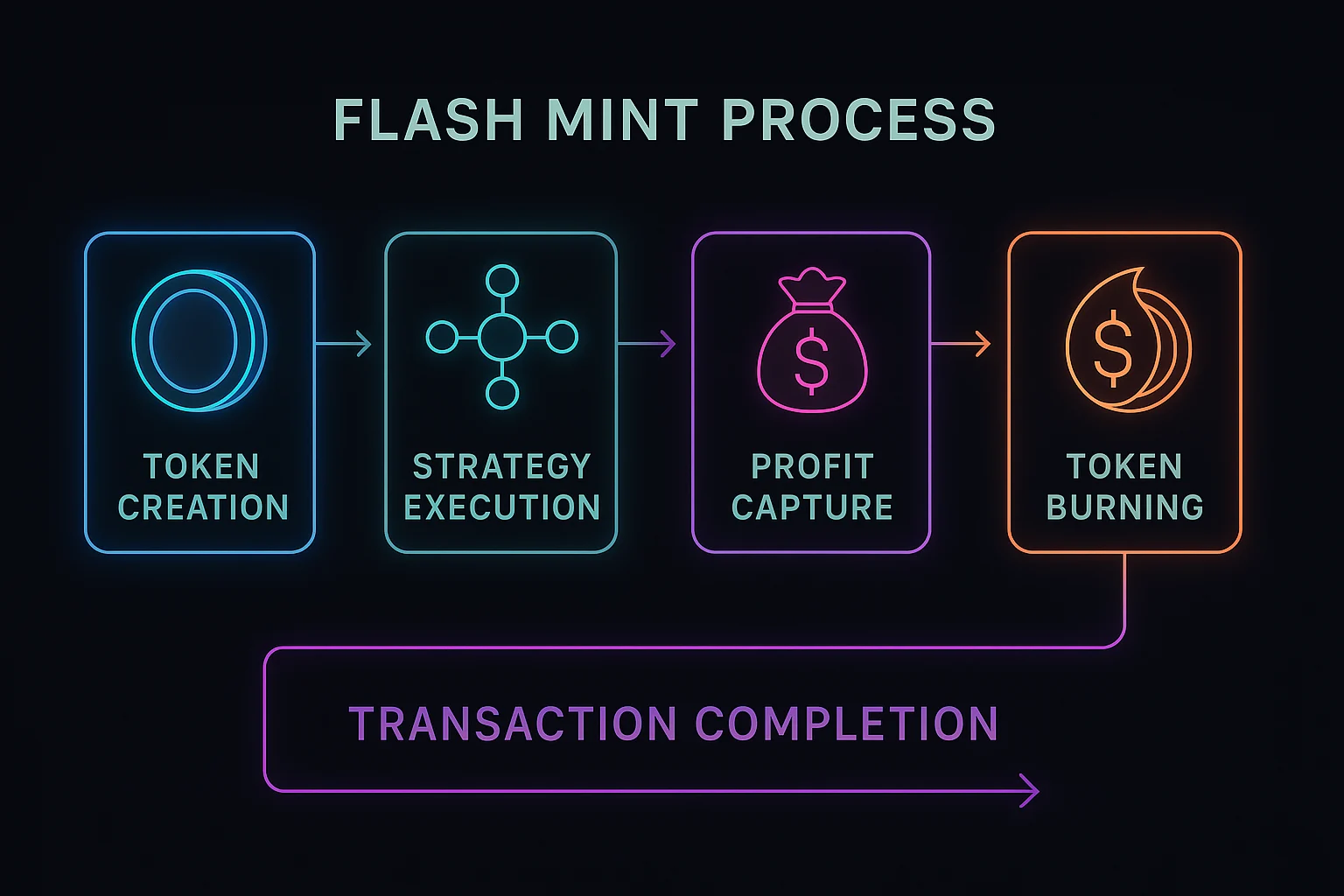
Flash mint process showing token creation, strategy execution, profit capture, token burning, and transaction completion

Real-World Examples

  • MakerDAO allows flash minting DAI for liquidations and arbitrage opportunities
  • Various stablecoins implement flash minting for improved capital efficiency
  • Arbitrage strategies use flash minting to execute large trades without holding capital

Why Beginners Should Care

Capital efficiency enables profitable strategies that would otherwise require significant upfront capital to execute.

Protocol risks from flash mint functionality that could be exploited if not implemented correctly or if economic models are flawed.

Market impact as flash minting can enable larger arbitrage trades that help maintain protocol stability and fair pricing.

Related Terms: Flash Loan, Arbitrage, Atomic Transaction, Capital Efficiency

Back to Crypto Glossary

Similar Posts

  • Hash Rate

    Hash Rate: Network Security Measurement Hash rate measures how much computational power secures a blockchain network. Higher hash rates mean stronger security against attacks and manipulation. Hash rate is the total computational power used by miners to process transactions and secure a proof-of-work blockchain network. It’s measured in hashes per second – calculations attempting to…

  • Verifiable Credentials

    Verifiable Credentials: Tamper-Proof Digital DocumentsVerifiable credentials are digital documents that can be cryptographically verified without contacting the issuing authority. They're like diplomas that anyone can authenticate instantly.Verifiable credentials are digital documents that use cryptographic techniques to enable instant verification of authenticity without requiring contact with the issuing organization. These credentials enable trusted digital identity and qualification…

  • DEX Aggregator

    DEX Aggregator: Optimal Trading Route FinderDEX aggregators find the best prices across multiple decentralized exchanges for cryptocurrency trades. They're like price comparison websites that automatically execute trades at the best available rates.A DEX aggregator is a service that compares prices and liquidity across multiple decentralized exchanges to find optimal trading routes for cryptocurrency swaps. These platforms…

  • CoinJoin

    CoinJoin: Bitcoin Transaction MixingCoinJoin combines multiple Bitcoin transactions into single transactions to obscure the connection between inputs and outputs. It's like mixing your laundry with other people's to make it harder to tell which clothes belong to whom.CoinJoin is a Bitcoin privacy technique that combines multiple transactions from different users into a single transaction, making…

  • EIP-1559

    EIP-1559: Ethereum's Fee ReformEIP-1559 reformed Ethereum's fee structure by introducing base fees that get burned and optional tips for miners. It's like switching from auction-based pricing to more predictable fee markets.EIP-1559 (Ethereum Improvement Proposal 1559) changed how Ethereum calculates and processes transaction fees by introducing a base fee that gets burned and making fee estimation…

  • Exit Strategy

    Exit Strategy: Investment Withdrawal PlanningAn exit strategy is a predetermined plan for selling cryptocurrency investments to realize profits or limit losses. It's like having a fire escape route planned before you need it, so you know exactly what to do when the time comes.Exit strategy refers to a predetermined plan that defines when, how, and…