
HODL

HODL: The Art of Doing Nothing

HODL started as a typo but became crypto’s most important investment strategy. Sometimes the best move is not moving at all.

HODL means holding cryptocurrency long-term regardless of short-term price volatility, derived from a misspelled “hold” in a 2013 Bitcoin forum post. It represents the strategy of buying and holding rather than actively trading.

How HODL Works

Time arbitrage leverages crypto’s long-term growth trends while avoiding the stress and fees of constant trading. HODLers believe in underlying technology adoption over short-term price movements.

Emotional discipline prevents panic selling during crashes and FOMO buying during peaks. HODLing removes timing decisions that most retail traders get wrong.

Dollar cost averaging often accompanies HODL strategies – consistently buying fixed dollar amounts regardless of price to smooth out volatility over time.
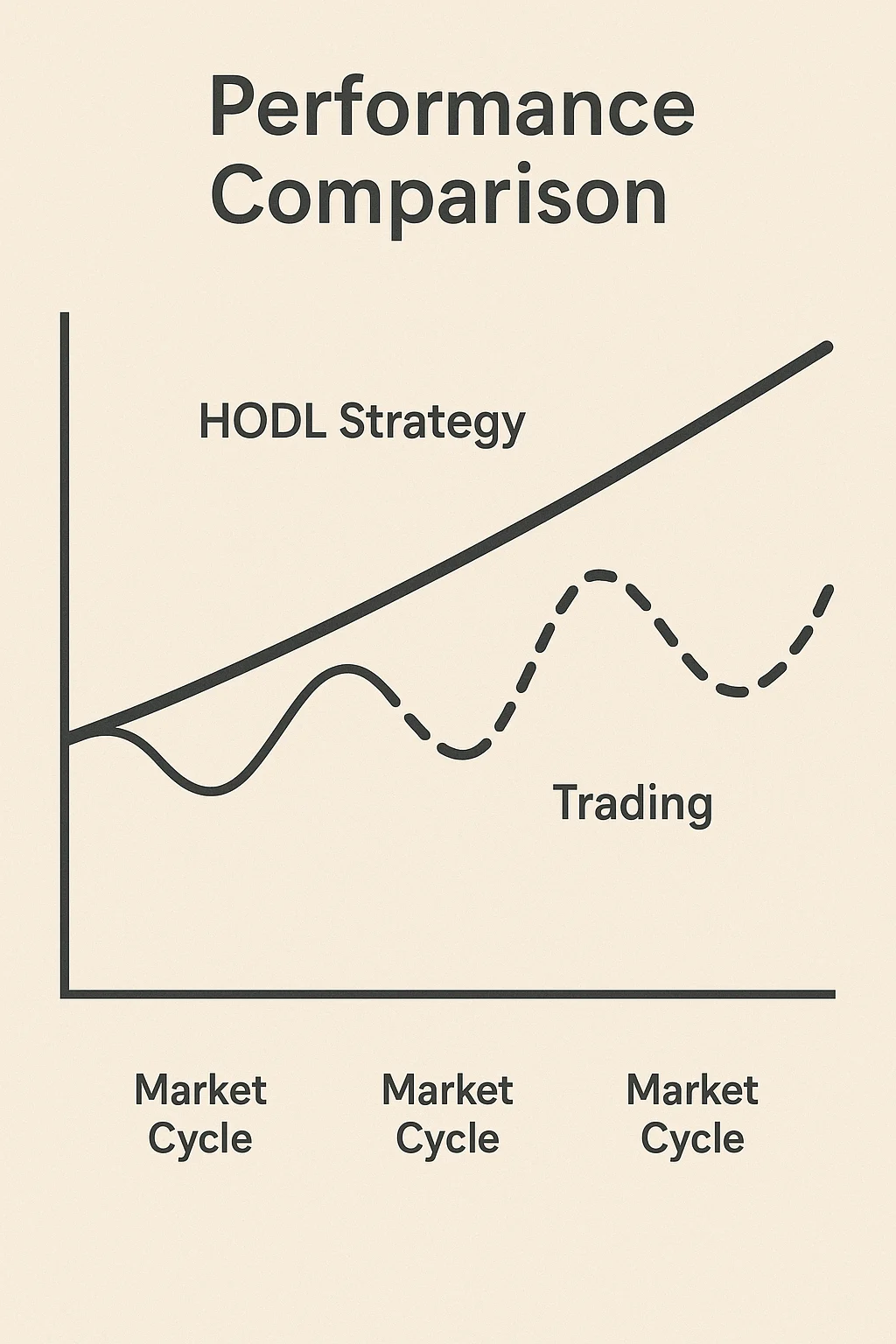
Line chart comparing HODL strategy with trading over multiple market cycles, showing steady gains for HODL and volatility for trading

Real-World Examples

  • Early Bitcoin adopters who held through multiple 80%+ crashes are now wealthy
  • Ethereum holders from 2016 experienced massive gains despite severe volatility
  • “Bitcoin pizza guy” spent 10,000 BTC on pizza in 2010 – worth $300+ million today

Why Beginners Should Care

HODLing beats trading for most people. Studies show active traders typically underperform simple buy-and-hold strategies after accounting for fees and taxes.

Psychological benefits include reduced stress from daily price watching and elimination of complex timing decisions that even professionals struggle with.

Tax advantages in many jurisdictions favor long-term holding over short-term trading, reducing overall tax burden on crypto gains.

Related Terms: Diamond Hands, DCA, Bull Market, Bear Market

Back to Crypto Glossary

Similar Posts

  • Validator

    Validator: Proof-of-Stake Network Guardians Validators are the security backbone of proof-of-stake networks. They propose blocks, verify transactions, and earn rewards for honest behavior. A validator is a network participant in proof-of-stake blockchains who validates transactions, proposes new blocks, and maintains network consensus in exchange for staking rewards. Validators replace miners in PoS systems. How Validators…

  • Token Lockup

    Token Lockup: Preventing Early Selling Token lockups prevent allocated tokens from being sold or transferred for specific time periods. It’s like putting your poker winnings in a time-locked safe to prevent impulse spending. Token lockup is a mechanism that prevents token holders from selling, transferring, or accessing their tokens until predetermined conditions are met. Lockups…

  • Back Running

    Back Running: Following Profitable TransactionsBack running involves placing transactions immediately after profitable transactions to capture secondary opportunities. It's like following successful traders to pick up the crumbs they leave behind.Back running is a MEV extraction strategy where bots place transactions immediately after profitable transactions to capture residual value or secondary opportunities. This technique exploits the predictable…

  • Security Token

    Security Token: Regulated Digital AssetsSecurity tokens are cryptocurrency tokens that represent ownership in real-world assets and are subject to securities regulations. They're like digital stock certificates that comply with financial laws.Security tokens are cryptocurrency tokens that represent ownership stakes in real-world assets and are subject to securities regulations and compliance requirements. These bridge traditional finance with…

  • Price Manipulation

    Price Manipulation: Artificial Market DistortionPrice manipulation involves artificially influencing asset prices through coordinated trading, false information, or market abuse. It's financial fraud adapted for the crypto age.Price manipulation refers to illegal or unethical activities designed to artificially inflate or deflate cryptocurrency prices for profit. These activities exploit market inefficiencies and harm other investors through deceptive practices.How…

  • Quadratic Funding

    Quadratic Funding: Democratic Resource AllocationQuadratic funding uses mathematical formulas to allocate resources based on community preferences while preventing wealthy individuals from dominating funding decisions. It's democracy with math.Quadratic funding is a mechanism for allocating resources that gives more weight to the number of contributors than the amount contributed, using quadratic formulas to prevent wealthy individuals…