
Flash Mint

Flash Mint: Temporary Token Creation

Flash mints create tokens temporarily within single transactions that must be returned or burned before the transaction completes. It’s like borrowing inventory that must be returned instantly.

Flash minting allows creating large amounts of tokens temporarily within a single transaction, provided they are burned or properly backed before the transaction ends. This enables capital-efficient arbitrage and liquidation strategies.

How Flash Mints Work

Temporary creation mints tokens at the beginning of a transaction without requiring upfront collateral or reserves.

Transaction atomicity ensures that either the entire transaction succeeds (including token burning) or fails completely, preventing permanent token creation without backing.

Use case optimization enables arbitrage, liquidation, and other strategies that require temporary access to large token amounts without permanent supply expansion.
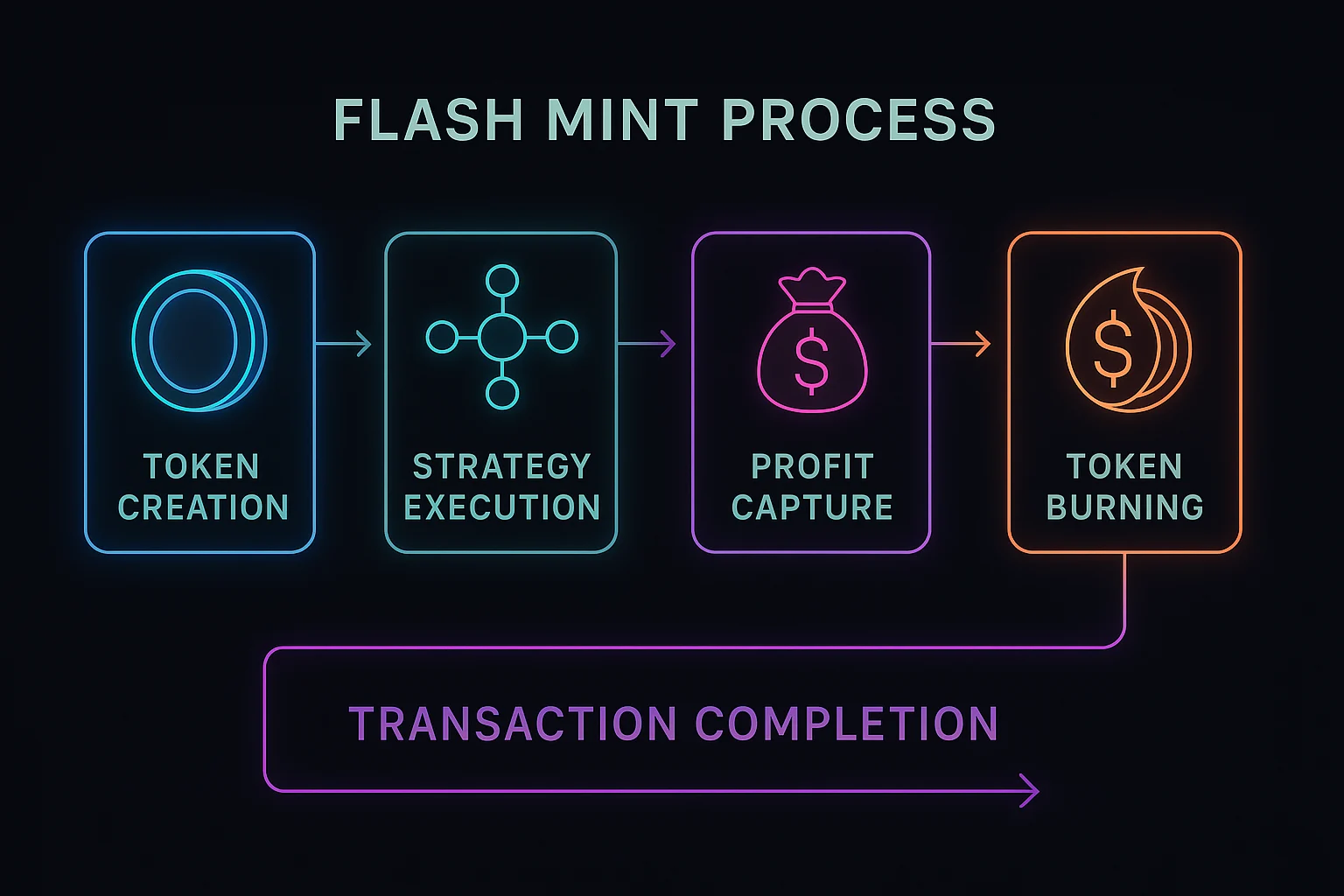
Flash mint process showing token creation, strategy execution, profit capture, token burning, and transaction completion

Real-World Examples

  • MakerDAO allows flash minting DAI for liquidations and arbitrage opportunities
  • Various stablecoins implement flash minting for improved capital efficiency
  • Arbitrage strategies use flash minting to execute large trades without holding capital

Why Beginners Should Care

Capital efficiency enables profitable strategies that would otherwise require significant upfront capital to execute.

Protocol risks from flash mint functionality that could be exploited if not implemented correctly or if economic models are flawed.

Market impact as flash minting can enable larger arbitrage trades that help maintain protocol stability and fair pricing.

Related Terms: Flash Loan, Arbitrage, Atomic Transaction, Capital Efficiency

Back to Crypto Glossary

Similar Posts

  • Community Governance

    Community Governance: Collective Decision MakingCommunity governance enables token holders and participants to collectively make decisions about project direction and protocol changes. It's like a democracy where community members vote on important issues.Community governance refers to decision-making systems where project participants have input and voting rights over protocol changes, resource allocation, and strategic direction. This distributes control…

  • Verification

    Verification: Confirming Accuracy and AuthenticityVerification is the process of confirming that information, transactions, or claims are accurate and authentic without requiring trust in the information source. It's like being able to personally test that a diamond is real using scientific instruments instead of just believing the jeweler's word.Verification refers to the mathematical and cryptographic processes…

  • Structured Products

    Structured Products: Complex Financial InstrumentsStructured products combine multiple financial instruments to create customized risk-return profiles for specific investment objectives. They're like elaborate recipe combinations that mix different financial ingredients to create unique investment flavors tailored to particular tastes.Structured products are complex financial instruments that combine derivatives, traditional assets, or cryptocurrencies to create customized investment products…

  • Sovereignty

    Sovereignty: Independent Control and GovernanceSovereignty in blockchain refers to independent control over governance, economics, and technical decisions without external interference. It's like having your own country with its own rules.Sovereignty refers to complete independence and self-governance for blockchain networks, applications, or communities without requiring permission from or dependence on external authorities. This includes technical, economic, and…

  • Wallet Signature Spoofing

    Wallet Signature Spoofing: Fake Authorization Attacks Wallet signature spoofing tricks users into signing malicious transactions that appear legitimate but actually authorize harmful actions. It’s like signing a contract where the fine print changes after you sign. Wallet signature spoofing involves presenting misleading information about transaction contents to trick users into signing authorizations for unintended actions….

  • Digital Currency

    Digital Currency: Electronic Money SystemsDigital currency refers to money that exists only in electronic form, including both centralized and decentralized varieties. It's like having money that lives entirely in computers and phones instead of physical bills and coins in your wallet.Digital currency encompasses all forms of money that exist exclusively in electronic format, including cryptocurrencies,…