
Flash Mint

Flash Mint: Temporary Token Creation

Flash mints create tokens temporarily within single transactions that must be returned or burned before the transaction completes. It’s like borrowing inventory that must be returned instantly.

Flash minting allows creating large amounts of tokens temporarily within a single transaction, provided they are burned or properly backed before the transaction ends. This enables capital-efficient arbitrage and liquidation strategies.

How Flash Mints Work

Temporary creation mints tokens at the beginning of a transaction without requiring upfront collateral or reserves.

Transaction atomicity ensures that either the entire transaction succeeds (including token burning) or fails completely, preventing permanent token creation without backing.

Use case optimization enables arbitrage, liquidation, and other strategies that require temporary access to large token amounts without permanent supply expansion.
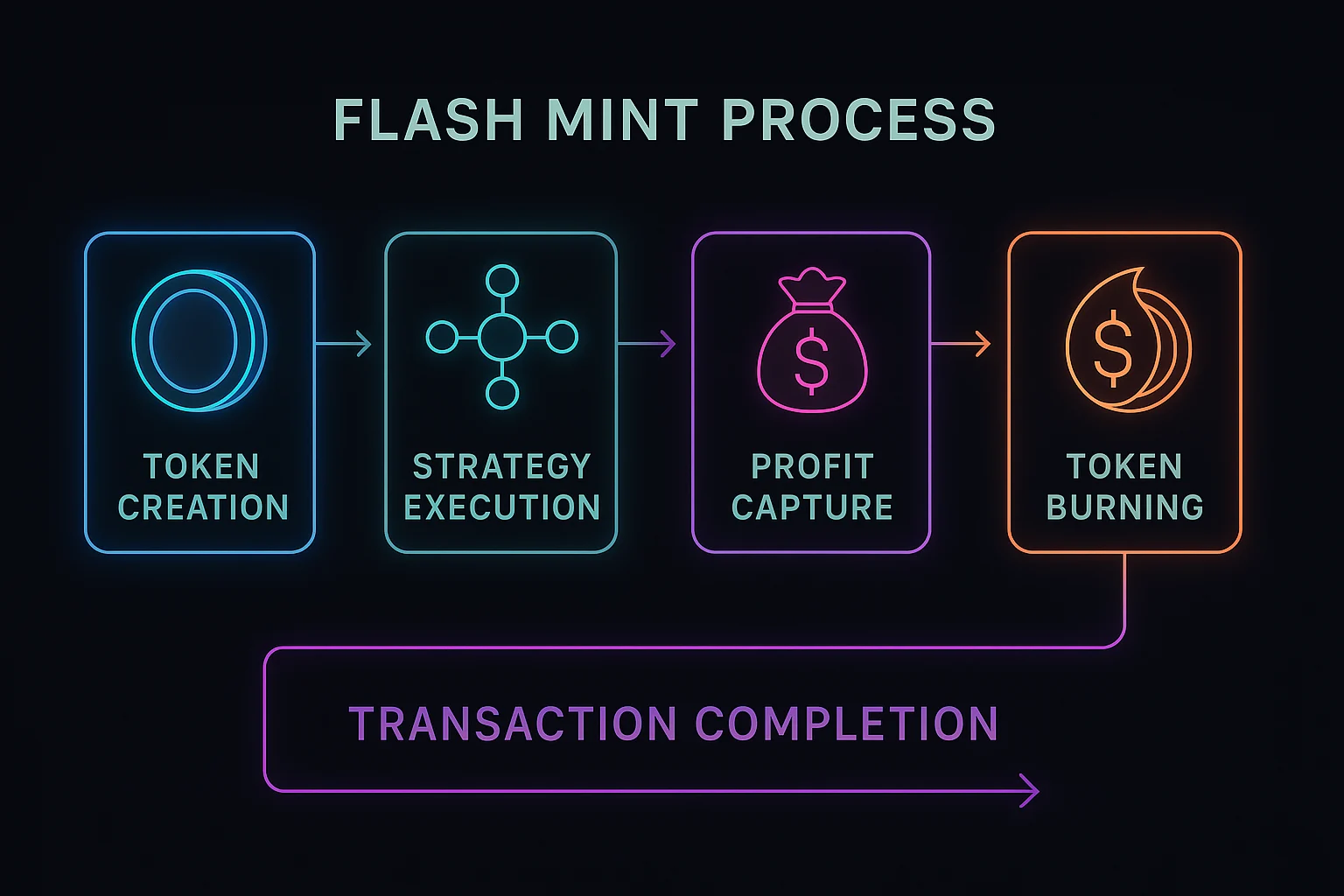
Flash mint process showing token creation, strategy execution, profit capture, token burning, and transaction completion

Real-World Examples

  • MakerDAO allows flash minting DAI for liquidations and arbitrage opportunities
  • Various stablecoins implement flash minting for improved capital efficiency
  • Arbitrage strategies use flash minting to execute large trades without holding capital

Why Beginners Should Care

Capital efficiency enables profitable strategies that would otherwise require significant upfront capital to execute.

Protocol risks from flash mint functionality that could be exploited if not implemented correctly or if economic models are flawed.

Market impact as flash minting can enable larger arbitrage trades that help maintain protocol stability and fair pricing.

Related Terms: Flash Loan, Arbitrage, Atomic Transaction, Capital Efficiency

Back to Crypto Glossary

Similar Posts

  • AMM

    AMM: Automated Market MakingAutomated Market Makers use mathematical formulas to price assets and facilitate trading without traditional order books. They're like vending machines for cryptocurrency trading.An Automated Market Maker (AMM) is a decentralized exchange mechanism that uses mathematical algorithms to price assets and facilitate trading through liquidity pools instead of order books. AMMs enable constant liquidity…

  • Smart Contract Compatibility

    Smart Contract Compatibility: Cross-Platform Code ExecutionSmart contract compatibility enables applications to run across different blockchain networks without modification. It's like writing software that works on both Windows and Mac without changes.Smart contract compatibility refers to the ability of smart contract code to execute on multiple blockchain platforms without requiring rewrites or significant modifications. This enables broader…

  • Wallet Connect

    Wallet Connect: Universal dApp Connection Standard WalletConnect is an open protocol that enables secure connections between mobile wallets and desktop applications. It’s like Bluetooth for crypto wallets and dApps. WalletConnect is a communication protocol that allows cryptocurrency wallets to interact with decentralized applications across different devices and platforms. It enables secure, encrypted connections without exposing…

  • Secure Element

    Secure Element: Hardware Security ChipA secure element is a tamper-resistant hardware chip designed to store sensitive information like private keys. It's like having a tiny vault built into your device that's extremely difficult to break into.A secure element is a specialized hardware component designed to provide isolated, tamper-resistant storage and processing for sensitive data such…

  • Solver Network

    Solver Network: Optimized Transaction ExecutionA solver network consists of specialized entities that find optimal execution paths for complex transactions across multiple protocols and chains. They're like GPS systems that find the best routes for your crypto transactions.A solver network comprises specialized services that analyze and execute complex transactions by finding optimal paths across multiple protocols,…

  • Node

    Node: The Network’s Backbone Nodes are individual computers that maintain copies of the blockchain and enforce network rules. They’re the distributed infrastructure that makes cryptocurrency possible. A node is a computer that participates in a blockchain network by maintaining a copy of the distributed ledger and relaying transactions. Nodes validate transactions, store blockchain history, and…