
DeFi Composability

DeFi Composability: Building Block Finance

DeFi composability allows protocols to integrate seamlessly, creating complex financial products by combining simpler components. It’s like financial Lego blocks that snap together perfectly.

DeFi composability refers to the ability of decentralized finance protocols to interact and build upon each other, creating more complex financial products through modular integration. This enables innovation through combining existing building blocks.

How DeFi Composability Works

Standardized interfaces like ERC-20 tokens and common smart contract patterns enable protocols to interact without custom integration work.

Permissionless innovation allows anyone to build on existing protocols without asking permission, creating rapid ecosystem development.

Yield stacking combines multiple protocols to optimize returns, such as lending tokens that earn yield while being used as collateral elsewhere.
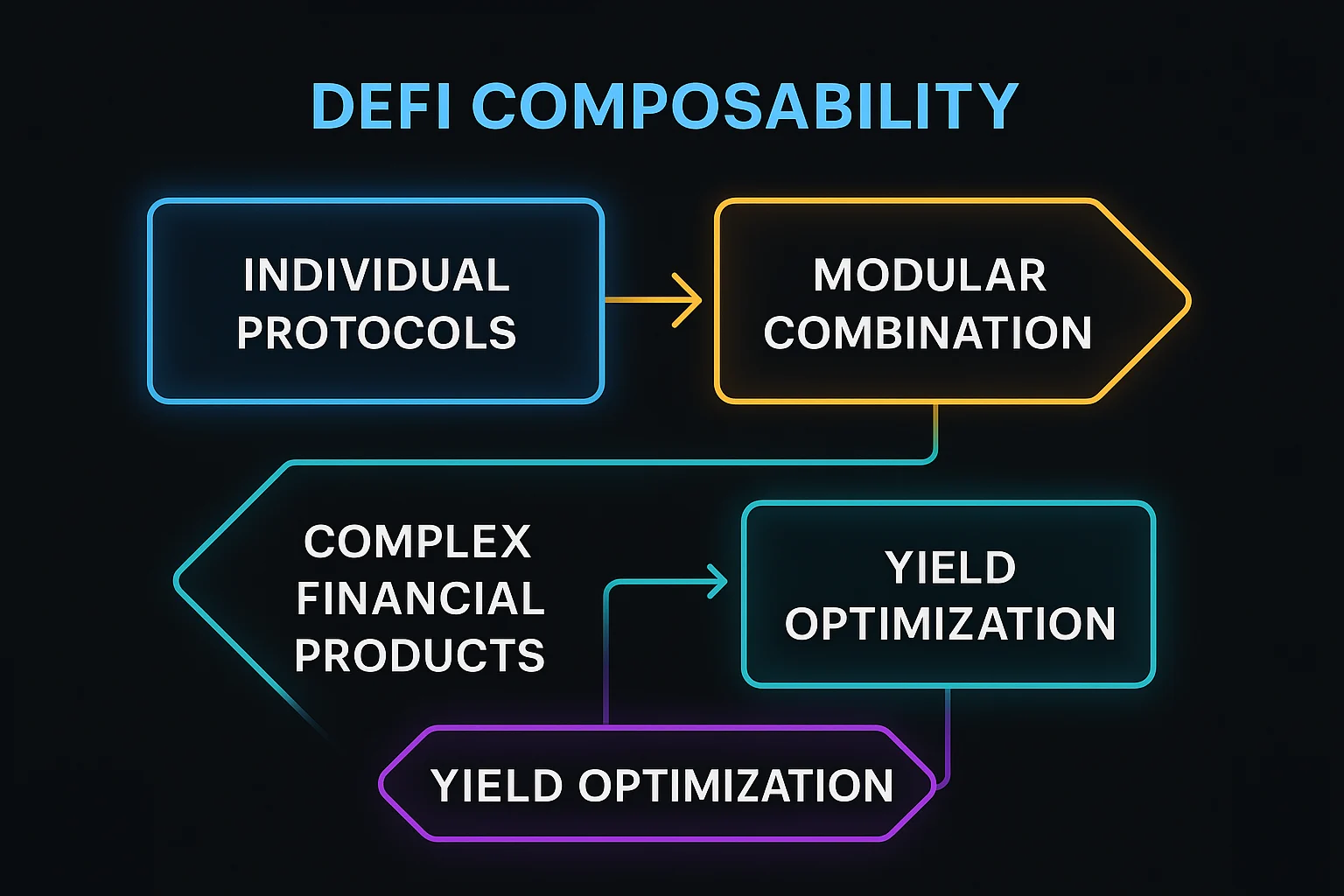
DeFi composability diagram showing individual protocols, modular combination, complex financial products, and yield optimization

Real-World Examples

  • Yearn Finance combines lending, farming, and trading protocols to optimize yields automatically
  • Convex Finance builds on Curve to enhance liquidity mining rewards
  • Index protocols create diversified portfolios using multiple DeFi primitives

Why Beginners Should Care

Innovation acceleration as new protocols can leverage existing infrastructure rather than rebuilding everything from scratch.

Systemic risks from interconnected protocols where failures can cascade across multiple applications and user positions.

Complexity management becomes crucial as composed strategies may be difficult to understand and evaluate for risk.

Related Terms: DeFi Primitives, Yield Stacking, Smart Contract

Back to Crypto Glossary

Similar Posts

  • Total Value Locked (TVL)

    Total Value Locked (TVL): DeFi’s Scorecard TVL measures how much money is deposited in DeFi protocols. It’s like measuring the size of a bank by its total deposits – bigger usually means more trust and activity. Total Value Locked (TVL) is the aggregate value of all assets deposited in a DeFi protocol or across the…

  • Gas Token

    Gas Token: Optimizing Transaction Costs Gas tokens store cheap gas for later use when network fees are high. It’s like buying gasoline when prices are low and using it when prices spike. A gas token is a cryptocurrency designed to optimize transaction costs by storing cheap gas during low-demand periods for use when fees are…

  • Storage Rent

    Storage Rent: Pay-per-Use Blockchain StorageStorage rent is a proposed mechanism where users pay ongoing fees for maintaining data on blockchain networks. It's like paying monthly rent for keeping files in cloud storage instead of a one-time purchase.Storage rent refers to fee mechanisms that charge users for ongoing blockchain storage rather than allowing permanent storage after…

  • ICO

    ICO: Initial Coin OfferingAn ICO is a fundraising method where new cryptocurrency projects sell tokens to early investors. It's like an IPO for stocks, but for new cryptocurrency tokens instead of company shares.An Initial Coin Offering (ICO) is a fundraising mechanism where cryptocurrency projects sell tokens to investors to raise capital for development and operations. ICOs…

  • Atomic Swap

    Atomic Swap: Trustless Cross-Chain Trading Atomic swaps enable direct trading between different cryptocurrencies without exchanges or intermediaries. Either both trades complete successfully, or neither happens – no middle ground. An atomic swap is a smart contract technology that enables the exchange of cryptocurrencies from different blockchains without requiring a trusted third party. The swap either…

  • Validator Set Rotation

    Validator Set Rotation: Dynamic Network Security Validator set rotation periodically changes which nodes validate transactions, preventing long-term centralization and maintaining network security through diversity. It’s like jury rotation for blockchain consensus. Validator set rotation is a mechanism that periodically changes which validators are active in securing a blockchain network. This prevents permanent centralization and ensures…