
Liquidity Bootstrapping

Liquidity Bootstrapping: Fair Token Launch Mechanism

Liquidity bootstrapping uses gradually declining prices to enable fair token distribution while building trading liquidity. It’s like having a reverse auction that creates a fair market price.

Liquidity bootstrapping is a token launch mechanism that starts with high prices that gradually decrease over time, allowing market forces to discover fair value while building trading liquidity. This prevents bots from capturing all tokens at launch.

How Liquidity Bootstrapping Works

Descending price auctions start with high token prices that automatically decrease until market demand matches the declining price curve.

Automated market making provides continuous liquidity throughout the price discovery process rather than relying on order book matching.

Bot resistance through high initial prices and gradual decreases makes it unprofitable for bots to extract value from early price inefficiencies.
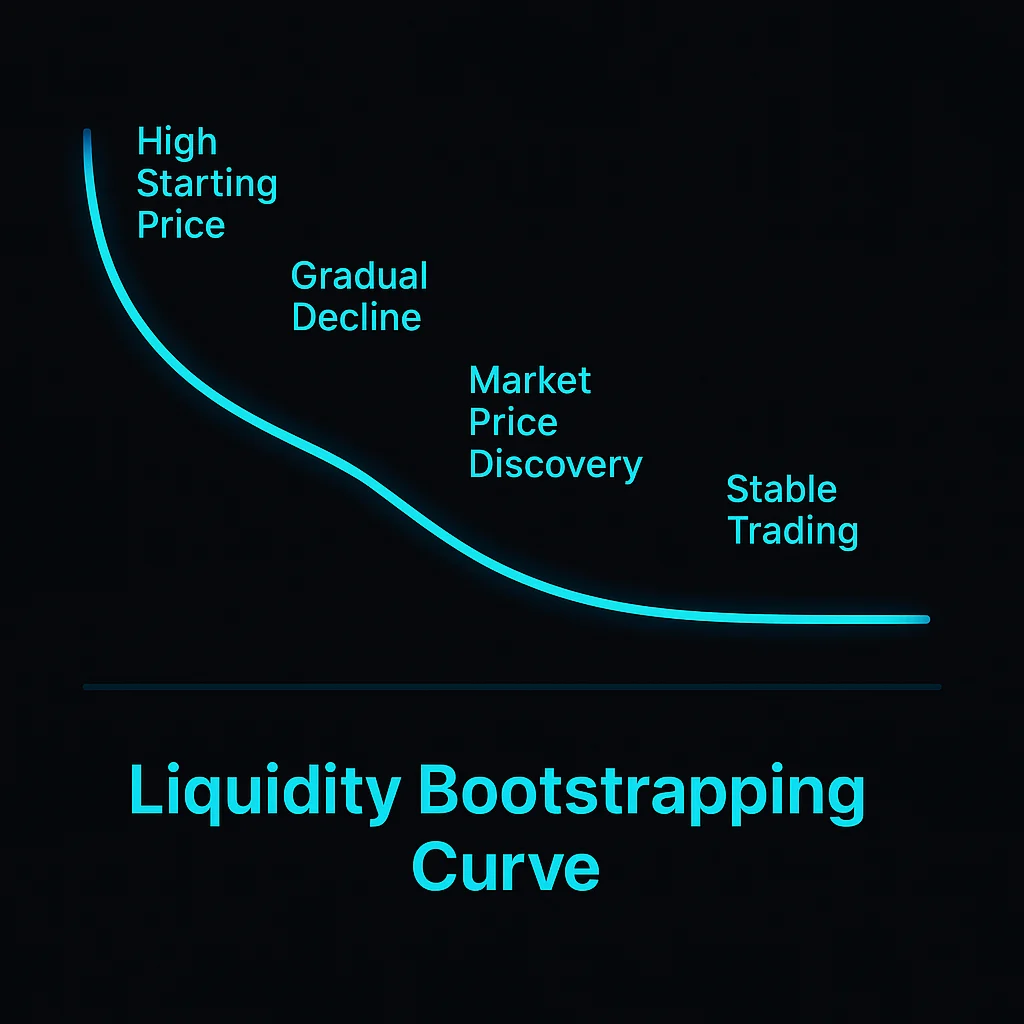
Liquidity bootstrapping curve showing high starting price, gradual decline, market price discovery, and stable trading

Real-World Examples

  • Balancer LBPs have launched hundreds of projects with fair price discovery mechanisms
  • Copper Launch provides liquidity bootstrapping infrastructure for new tokens
  • Major DeFi projects use LBPs to avoid the problems of traditional fixed-price token sales

Why Beginners Should Care

Fairer distribution compared to fixed-price sales where bots often capture most tokens before regular users can participate.

Price discovery through market mechanisms rather than arbitrary pricing by project teams who may not understand market demand.

Participation timing flexibility allows users to buy at any point during the bootstrap period rather than competing for limited fixed-price allocations.

Related Terms: Token Launch, Price Discovery, Fair Distribution, Automated Market Maker

Back to Crypto Glossary

Similar Posts

  • Sequencer

    Sequencer: Transaction Order ControllerA sequencer determines the order in which transactions are processed in Layer 2 networks and some blockchain systems. It's like the traffic controller that decides which cars go through the intersection first.A sequencer is a component in Layer 2 scaling solutions that collects, orders, and batches transactions before submitting them to the…

  • Chain Reorg (Reorganization)

    Chain Reorg (Reorganization): Blockchain History Changes Chain reorgs occur when a blockchain adopts a different version of transaction history, potentially reversing confirmed transactions. It’s like time travel, but messier and more expensive. A chain reorganization (reorg) happens when a blockchain network adopts an alternative chain of blocks as the canonical history, potentially reversing previously confirmed…

  • Lockup Period

    Lockup Period: Temporary Access RestrictionsLockup periods prevent token holders from selling or transferring their holdings for specified time frames. It's like having a certificate of deposit that you can't cash out early.A lockup period is a predetermined time frame during which cryptocurrency holders cannot sell, transfer, or access their tokens. These restrictions are typically enforced through…

  • Node

    Node: The Network’s Backbone Nodes are individual computers that maintain copies of the blockchain and enforce network rules. They’re the distributed infrastructure that makes cryptocurrency possible. A node is a computer that participates in a blockchain network by maintaining a copy of the distributed ledger and relaying transactions. Nodes validate transactions, store blockchain history, and…

  • Hash Rate

    Hash Rate: Network Security Measurement Hash rate measures how much computational power secures a blockchain network. Higher hash rates mean stronger security against attacks and manipulation. Hash rate is the total computational power used by miners to process transactions and secure a proof-of-work blockchain network. It’s measured in hashes per second – calculations attempting to…

  • Private Mempool

    Private Mempool: Protected Transaction PoolsPrivate mempools keep pending transactions hidden from public view until they're included in blocks, preventing front-running and MEV extraction. It's like having a VIP lane that bots can't see.A private mempool is a non-public pool of pending transactions that are not visible to other network participants until they are included in…