
Preconfirmation (Pre-confirm)

Preconfirmation (Pre-confirm): Faster Transaction Guarantees

Preconfirmations provide early guarantees that transactions will be included in upcoming blocks before final confirmation. It’s like getting a reservation confirmation before the restaurant officially opens.

Preconfirmation is a mechanism where validators or sequencers provide early commitments to include specific transactions in future blocks. This reduces user-perceived latency by providing execution guarantees before final settlement.

How Preconfirmations Work

Early commitments from validators signal intent to include transactions in their next block, providing users with confidence about execution timing.

Economic bonds often back preconfirmation promises, with validators facing penalties if they fail to include preconfirmed transactions.

Reduced uncertainty enables applications to provide better user experiences by showing transaction status before final blockchain confirmation.
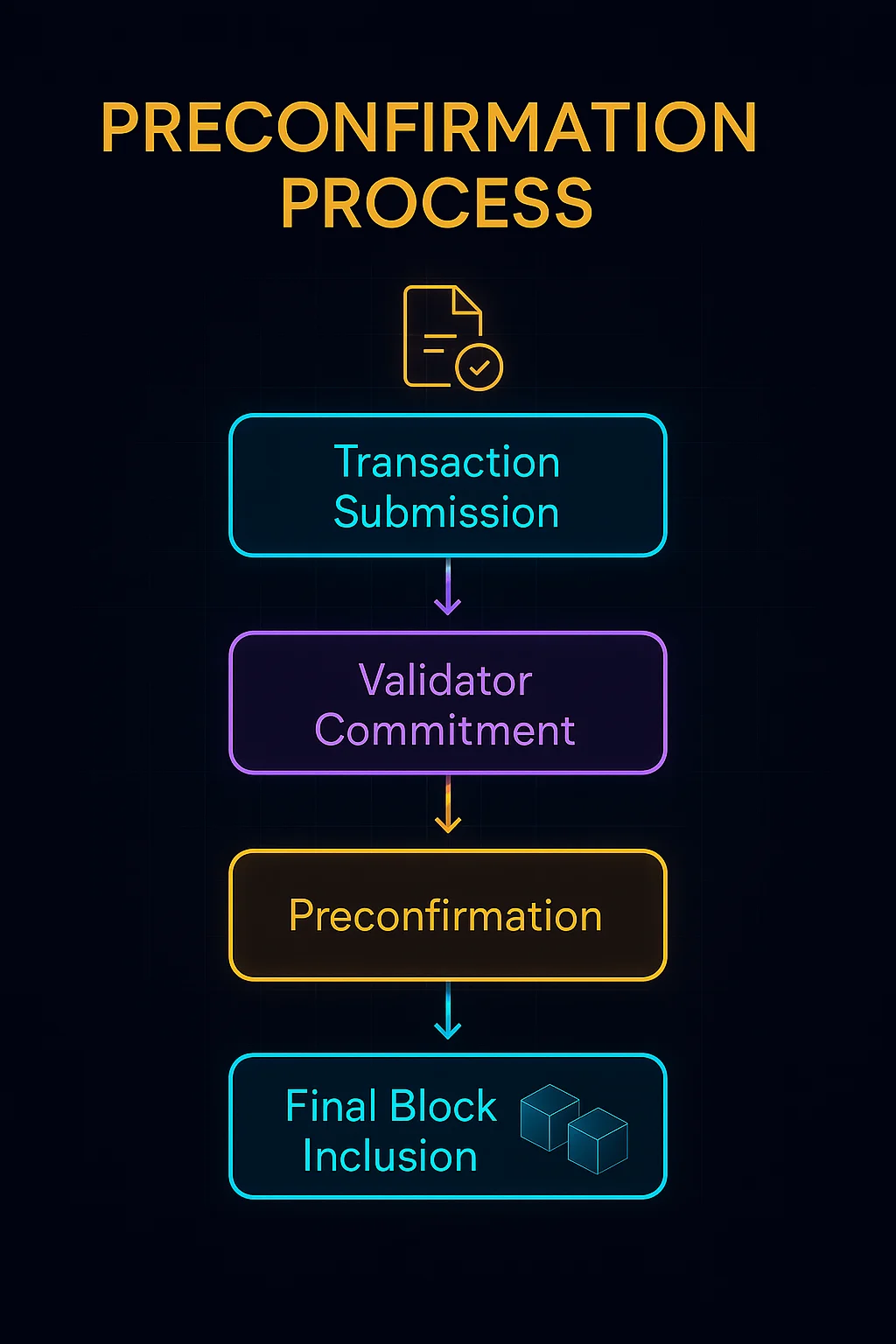
Infographic showing blockchain preconfirmation process: transaction submission, validator commitment, preconfirmation, and final block inclusion

Real-World Examples

  • Layer 2 sequencers provide preconfirmations for faster user feedback on rollup transactions
  • MEV-Boost implementations experiment with preconfirmation mechanisms for Ethereum
  • Application-specific chains often implement preconfirmations for improved user experience

Why Beginners Should Care

Faster feedback improves user experience by reducing perceived transaction latency even when final confirmation takes the same time.

Trust assumptions require believing that validators will honor their preconfirmation commitments rather than waiting for cryptographic finality.

Implementation complexity makes preconfirmations challenging to implement correctly without introducing new attack vectors or centralization risks.

Related Terms: Block Confirmation, Finality, Sequencer

Back to Crypto Glossary

Similar Posts

  • NFT (Non-Fungible Token)

    NFT (Non-Fungible Token): Digital Ownership Certificates NFTs transformed JPEGs into million-dollar assets and made digital ownership mainstream. Love them or hate them, they’re reshaping how we think about digital property. A Non-Fungible Token (NFT) is a unique digital certificate stored on a blockchain that proves ownership of a specific digital asset. Unlike cryptocurrencies where each…

  • Token Delisting

    Token Delisting: Removal from Trading PlatformsToken delisting occurs when exchanges remove cryptocurrencies from their trading platforms. It's like a store deciding to stop selling a particular product and removing it from their shelves.Token delisting refers to the removal of cryptocurrency tokens from exchange trading platforms, making them unavailable for purchase or sale on those specific…

  • Token Distribution

    Token Distribution: Allocating Digital AssetsToken distribution refers to how cryptocurrency tokens are allocated among different stakeholders and released into circulation. It's like deciding how to divide up a pie among various groups of people.Token distribution encompasses the initial allocation and ongoing release of cryptocurrency tokens to various stakeholder groups including founders, investors, community members, and…

  • Trading Pairs

    Trading Pairs: Currency Exchange MarketsTrading pairs represent the exchange rate between two different cryptocurrencies or assets. They're like forex pairs but for digital currencies.A trading pair consists of two assets that can be traded against each other, showing the exchange rate between them. Trading pairs enable price discovery and liquidity for cryptocurrency markets.How Trading Pairs WorkBase…

  • Reputation System

    Reputation System: Building Digital TrustReputation systems track and score user behavior to enable trust and coordination in decentralized environments. They're like credit scores but for overall trustworthiness and competence.A reputation system records and evaluates user actions, contributions, and behavior to create trustworthiness scores that enable cooperation in decentralized systems. These systems help identify reliable participants without…

  • Slashing Conditions

    Slashing Conditions: Validator Penalty Rules Slashing conditions define specific behaviors that result in validators losing staked funds as punishment for malicious or negligent actions. They’re the rules of engagement for network security. Slashing conditions are predetermined criteria that trigger automatic penalties for validators who violate network consensus rules or behave maliciously. These penalties involve destroying…