
Liquidity Sniping

Liquidity Sniping: Front-Running New Pools

Liquidity sniping involves immediately buying tokens when new liquidity pools are created, often using bots to front-run regular users. It’s like cutting in line at the grand opening sale.

Liquidity sniping is the practice of using automated systems to immediately purchase tokens as soon as new liquidity pools go live, taking advantage of low initial prices before regular users can react. This often involves MEV extraction and front-running techniques.

How Liquidity Sniping Works

Pool monitoring tracks new token launches and liquidity additions across decentralized exchanges to identify sniping opportunities.

Automated execution uses bots with high gas prices to ensure transactions get included immediately when new pools become active.

Price arbitrage captures value from initial price inefficiencies before markets reach equilibrium through normal trading activity.
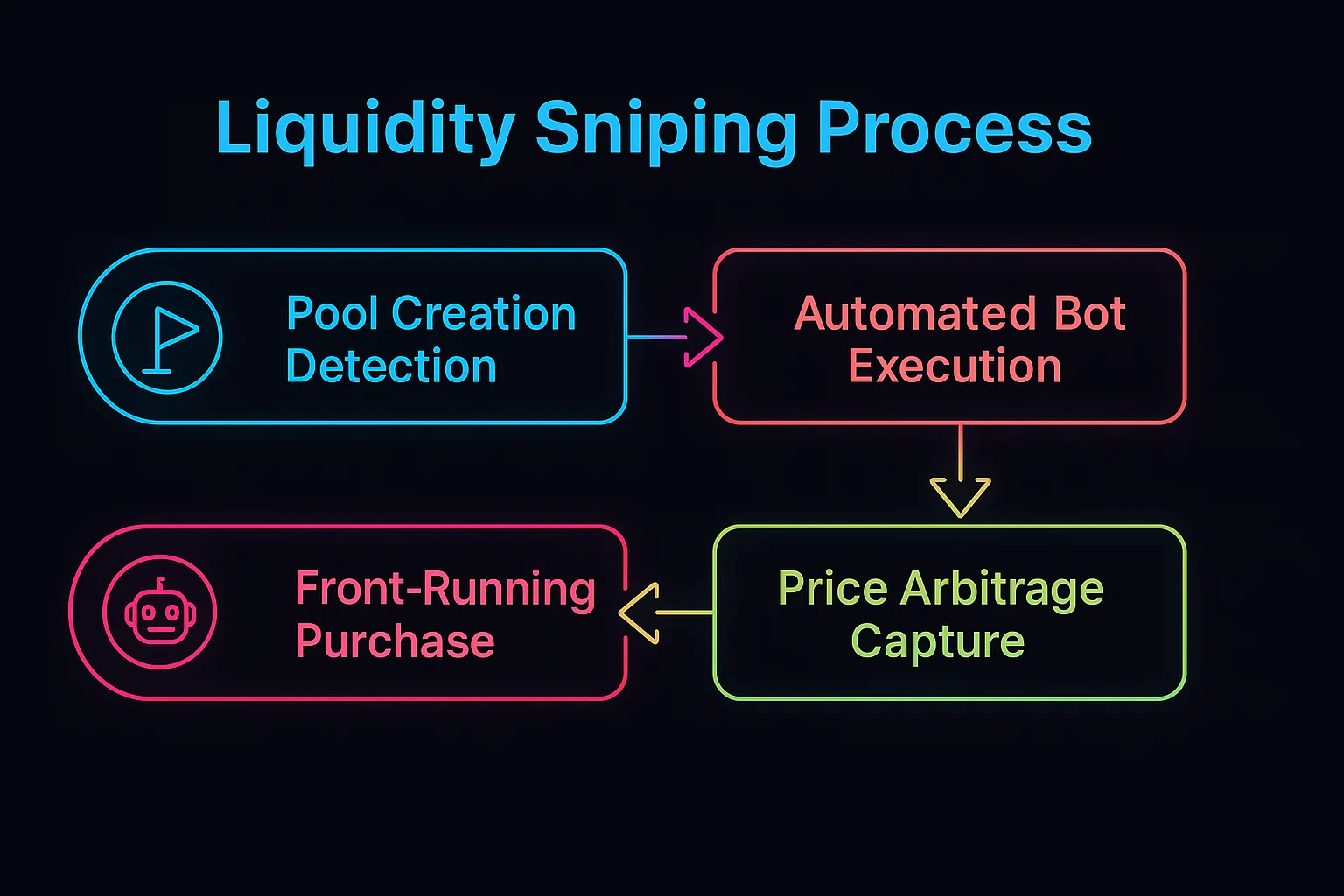
Liquidity sniping flow showing pool creation detection, automated bot execution, front-running purchase, and price arbitrage capture

Real-World Examples

  • New token launches on Uniswap frequently face sniping bots that buy tokens within the same block
  • Sandwich attacks during pool creation that manipulate prices for sniping profits
  • MEV bot networks specialized in detecting and exploiting new liquidity opportunities

Why Beginners Should Care

Unfair advantages for sophisticated actors with automated systems over retail users trying to participate in new token launches.

Price impact from sniping can dramatically affect initial token prices and distribution fairness for legitimate users.

Protection strategies include using private mempools, delayed launches, or anti-MEV mechanisms to reduce sniping effectiveness.

Related Terms: MEV, Front-Running, Liquidity Pool, Bot Trading

Back to Crypto Glossary

Similar Posts

  • DAO (Decentralized Autonomous Organization)

    DAO (Decentralized Autonomous Organization): Democracy Meets Code DAOs are how crypto communities govern themselves without traditional corporate structures. They’re experiments in digital democracy where token holders vote on everything. A Decentralized Autonomous Organization (DAO) is a community-governed entity where decisions are made collectively by token holders through blockchain-based voting. Smart contracts execute the community’s decisions…

  • Sequencer

    Sequencer: Transaction Order ControllerA sequencer determines the order in which transactions are processed in Layer 2 networks and some blockchain systems. It's like the traffic controller that decides which cars go through the intersection first.A sequencer is a component in Layer 2 scaling solutions that collects, orders, and batches transactions before submitting them to the…

  • Collateral Ratio

    Collateral Ratio: Loan Security MeasurementCollateral ratio measures the value of assets securing a loan compared to the loan amount. It's like the down payment percentage when buying a house with a mortgage.Collateral ratio is the percentage relationship between the value of collateral assets and the amount borrowed against them. Higher ratios provide more security for lenders…

  • Token Lockup

    Token Lockup: Preventing Early Selling Token lockups prevent allocated tokens from being sold or transferred for specific time periods. It’s like putting your poker winnings in a time-locked safe to prevent impulse spending. Token lockup is a mechanism that prevents token holders from selling, transferring, or accessing their tokens until predetermined conditions are met. Lockups…

  • Leverage

    Leverage: Borrowing Money to Amplify TradesLeverage lets you control larger positions than your actual capital by borrowing funds from exchanges or platforms. It's like using a lever to lift heavy objects – small movements create big effects.Leverage in cryptocurrency trading allows borrowing funds to increase position sizes beyond available capital, amplifying both potential profits and…

  • EIP-2612

    EIP-2612: Permit Function for Token ApprovalsEIP-2612 introduces permit functions that allow token approvals through signatures instead of transactions. It's like giving someone permission to spend your money without having to make a separate payment for the permission slip.EIP-2612 is an Ethereum Improvement Proposal that adds permit functionality to ERC-20 tokens, enabling approvals through off-chain signatures…